


 Latinoamérica
 Europa
All Pascual Quality Milk is 100% Animal Welfare


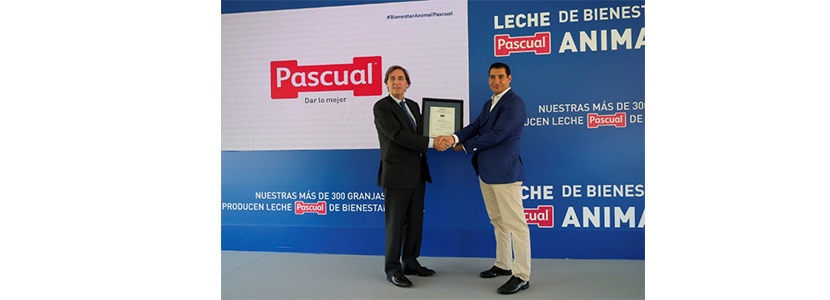



Calidad Pascual has obtained the AENOR Conform Animal Welfare certificate for its 348 milk supplying farms. Thus, it becomes the only major manufacturer with all its farms certified. As a result, currently, 100% of Pascual Milk is Animal Welfare certified.
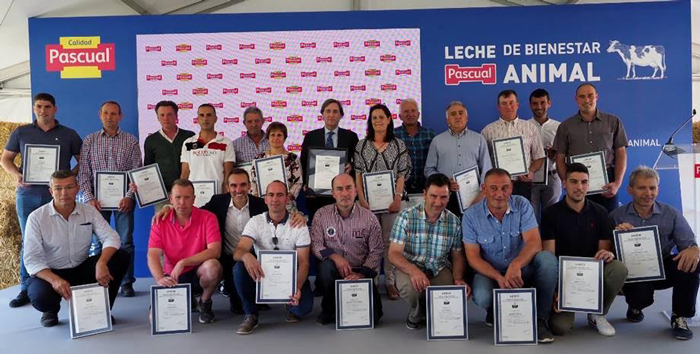
In an event held at the Fuentespina farm (Burgos), Calidad Pascual and its farmers received this distinction from AENOR, recognizing one of the company’s distinguishing values: its work in the field. A first link in the value chain that influences the good practices and quality standards of the rest of the chain.
This certificate certifies that the milk supplying farms to Pascual meet the requirements of the AENOR Animal Welfare model, developed together with the Institute of Agrifood Research and Technology (IRTA) and based on the European Welfare Quality® reference, the standard used for on-farm evaluations. In summary, this pioneering accreditation model in Europe considers different parameters grouped into 4 basic principles:
- Good feeding
- Good housing
- Good health
- Appropriate behavior for the species’ needs.
It thus demonstrates the company’s concern for animal care as a basic pillar of its value chain.
The event, titled “Animal Welfare and Quality, the Binomial of the Best Milk”, was attended by the Minister of Agriculture and Livestock of the Junta de Castilla y León, Milagros Marcos; the Deputy Director General of Livestock Products of the Ministry of Agriculture, Fisheries and Food, María Josefa Lueso; the mayor of Aranda de Duero, Raquel González; and the Director of Conformity Operations of AENOR, Javier Muñoz.
Calidad Pascual was represented by its president Tomás Pascual Gómez-Cuétara, and its CEO-General Executive Director, José Luis Saiz.
The Minister of Agriculture and Livestock of the Junta de Castilla y León, Milagros Marcos, highlighted that “Calidad Pascual works for and with the consumer, considering the farmer, the producer, and the animals. Thus, as a visionary company, it closes the circle with a certificate that goes beyond market demands”. In this way, “all links in the value chain are satisfied and work together”.
Meanwhile, the Deputy Director General of Livestock Products of the Ministry of Agriculture, Fisheries and Food, María Josefa Lueso, pointed out that “Animal Welfare is a distinguishing value and a key pillar of livestock production to ensure the safety of the food chain, as expressed by the Common Agricultural Policy (CAP)”.
From Spain’s first brick to animal welfare milk.
Tomás Pascual Sanz founded Leche Pascual in 1969. He was a pioneer in introducing milk uperization and brick packaging in Spain during the 70s. Also, in the 80s, the company launched the first skimmed and semi-skimmed milks on the market.
His obsession with quality led him to become the leader of the dairy market in Spain. Today Pascual is present in more than 10 million households* and its goal is to once again be the dairy benchmark. But the consumer has changed, and currently, concern for animal welfare is on the rise both in the dairy market and in the rest of the food industry.
According to the latest Eurobarometer on animal protection, 94% of Spaniards believe farm animal welfare is important.
“Companies adapt to people’s lifestyles. But this is not new for Pascual. My father used to say that we don’t want milk. It sounds striking when said like that. And it’s because we don’t make the milk, our cows do. Our goal is to give the best in every part of the process, to ensure that the best of our milk reaches your home. My father was aware from the beginning in the 70s that the productive structures of the primary sector had to be socially viable and economically profitable, while respecting animal welfare and the environment. He paved the way with quality as the highest standard, and today we maintain the same spirit”, explained Tomás Pascual, president of Calidad Pascual.
But in the 21st century, simple promises are not enough, “we want to be transparent with our consumers”, indicated the company’s president.
Meanwhile, Javier Muñoz, Director of Conformity Operations of AENOR, noted that “the Animal Welfare certification for Calidad Pascual demonstrates that this company, once again, chooses to differentiate its products through their qualities. Calidad Pascual has voluntarily undergone the examination of an independent third party, recognized by consumers, to publicly express a firm long-term commitment to good farming practices, in line with current societal values”.
The achievement of this certification is part of the relaunch of the company’s flagship brand, with almost 50 years of history. Its new positioning, ‘Giving the Best’, reflects a way of working focused on obtaining the highest quality from the origin, with a new design and packaging improvements resulting from active listening to its consumers.
Four strategic pillars.
The company has positioned the active policy of animal welfare as one of its strategic pillars, considering it essential to complete a differential offer throughout the dairy value chain. The Spanish dairy cattle census in April 2018 amounted to 850,804 cows, and the company aims to lead the living conditions of the 90,000 cows living on its 348 farms.
For Calidad Pascual, animal welfare closes the circle of industrial qualification in the sector. It accompanies the other distinguishing elements of the group, which also develop the productive efficiency of the farms, the segmentation and specialization of products to optimize their healthy, nutritional, and flavor qualities, and promote social research and dissemination of the benefits of dairy intake in the diet.
The value of the field.
During the day, a round table on the value of the field and animal welfare was held, featuring Olga Minguez, head of Animal Health Service of the Junta de Castilla y León; Joaquín Lorenzo, Agro Purchasing Director of Calidad Pascual; Juan José Badiola, president of the General Council of Veterinary Colleges, David Verano, Director of Agrifood Industry and Distribution of AENOR; and Inocencio Barez, farmer.
The first question was directed to Olga Mínguez, who pointed out that “all administrations must walk hand in hand and be committed to animal welfare, which is what the final consumer values most”.
Meanwhile, Joaquín Lorenzo explained that “the search for productive efficiency improves the expectations and competitiveness of the 348 producing farms of Calidad Pascual, tends to qualify their production, and improves their expectations in the medium and long term. The sector’s future involves a more segmented liquid milk offer towards new tastes and nutritional needs of citizens, and a broader offer of dairy derivatives. The European Union highlights in its sectoral forecasts until 2030 the foreseeable development of exports and opening of new dairy markets, and quality and qualification are the best tools to take positions in that new international scenario”.
According to Badiola, “Calidad Pascual has always been committed to product safety and quality, and that is why with this certification it has advanced and positioned itself ahead of other companies”. Today, the consumer values and demands animal care, so “in the future, there will be consumers who do not want to buy milk that does not have this certification”.
For David Verano, Director of Agrifood Industry and Distribution of AENOR, “this certification provides confidence to the consumer and society and responds to a clear sector trend. The competitiveness of the livestock sector in Europe inevitably involves quality policies that differentiate the product”.
In this sense, the farmer Inocencio Barez considers “having this certificate is essential as an added value for farmers, as it ensures that animals have the best conditions of health, feeding, and housing”.
As a conclusion to the event, Tomás Pascual and AENOR presented the certificates to the attending farmers; a recognition that guarantees compliance with the AENOR Animal Welfare model requirements.
Calidad Pascual
Calidad Pascual, a family business with a consolidated and differentiating set of values, a reference in the food sector, began its journey in 1969 in Aranda de Duero, Burgos, to quickly establish itself throughout Spain and today export to 67 countries. With a range of more than 200 products, 6 plants, 27 delegations, and over 2,300 employees, its main activity is the preparation, packaging, distribution, and sale, among others, of dairy products and derivatives under the Pascual brand, Bezoya natural mineral water, Vivesoy vegetable drinks, Bifrutas, Mocay Caffè, and The Goods.
Calidad Pascual complements its portfolio with other value-added products, thanks to alliances with companies such as Idilia foods (Cola Cao and Okey shakes), Unilever (Leche Flora), Unicer (Agua Das Pedras Salgadas), Kellogg (cereals and Pringles), Heinz, Conservas Garavilla (Isabel), Borges (Oils and Vinegars Cosecha), and La Zaragozana (Ambar).
Thanks to Calidad Pascual’s activity, more and more people enjoy a new concept of quality, broader and more global, beyond the development of healthy products. Calidad Pascual’s guiding principle is to contribute value and quality to people’s lives, understood as a collective commitment to improvement in the daily pursuit of their well-being.
AENOR
AENOR, through certification and conformity assessment, contributes to improving the quality and competitiveness of companies, their products, and services. AENOR is the leading certification entity in Spain, as its recognitions are the most valued, and it is among the top 10 certifiers in the world.
Currently, more than 80,000 workplaces have one of AENOR’s certificates, which support organizations in fields such as Quality, Environmental Management, Innovation, Occupational Safety, or Social Responsibility.
AENOR is a global entity, already operating in 90 countries in certification, training, information services, inspection, analysis, validation, and verification of emission reduction projects, accompanying companies in their expansion. In Spain, it has a complete network of 20 offices.