


 Latinoamérica
 Europa
Keys to Successful Flea Control in Ruminants




 Avda. de Castilleja de la Cuesta, 26 (PIBO) Bollullos de la Mitación, Sevilla 41110
  + 34 955 77 65 77

Just mentioning the word “fleas” makes our skin itch. These small insects can be a real headache on a livestock farm.
But what do we know about these insects?
Definition
Fleas are ectoparasitic hematophagous insects, belonging to the order Siphonaptera, meaning they are parasites that feed on the blood of other animals.
Characteristics
They are characterized by their:
- Small size
- Laterally flattened morphology
- Brown color
Despite their small size, they are surprising insects, worthy of the title “high jump champions,” capable of jumping up to 100 times their own height, a skill that popularized “flea circuses,” where their spectacular talent was showcased. Another of their “weapons” is the enzyme apyrase, an anti-platelet aggregator responsible for the intense skin and allergic reactions that appear in the host.
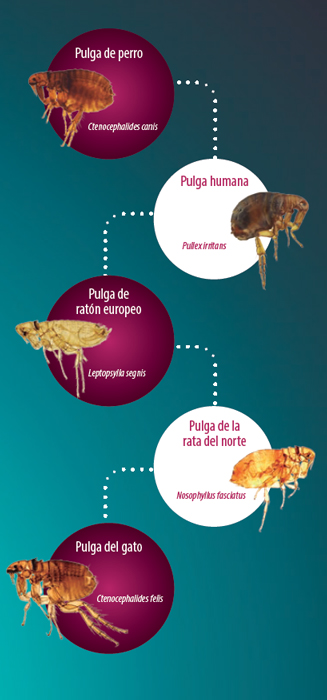
Flea Species & Subspecies
Of the more than 2,000 species and subspecies, the most relevant for human and veterinary medicine are:
Importance of Flea Control
They are parasites and, as such, directly affect the performance of animals due to the continuous discomfort of their bites. Most importantly, they are transmitters of significant diseases.
Fleas have the “pride” of being transmitters of one of the most devastating pandemics in human history, the bubonic plague – Yersinia pestis-, which ravaged the European continent during the 14th century.
Main Problems Associated with Fleas
The main problems that can be found on livestock farms associated with fleas are:

Flea Control
Factors to Consider for Flea Control
Biological Cycle
Fleas have a great reproductive capacity, being able to multiply rapidly on a livestock farm, favoring the emergence of resistance to insecticides if the appropriate treatment is not carried out. The flea is a holometabolous insect, meaning it undergoes a complete metamorphosis, going through the stages of:
- Eggs
50% (invisible). They are not sticky, so they fall to the ground, mainly found in the host’s bedding. The facility fills with eggs in no time!
- Larva
35% (invisible). They feed on organic debris, moving by stimuli such as vibration, pressure, and CO2, during the night, as they are blind and avoid light.
- Pupa
10% (invisible). After a state of latency, they emerge thanks to stimuli such as CO2, pressure, vibration, and heat.
- Adult
5% (Visible). Their biological cycle depends on: Temperature. Sensitive to cold and heat Humidity Feeding. Females feed on the host’s blood Light. The change in light is the stimulus to jump onto the host
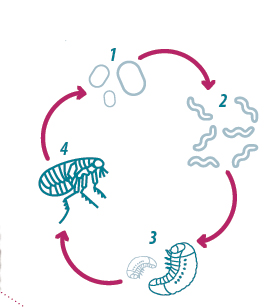
After mating on the host, the female lays her eggs on it: 12-20 eggs per laying (600-1,000 eggs throughout her life)
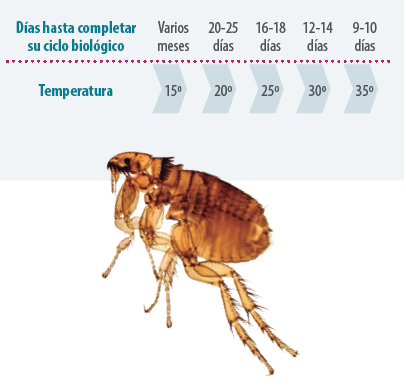
Factors on Which the Flea’s Biological Cycle Depends
- Temperature: It has a great impact, as it determines the average development time of the flea
- Humidity
- Species
- Substrate they feed on
Average Development Time of the Flea
There are factors dependent on the facility, such as the level of cleanliness and manure management, as poor hygienic conditions favor the proliferation of fleas
Important Aspects for Flea Control
Environment
To achieve effective flea control, it is essential to act on two levels: on the host and in its resting place.
Vectors
It is important to avoid the presence of vectors and reservoirs on the farm, such as cats, dogs, rodents, foxes, etc., carry out good manure management, and strictly follow a cleaning and disinfection protocol designed according to the conditions of the facilities.
Product
The application of a treatment aimed only at eliminating adults will be a futile effort as they only constitute 5% of the population. The remaining 95% are precursor forms -invisible to the naked eye-, and if they are not eliminated, the cycle will continue.
An integral treatment on the farm is recommended, using an Adulticide combined with a Larvicide, so that all present phases are controlled
To effectively control the flea population, it is crucial to act on all phases of the insect. Some market products are designed to act specifically against a particular stage of the flea, and they can be used together to enhance their action.
Products formulated with different compounds and presentations should be combined to act at all levels, specifically in the different areas where fleas inhabit.
It is clear that the flea is a great adversary for the farmer, but as long as they work with a well-designed control strategy, with consistency and foresight, and using high-quality products, success is guaranteed.