


 Latinoamérica
 Europa
Consensus Document on Drying Off Treatment




 Prat de la Riba nº 50 Sant Cugat del Vallès (Barcelona) 08174
  +34 93 404 51 00

The recommendations in the “Consensus Document on Drying Off Treatment” are based on the experience of the authors, all of whom are experts in Milk Quality. The aim of this meeting was to reach a consensus on the circumstances under which antibiotic drying off therapy should be recommended, as well as when the use of internal teat sealants should be recommended.
The purpose of this consensus document is to optimize the prudent use of antibiotics ensuring animal health and welfare, taking into account the complexity of the management of each cow and each farm.
The systematic administration of an intramammary antimicrobial treatment for drying off was for a long time an important strategy for the management of mastitis.
The dry period is a crucial time for the cow, as there is a high risk of new intramammary infections. Additionally, there is a higher probability of curing existing infections compared to treatments carried out during lactation3.
For this reason, the systematic drying off treatment with antibiotics has been extensively used as a tool for the prevention and treatment of intramammary infections during the dry period, and consequently, the systematic drying off treatment with antibiotics has successfully contributed to the control of clinical and subclinical mastitis in the following lactation 4.
Currently, there is much debate about the emergence of antimicrobial resistance and the prudent use of antibiotics in human and veterinary medicine. In this context, although the dairy cattle sector, compared to other production systems, uses relatively few antibiotics, it must also comply with the requirements of responsible use. Most of the antibiotics used in dairy cattle herds are related to udder health aspects, and a significant percentage of them are used in drying off.
Replacing systematic drying off antibiotic treatment with a selective drying off strategy can significantly contribute to reducing antibiotic consumption on dairy cattle farms 5, 6.
Milk quality and the control of contagious mastitis have evolved greatly since the development of the “Five-Point Plan” in the 1960s4.
- The rates of clinical and subclinical mastitis have decreased, and now there are fewer cows with udder infections at the time of drying off 7.
- Additionally, zootechnical challenges have been overcome, and the needs of the cow during the dry period have been improved, contributing to an improvement in the general immune status and udder health of dry cows.
- The result of all this is that contagious mastitis is better controlled by shifting the emphasis of antibiotic drying off therapy (ADCT) from curing to prevention4.
Research insists that, despite the progress made, the dry period still plays an important role in the epidemiology of mastitis, especially during the beginning and end of this period, when cows can become more easily infected 8. As a result of these infections, cows suffer more clinical mastitis during lactation, which not only compromises animal welfare but can also increase the infection pressure on the farm and thus the use of antibiotics for curative purposes 9.
There is undoubtedly a need to adopt a treatment strategy against new intramammary infections during the dry period on all dairy cattle farms 9.
Nonetheless, in addition to antibiotic drying off treatments, internal sealants are a very effective solution in preventing new infections during the dry period as they are a physical barrier against invading microorganisms 10. For the aforementioned reasons, a more selective use of antibiotic drying off therapy is often recommended, and consequently, it is absolutely necessary to have clear guidelines for the systematic application of this antibiotic therapy, its selective application, and/or the use of internal sealants.
The implementation of responsible antibiotic use is at different levels of development depending on the region or country in question. In some countries, the systematic use of antibiotics in drying off is prohibited, either by law or by the dairy industry itself, while in others, farmers and veterinarians have more freedom. On the other hand, farms differ from one region to another, requiring different approaches precisely because of these differences between countries.
This consensus document aims to be a guide for dairy cattle farmers, with the appropriate advice of their veterinarian, to make a decision for any type of farm.
CONSENSUS DOCUMENT
- We recommend the use of internal teat sealants at the time of drying off, in all cows, and on all farms.
- In those animals where there is a higher probability of infection, a drying off treatment with antibiotics will be needed in addition to the internal teat sealant.
- At the herd level, each farm should be classified into one of these two categories based on the udder health status: High-risk farms & Low-risk farms.
- Ultimately, any herd is a candidate for selective drying off with antibiotics.
- Herds classified as high-risk should undergo a process of improving overall management and udder health.
- Veterinarians should ensure training in selective drying off with antibiotics for farm staff, as well as in the hygienic application of internal sealants.
Definition of high-risk herds
- Farms with a bulk tank somatic cell count above 250,000 cells/ml (for at least 2 months out of the last 6)
- Herds with S. agalactiae problems
- Increasing bulk tank somatic cell count (above 250,000 cells/ml)
- Confirmed presence of S. agalactiae
- Open herd
- When exceptional and unavoidable risk periods occur on the farm (e.g., staff issues impacting the farm, new building, new installation of a milking robot system, etc.)
In these herds, the priority is to improve udder health and management both during lactation and the dry period.
Selective drying off with antibiotics can be implemented in these herds, although its use should be carried out with caution. Adequate advice should always be sought, as well as the corresponding risk/benefit analysis.
Systematic drying off therapy with antibiotics should be used prudently until udder health has improved.
Systematic drying off therapy with antibiotics should be one more point in the recommendations, as milking routine, animal housing conditions, nutrition, milking machine maintenance, internal biosecurity conditions, and any other management changes aimed at improving udder health should also be considered.
Definition of low-risk herds
Farms with a somatic cell count below 250,000 cells/ml (for at least 4 months out of the last 6)
In these herds, the veterinarian can set the goal for their farmers to switch from systematic drying off therapy with antibiotics to selective drying off therapy.
The switch to selective drying off therapy should be carried out according to the farm’s objectives. The criteria for choosing cows as candidates for selective drying off should be based on udder health parameters (e.g., if the bulk tank somatic cell count increases or decreases) and management factors such as the frequency of individual somatic cell count analysis.
Special attention should be paid to the motivation of the farmer, as well as the rest of the parlor staff, to switch to a selective drying off model.
In these herds, cows that are more likely to be infected by a major pathogen should be treated with drying off antibiotics, in addition to an internal sealant. Although there are others, the methods to define the probability of infection can be a positive bacteriological culture, a somatic cell count above a given threshold, or a positive PCR result.
Criteria for determining the existence of mastitis
We propose the following criteria to indicate that cows are likely infected by a major pathogen and should be considered as candidates for drying off using antibiotic drying off therapy, in addition to an internal teat sealant.
- Cows with more than 200,000 cells/ml in at least one of the counts of the last three days before drying off. The count of the last day should be planned during the last four weeks before drying off to have optimal information.
- Cows with clinical mastitis in the interval of the last three days before drying off treatment. It is essential that mastitis cases are systematically recorded to make decisions based on this criterion.
If the counts of the last three days are not available, the decision can be based on the count of the last day. This count should be done within the last four weeks before drying off. In this case, it is recommended to lower the threshold to 100,000 cells/ml in milk to maintain approximately the same level of sensitivity. The criteria may vary depending on the farm’s results (e.g., it is recommended to lower the individual somatic cell count threshold if it is detected that the somatic cell level is increasing). In any case, it is recommended that a cow with a somatic cell count above 250,000 cells should be dried off using antibiotic therapy.
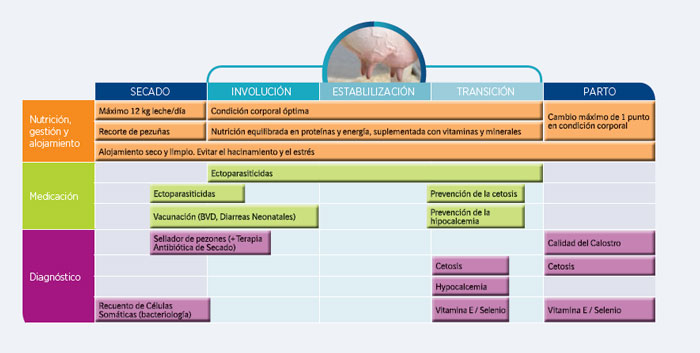
Figure 1. Summary of points to consider during the dry and transition period.
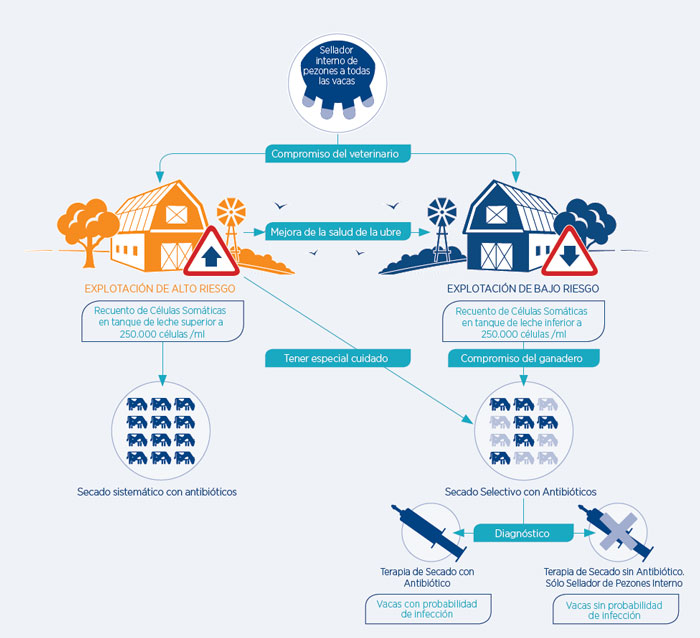
Figure 2. Proposed decision tree [1] for the use of selective drying off with antibiotics or systematic drying off with antibiotics in high and low-risk farms. In some countries, evidence of infection using a specific technique is required prior to the use of antibiotic drying off therapy in any animal, for example through PCR or bacteriological culture, regardless of the herd’s risk status. This consensus document does not have the ambition or intention to question any local legislation.
Control Tools
The following tools can be used to:
- Control Tools Advise on management improvements before implementing the selective use of antibiotics for drying off.
- Monitor the success of selective drying off with antibiotics.
- Adjust the thresholds of the criteria used for the use of antibiotic therapy for drying off according to the farm’s objective.
- Decide which antibiotic treatment cannula to use in drying off.
DATA TO ANALYZE
The information described below can be used to assess the udder health status on the farm.
- Bulk tank somatic cell count.
- Individual somatic cell count to assess the individual udder health status, preferably every four weeks.
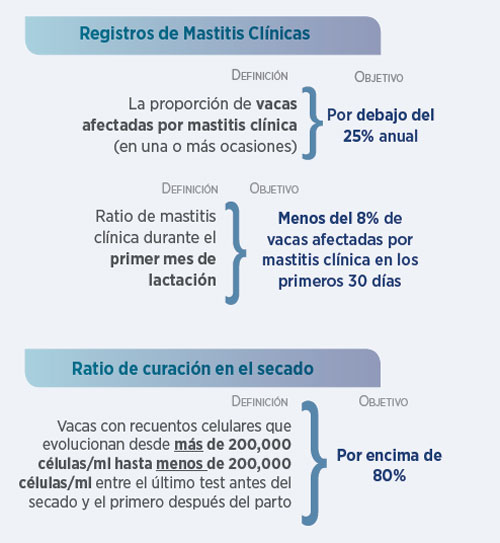
- Detailed record of clinical mastitis on the farm.
- Bacteriological cultures from the farm with antimicrobial sensitivity data for the most relevant pathogens. It is especially important to have samples from:
- Cows with clinical mastitis in the last lactation.
- Cows with repeated cases of clinical mastitis.
- High somatic cell count at the end of lactation.
- When individual udder health status information is not available:
- Conduct a single somatic cell count at the time of drying off (consider a low threshold) and monitor using a California Test after calving. Promote individual somatic cell counts.
- Milk production at the time of drying off and loss of milk production in the next lactation.
OBJECTIVES AND THRESHOLD
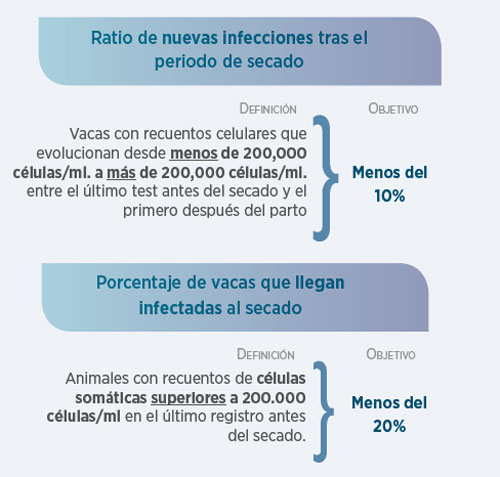
With these tools, the following objectives and thresholds can be defined to improve or compare the udder health status of the dry period on the farm