


 Latinoamérica
 Europa
Nanta celebrates its 50th anniversary at the Lázaro Galdiano Museum


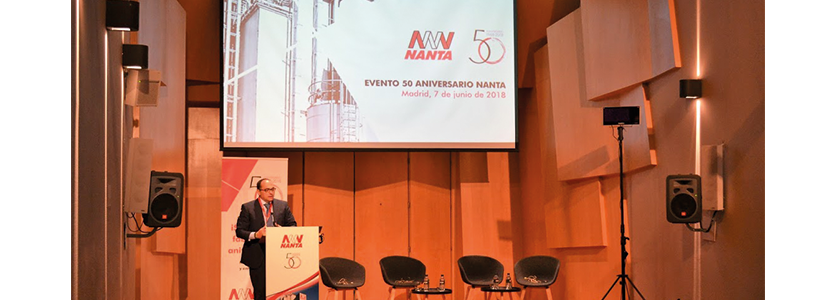



Thus, on June 7, more than 120 professionals from the main livestock sectors gathered to discuss global economic trends, the current and future state of the animal protein market, and the evolution of products and consumers, all guided by renowned experts in the fields (NANTA).
Joaquín Peinado, Nanta’s marketing director, introduced the day by emphasizing the trust that Nanta has provided over these 50 years, and will continue to provide, to its clients. This is summarized in its concept “Nanta Trust”, the sphere of trust of Nanta, a unifying foundation of the company’s philosophy with which it aims for its clients to achieve excellence, efficiency, and profit in their businesses.
After this brief introduction, the first speaker, Carlos Rodríguez Braun, an expert in economic thought and liberalism and a reference and opinion maker on Spain’s economic, political, and social reality, currently a commentator in various media such as Onda Cero, shared his vision on the current economic situation. The economist, with a markedly positive attitude, expressed that the prosperity experienced over the last two centuries has been extraordinary. More specifically, focusing on the current moment, he pointed out that we come from a period of active growth and that it is likely to slow down in the coming years. However, he highlighted that Europe maintains advantages compared to past times: on one hand, the internationalization of companies and, on the other, the euro as a community currency. In fact, in Spain, since 2013, the economy has recovered and is growing at a rate higher than the European average.
Rodríguez Braun highlighted that innovations in our time have accelerated and have been mainly directed at reducing production costs. “There have also been profound changes at the business level, but the hypertrophy of the political dimension does not let us see these changes,” explained the expert.
The role of protein in the value chain
Jan Peter Van Ferneij, senior animal protein analyst at Rabobank, continued with a review of the current state of animal protein consumption and market and future trends. “In the next two decades, the demand for all animal proteins will grow by 45%” – estimated the analyst, adding that – “90% of that global growth will occur in emerging countries, with Asia alone representing 40%”. Due to this, he especially highlighted this continent, and specifically China, as a reference for the future of the protein market.
On the other hand, Van Ferneij also spoke about the main strategic challenges for companies, pointing out that “today, the carcass must be broken down into more than 150 products and each of these products must be directed to the best market”. Thus, among these challenges, he mentioned the need to provide added value and offer consumers what they really demand, taking into account aspects such as animal welfare, simplicity, authenticity, and trust. Finally, he mentioned alternative proteins, such as plant proteins, which currently do not represent a reality, but whose production will grow slightly.
Where the consumer is heading
The evolution of the consumer was addressed by Pedro Nueno, Doctor of Business Administration from Harvard University, and emeritus professor of the Department of Entrepreneurial Initiative at IESE Business School. The expert highlighted the changes in products and ways of consuming over the years to conclude that “investment in R&D will lead to a concentration of production and the need for large distribution chains and, consequently, to a greater number of mergers and acquisitions, which will mean less competition and fewer brands”. Thus, he pointed to globalization and innovation as key elements to reach an increasingly segmented consumer, but who will tend to become more similar.
We feed growth
The closing of the meeting was led by the general director of Nanta, Pedro Cordero, who recalled the company’s beginnings when production barely reached 100,000 tons. “Today, Nanta is a more solid company, with a production of 3 million tons, a 15% market share, revenues of 800 million euros, and 19 factories distributed throughout the Peninsula, to which one more will be added that will open in 2018. A company that” – he emphasized – “also maintains strong roots to face the future, having technology, innovation, work, and effort as pillars”.
After the session, attendees enjoyed a lunch in the Museum’s gardens and later took a private tour of the Lázaro Galdiano Museum, where they could appreciate works by renowned painters such as Goya or Bosch, among others.
About Nanta
Nanta, a leading company in the manufacture and marketing of compound feeds in the Iberian Peninsula, celebrates its 50th anniversary this year. It began its activity in 1968 and since then the high degree of commitment to its clients and the livestock production world in general, the technology used, and its R&D&i and quality programs have been a true driving force for this industrial sector. A clear vocation and commitment to innovation that the company maintains and will maintain in the future. Part of the multinational Nutreco, Nanta has 19 production centers equipped with cutting-edge technology, all certified under the ISO 14001 environmental standard and OHSAS18000 occupational risk prevention. Notably, the ISO22000 Food Safety certification guarantees the safety and quality of the company’s products. Its portfolio of more than 200 products includes feeds for white and Iberian pigs, for rabbit and poultry farming, for beef cattle and dairy cattle, sheep and goats, and for feeding dogs, cats, and horses.
For more information visit the Nanta website