


 Latinoamérica
 Europa
New packaging and waste regulations: How do they affect the livestock sector and producers?








|
The management of packaging and waste in the livestock and agri-food sector faces significant changes with the entry into force of new regulations.
|
 Although the concepts of circular economy and eco-design may seem unrelated to the day-to-day of a farm, understanding how these obligations affect producers and waste holders is essential to adapt to the new legislative scenario.
Lately, we have been seeing different opinion articles, webinars, and announcements regarding the obligations arising after the entry into force of:

The frequently mentioned objectives, such as reducing waste, increasing recycling, eco-design, or the circular economy, may seem somewhat abstract or unfamiliar to those who do not work directly in the environmental field and whose main activity takes place on a farm. This raises questions such as:
 What are the deadlines for adapting my business to the new regulations?
Does it affect me if I don’t package any products?
What is a SCRAP and what distinguishes a producer from a product holder?
What are the differences between SCRAPS and which is the most suitable for my company?
What should I include in my invoices and what costs should I plan for?
|
|
 Although all stakeholders end up being involved in one way or another, it is advisable to clarify who is affected by what in our sector.
SCRAPS and their role in the new legislation
SCRAPS: what are they and when must a packager or product producer join?
A SCRAP is a Collective System of Extended Producer Responsibility.
 According to RD 105/2022, every product producer must be part of a SCRAP or, alternatively, establish a SIRAP (Individual System of Extended Producer Responsibility).
 However, the SIRAP is economically unviable for most companies, so joining a SCRAP is the most logical option for product producers.
Product producers will place single-use or reusable packaging on the market, in which case they must adapt to Return and Deposit Systems (SDR).
Differences between SCRAPS

Better new SCRAPS or from existing systems?
Both completely new SCRAPS and others derived from sectoral associations or already existing collective systems have emerged, especially in the field of domestic or specific waste, such as WEEE or used oils.
|
|
 Although some new SCRAPS may lack direct experience in certain areas, all have sufficient knowledge of the environmental sector to ensure their functionality.
Which one to join if you are a packager or product producer?
The choice of SCRAP will largely depend on the characteristics of the company and the packaging you manage.
Among the available options are, for example, ECOLEC, ECOVIDRIO, PROCIRCULAR, CARTON CIRCULAR, IMPLICA, AEVAE, SIGFITO, ENVALORA, ECOEMBES, GENCI, PUNTO GRETA or RECYCLIA.
 Some SCRAPS began their authorization process before others and, although currently only a few have received definitive authorization from the Ministry, it is expected that all will be fully operational in the short term.
To make the best decision, the following aspects can be considered:
|
COSTS There are SCRAPS with free registration, while others require initial payments ranging from €350 to €2,000. |
|
SECTORAL COMPATIBILITY Although some SCRAPS are initially focused on specific sectors, they will all eventually become multisectoral and operate in any geographical area. |
|
TRAJECTORY Some systems come from already existing associations or collective systems, which can be an advantage in terms of experience and operation.
|


 However, even new SCRAPS have sufficient knowledge of the environmental sector to ensure their effectiveness.
The choice of an appropriate SCRAP will depend on operational needs, budget, and the sector in which your company operates. Comparing the characteristics and advantages of each system will allow you to comply with legal obligations efficiently.
Obligations of the product producer
Product producer
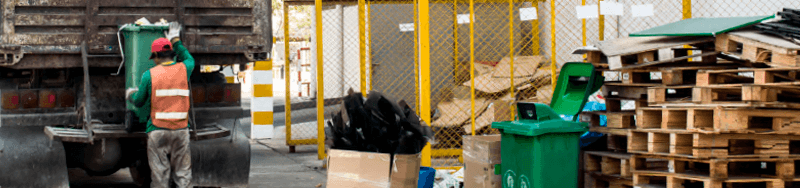
The product producer refers to packagers, including companies such as feed factories, companies that manufacture or package veterinary products, retail stores, wholesale establishments, distribution companies, and, in general, any business that sells packaged products to its customers.
It is important not to limit thinking solely to primary packaging, such as the bags in which feed is packaged.
Secondary and tertiary packaging are also included, such as:
 The boxes in which the packages are placed.
The pallets used to organize shipments.
The bags, cartons, film, or strapping used to ensure that transported products (whether manufactured by the company itself or not) arrive in good condition to the customer.
Key practical points for these Product Producers
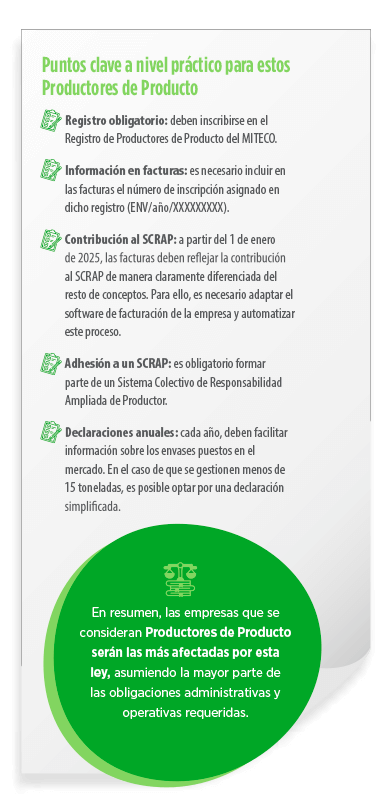
Deadlines to register as a product producer with MITECO and in a SCRAP
From January 1, 2025, it is mandatory to comply with all the provisions of this Law.
 Although the Administration has allowed extensions for two years and the registration in the Product Producers Registry at the Ministry remains open, those who have not yet done so must regularize their situation as soon as possible.
The final holder of the waste: impact on farms
The farmer is not a product producer, but always the final holder of the waste, as waste (cardboard boxes, film, empty big bags, pallets, jerrycans, IBCs, etc.) is usually generated in their facilities.
 However, many times other companies fall into this category, such as feed factories, which bear the dual role of product producer (because they package) and final holder of the waste (due to the waste affected by this law generated in their facilities).
The final holder will continue working in the same way as before with their usual waste manager, correctly segregating their waste.
However, additionally, they must inform a SCRAP with whom they sign a voluntary agreement on the correct management they perform of their waste through their usual waste manager, sending the waste identification documents that the manager provides them.
|
It is important to differentiate these wastes from other common ones on the farm that are not affected by this regulation, such as needles, vaccines, medications, batteries, fluorescent lights, expired products, or construction debris. In these cases, no additional action will be necessary. |
Information flow
The management of documentation will be a key aspect, as many of the processes will have to be carried out through the web platforms of the SCRAPS. For now, these systems are not completely automatic, which adds a considerable administrative burden.
In some cases, it will be the final holder of the waste (such as the farmer) who must attach the Waste Identification Documents that justify the correct management carried out, while in others, this task will fall directly on the waste manager.
 For the farmer, this process can be cumbersome, as it involves connecting to the platform, accessing through identification, and uploading scanned files.
 Although the SCRAPS offer a bonus for the information sent, these are usually low, insufficient to compensate for the time and resources necessary to carry out this process. Furthermore, at present, few SCRAPS have made their rates public, which creates uncertainty.
On the other hand, there is concern that this document management could lead to duplication of information, as different actors in the chain (Administration, SCRAPS, managers, OCAs, certifiers, etc.) could require similar data in a sector that is already highly regulated and subject to regular inspections.
In any case, it will be necessary to progressively adapt to this new legislative framework, integrating these additional tasks into the usual operations.
|
Conclusion: adapting to new times In short, since farmers will continue to manage their waste in the same way with their usual managers, respecting the frequencies and procedures established for each type of waste, the SCRAPS do not directly interfere in daily operations nor bring significant changes in terms of biosecurity, so this new legislation will not substantially affect livestock farms. In contrast, product producers will need to make significant adjustments to comply with the regulations, including adapting their processes to include annual declarations, updates in invoices, and the obligation to join a SCRAP.
|
 As a timeline, the year 2025 is expected to be informative and of more gradual adaptation. These modifications will be essential to ensure full compliance with the legislative framework.