


 Latinoamérica
 Europa
Prediction of the Thermal Stress Index and Real-Time Impact on Production Using the NEIKER-KABE Digital Platform








| Europe, including the Iberian Peninsula, has warmed at a rate of 0.5 °C per decade between 1991 and 2020, more than twice the global average.
Climate models project that, if the emission reduction commitments of the Paris Agreement are not met, average temperatures will increase by at least 2 °C compared to the pre-industrial era by mid-century. |
| The increase in the frequency and intensity of extreme heat events, as well as their de-seasonalization, currently represents one of the greatest challenges for the dairy cattle sector in Spain. |
| Events that were previously limited to the summer months now appear regularly from April to October.
Historically, this problem was associated with Mediterranean areas, but in recent decades it has become relevant also in temperate zones of the northern peninsula. The direct consequence is that the time window in which animals can suffer heat stress expands year after year, with a growing impact on production, milk quality, and animal welfare. |
In this context, the Spanish dairy sector, with a herd mostly composed of Holstein breed, is particularly vulnerable since this breed, selected for its high productive capacity, presents a high metabolic activity and lower efficiency in dissipating heat under high temperature and humidity conditions.
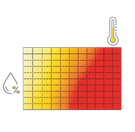 The quantification of environmental conditions is usually carried out through the temperature-humidity index (THI), which allows establishing stress thresholds from which cows are physiologically and productively affected.
Traditionally, thermal stress management has been corrective, that is, when high temperatures are recorded or obvious signs are observed in the animals, such as panting or reduced intake, management is adapted:
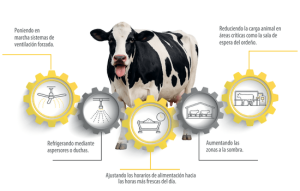
However, against this corrective approach, Precision Livestock Farming (PLF) introduces a shift towards proactive management, based on the use of data to anticipate risk situations.

| In this context, the Department of Natural Resources Conservation of NEIKER (Basque Institute for Agricultural Research and Development) has worked in recent years on the proactive management of thermal stress in dairy cattle within the framework of precision livestock farming. |
THE RELEVANCE OF THI IN THE BARN MICROCLIMATE
The THI index combines temperature and relative humidity and provides more information than temperature alone to determine stress thresholds.
For example, a temperature of 30 °C with low humidity may be tolerable while the same temperature with a relative humidity of 80% generates a much higher thermal sensation because heat dissipation through the skin becomes ineffective.
Historically, the onset of stress was set at a THI of 72, but current studies in high-producing cows such as Holstein cows place the threshold of productive loss at THI 68 or even lower.  |
It is essential to understand that the impact of heat stress is not linear and that determining the thresholds and duration of stress periods is crucial to not compromising animal welfare and milk production.
The severity of the physiological impact is determined by factors such as:
 The cumulative effect of hours above the threshold (Hours-THI: number of hours in which the THI exceeds the critical value in a given period).
The lack of nighttime recovery (the THI does not drop below 65-68 during the night).
An often underestimated aspect is that the THI relevant for the animals is the one recorded inside the barn and not outside of it. This indoor microclimate, even if the barns are naturally ventilated and open, is conditioned by:
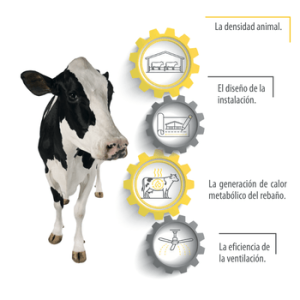
| These factors cause the temperature and humidity conditions to differ substantially from the outside conditions. |
One of the most relevant findings of the work carried out by the NEIKER research group is precisely the importance of measuring and predicting the THI inside the facilities.
The direct comparison between the THI calculated from sensors installed inside each barn and the THI derived from external weather stations showed a high correlation between both variables (R2=0.85), but with systematic differences with practical implications.
On warmer days, which pose the greatest risk to animals, the outdoor THI was on average 10% higher than indoors, indicating that the barn provides some protection against external conditions.
| However, differences were observed between the farms analyzed, between different points of the barns, and between day and night, highlighting that specific monitoring of the interior microclimate of each barn is necessary for an accurate assessment of animal comfort conditions. |
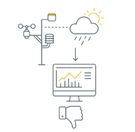  Basing management decisions on the nearest weather station (which may be several kilometers away) leads to systematic errors in the activation of mitigation measures. Basing management decisions on the nearest weather station (which may be several kilometers away) leads to systematic errors in the activation of mitigation measures.
Therefore, in situ monitoring through wireless sensor networks is, nowadays, an unavoidable technical necessity. |
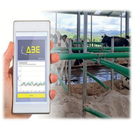 The technological response to this need has evolved significantly in recent years.
The deployment of low-cost wireless sensors, IoT communication networks, and cloud data management systems has opened a new dimension in thermal stress management:
 Calculate the THI in real-time inside each barn.
Predict future THI and its impact on production days in advance.
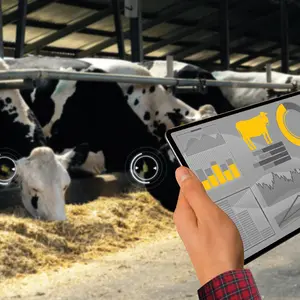
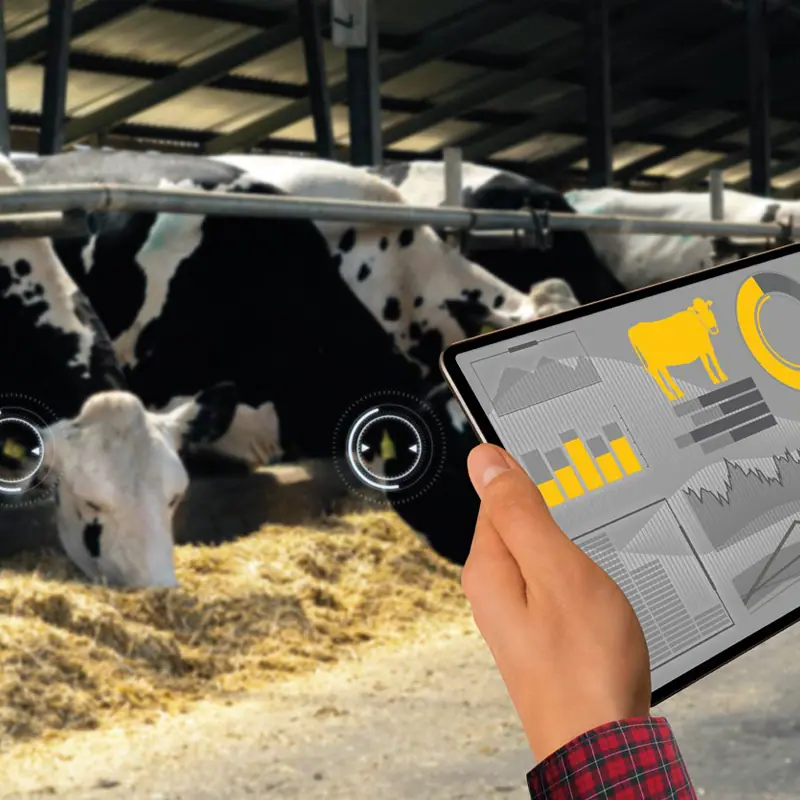
In this context, NEIKER has developed the NEIKER kABE IoT monitoring system, which allows real-time visualization of the environmental conditions of the barn and its surroundings.
Furthermore, through the analysis of individualized productive data of the animals and environmental data, a predictive AI model based on neural networks has been developed, capable of anticipating the effect of thermal stress events on milk yield.
This model allows estimating the expected productive trajectory of each animal and identifying deviations when production falls below expectations, detecting downward patterns between 1 and 3 days before significant drops occur.
| At the operational level, the developed system integrates temperature sensors and humidity distributed inside the barns that transmit data in real-time to the cloud.
The system calculates the internal THI continuously, with a frequency of 10 minutes, and generates automatic alerts when critical thresholds are exceeded established. |
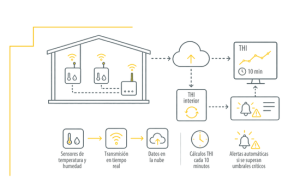

| Additionally, it integrates weather prediction models that allow anticipating the THI several days in advance. This prediction, combined with the AI model, allows estimating the impact of heat stress on milk production several days ahead.
The obtained model achieved a high accuracy (R2=0.79; RMSE=0.23 kg) in the estimation of production drops associated with THI at the farm scale. |

The practical value of this combination is clear…
 The farmer can know in advance if a heat stress episode is approaching and what its impact on milk production will be.
This allows acting in time, activating preventive management measures and improving decision-making capacity on the farm.
While implementation challenges persist, such as connectivity in rural areas, sensor costs, or user training, the available solutions are increasingly accessible and scalable.
| Overall, these tools help optimize the use of ventilation and cooling systems, improve animal welfare, and reduce associated productive losses, moving towards more efficient, precise, and data-driven management.
The key lies in the development of scalable, interoperable, and accessible solutions for all types of farms, along with the technical support that allows transforming data into specific management decisions in the day-to-day operations of the farm. |
You may be interested in: Continuous temperature monitoring in cows: key to addressing heat stress