


 Latinoamérica
 Europa
Mammary Physiology and Milking in Dairy Cows







THE SECRET LIFE OF THE MAMMARY GLAND
The cow’s mammary gland is of dermal origin, it is suspended outside the posterior abdomen and is considered a modified exocrine cutaneous gland whose product is milk.
From a physiological point of view, it can be considered part of the reproductive system, while from an anatomical point of view it belongs to the integumentary system due to its ectodermal origin.
In reality, it consists of four glands called quarters.
 Each quarter constitutes an independent functional unit that drains milk through its own duct.
Generally, the hindquarters are slightly larger and produce, on average, around 60% of the animal’s total milk.
Each quarter ends in a teat that projects ventrally and conducts the milk to the outside.
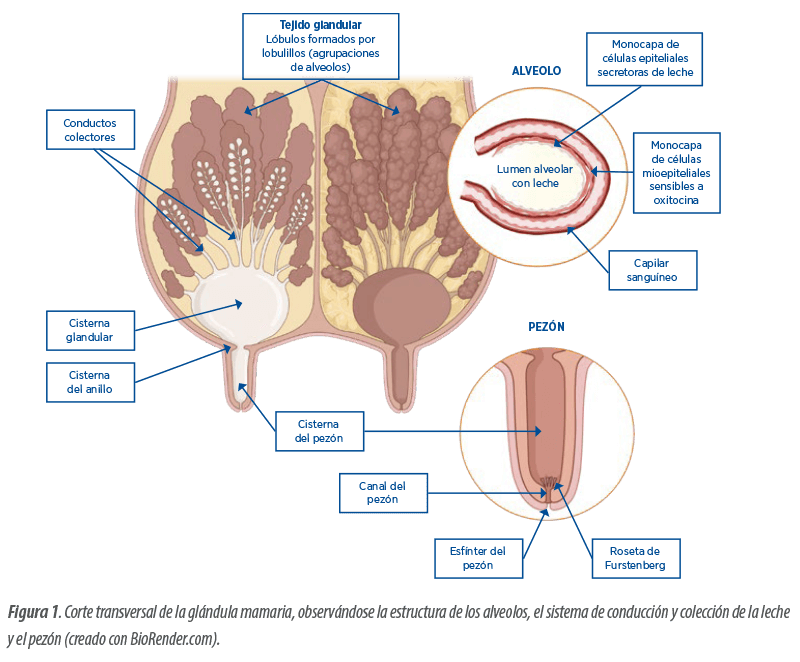
The mammary gland is composed of the mammary parenchyma, which includes both the secretory tissue, where milk is produced, and the connective tissue.
 The amount of secretory tissue or the number of secretory cells constitutes the main limiting factor in milk production.
| Externally, the udder is enveloped by a support system called the suspensory apparatus, whose function is to keep such a voluminous gland attached to the abdominal wall.
|
Mammary parenchyma
In relation to the mammary parenchyma, the alveolus is the functional unit of production, and each cubic centimeter of mammary tissue can contain around 150,000 alveoli.
 The alveoli are formed by a single layer of epithelial cells that surround a central cavity called the lumen.
Around each alveolus is found:
 A capillary network that supplies blood with the nutrients and hormones necessary for milk synthesis.
A network of specialized muscle cells, called myoepithelial cells, sensitive to oxytocin and which, under its effect, contract and release the milk into the lumen.
| Each group of alveoli forms a cluster that is grouped into lobule which, in turn, form lobes that discharge the milk into larger collecting ducts, finally leading it to the gland cistern, located directly above the teat. |

Teat
The teat is formed by a wall within which there is a cavity called the teat cistern, a continuation of the gland cistern.
 The teat cistern communicates with the outside through the teat canal, where a very important structure is located: the teat canal sphincter, a muscular ring whose anatomical and functional integrity constitutes a fundamental defense barrier against intramammary infections.
The teat is highly vascularized and innervated, making it very sensitive to contact, pressure, and temperature, factors that must be considered during preparation for milking.
 The stimulation of these receptors triggers milk let-down.
| The mammary gland reaches its full development during gestation thanks to the action of different hormones that promote the full development of the alveoli and the replacement of the udder’s fatty tissue. |

MILKING: BACK TO BASICS
Milking consists of extracting milk from the mammary gland of cows during the lactation period.
 It is a complex process in which the state of the cow, the milking machine, and the operator form a set that will determine the correct execution of the process.
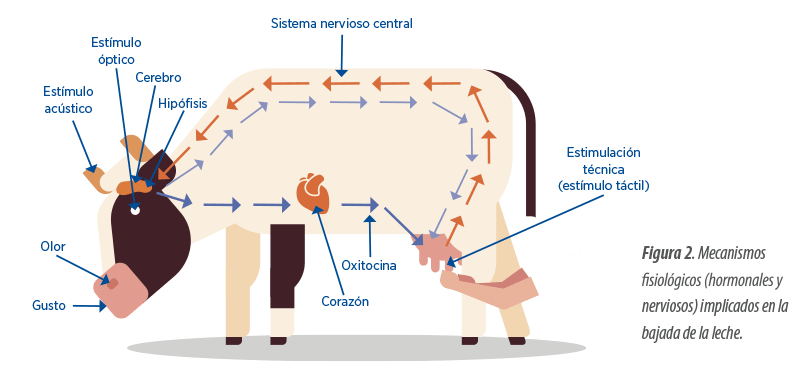
The first thing to consider is the physiological process of milk let-down, a reflex of hormonal and nervous nature that allows milk to flow from the alveoli to the teat canal.
When the cutaneous nerve endings of the teat are stimulated through the milking routine, the nerve signal is transmitted through the afferent pathways of the nervous system to the hypothalamus. Upon receiving this signal, the hypothalamus sends an order to the pituitary gland to release the hormone oxytocin into the circulatory stream.
The oxytocin reaches the receptors of the myoepithelial cells, which contract around the alveoli to cause the milk ejection.
Importance of the milking routine
The milking routine is the set of actions that the milker performs repeatedly and sequentially on each batch of cows to be milked.
Regardless of the type of routine (territorial or sequential), it must be designed on each farm:
 Respecting the physiological bases of milking.
Facilitating, as much as possible, the work of the operators.
 In this regard, the work capacity of the milker to maximize its efficiency should be considered, as well as the sizing of the milking machine to achieve the highest possible yield. In this regard, the work capacity of the milker to maximize its efficiency should be considered, as well as the sizing of the milking machine to achieve the highest possible yield. |
The milking routine is divided into two main phases:
1. PREPARATION TIME
This consists of the set of steps aimed at preparing the cow for milking:
Predipping
Teat cleaning
Forestripping
Waiting time for effective milk let-down
 The effective contact time with the teats should be at least 12 seconds, and the average support time should be approximately 90 seconds.
2. MILKING OR MILK EXTRACTION TIME
It begins with the attachment of the milking unit and ends with its removal and the subsequent sealing of the teats.
It should be as short as possible, depending on the volume of milk, aiming to achieve high milk flows per minute.
A milking routine is effective when the teats are milked clean, dry, and well-stimulated. To achieve this, milking should be:
Hygienic.
Regular: with constant intervals between milkings.
Complete: maintaining an adequate residual milk volume and avoiding teat damage from overmilking.
Uninterrupted: maintaining a stable vacuum level at the teat end.
Additionally, cows should be:
 Healthy, with adequate comfort and management conditions.
Well-fed, with good body condition and a correct transition that minimizes peripartum metabolic pathologies and ensures optimal production.
| If the milking routine is not effective and the cow is not well stimulated, the process becomes traumatic, as the milk is extracted solely by the effect of the vacuum pump. |
Impact of stress during milking
If the cow experiences stress during milking, adrenaline is released, blocking the action of oxytocin.
 Therefore, the efficiency of milking begins with a proper handling of the animals towards the parlor, being essential to avoid stress, overcrowding, and negative stimuli, as the cow remembers and learns from unpleasant experiences associated with the process.
| The cow is a social animal with regular habits and customs. Therefore, it is important to make her identify milking as a pleasant moment and ensure that the time spent in the parlor is as short as possible. |
Mastitis control
A proper milking routine is one of the fundamental pillars of any mastitis control program.
When executed properly and together with a correct adjustment of the milking machine, it results in a good condition of the sphincters.
The anatomical and functional integrity of the teat sphincter represents the main defense of the cow against new intramammary infections.
On a farm, no more than 20% of sphincters should be in poor condition (grade 3-4 according to the NMC classification), as there is a linear relationship between the increase in the number of cows with deteriorated sphincters or with hyperkeratosis and the incidence of intramammary infections.
CONCLUSIONS
In short, all the aspects described can be summarized in a single concept: milking ability. This term encompasses the ability to achieve efficient, hygienic milking that respects the cow’s physiology, ensuring both milk quality and animal health.
Good milking ability is achieved when:
The cows are milked calm and relaxed.
The preparation procedure is always carried out with the same sequence and the same timing.
The stimulus is sufficient, with a good forestripping of the first streams.
The milking unit is correctly placed, minimizing air intake, on clean, dry, and well-stimulated teats.
An adequate alignment of the milking unit is maintained.
The take-off flow is correctly programmed.
The milking machine operates efficiently.
| Overall, milking ability reflects the harmony between the cow, the operator, and the machine, an essential foundation for sustainable production and a healthy herd. |
You may be interested in: Udder Anatomy – Back to basics