


 Latinoamérica
 Europa
Contagious nodular dermatosis in Spain: Why preventive biosecurity can no longer wait


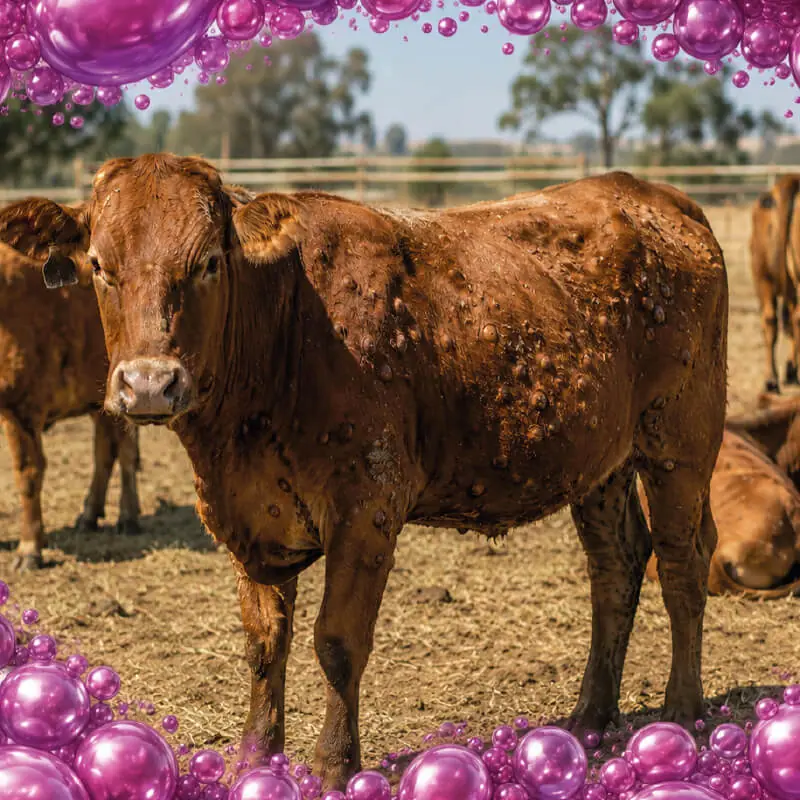






The outbreak of Contagious Nodular Dermatosis (CND) in the Spanish cattle herd in 2025 has changed the risk map forever. Analyzing what happened—and why—is the first step to prevent it from catching us off guard again.
A DISEASE THAT ARRIVED ANNOUNCED
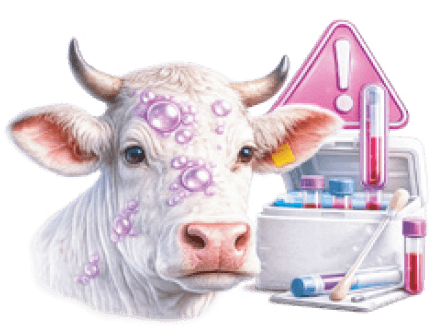
On October 3, 2025, early in the morning, the veterinary services of the Generalitat of Catalonia confirmed what many of us had been anticipating for months: Spain had its first outbreak of contagious nodular dermatosis (CND).
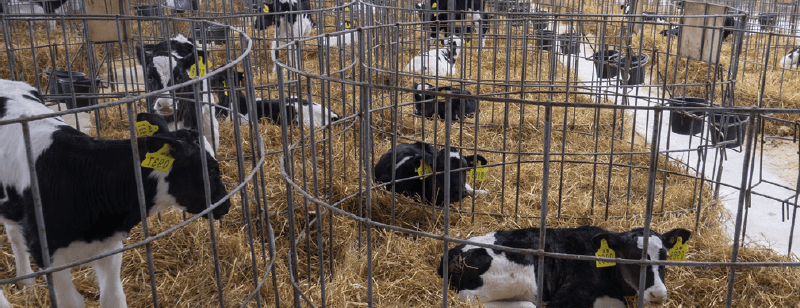
The affected farm was a heifer rearing farm in Castelló d’Empúries, in the heart of Alt Empordà, province of Girona.
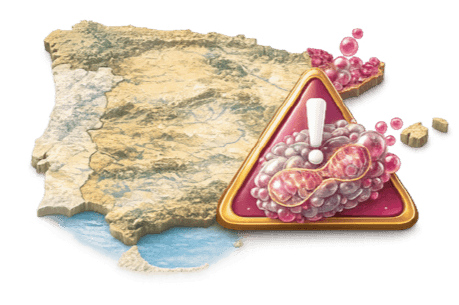
Neither the location nor the timing were coincidences: the virus had entered from France, which recorded its first case just three months earlier, following the same route used by arthropod vectors when Mediterranean summer temperatures are at their peak.
What followed was a textbook response:
 Restriction zone of 50 km radius.
Sanitary culling of affected animals.
Emergency vaccination initiated six days later with doses borrowed from the French ministry itself (15,250 vials that arrived while the urgent purchase of almost a million more was being processed).
Intensive disinsection.
Suspension of livestock fairs and gatherings in several autonomous communities.
By the end of the year, Spain had contained 18 outbreaks in Girona and two more in Huesca. Vaccine coverage in the affected area exceeded 95% and the outbreak was under control.
The real problem was not that outbreak, but what came before: the three-month interval between the first European case of 2025 (Italy, June 21) and the Spanish confirmation. Three months in which:
 The disease was approaching from the Alps.
Epidemiological warnings were public and accessible.
The vast majority of Spanish cattle farms had not reviewed a single biosecurity protocol.
 That is the diagnosis that this article wants to bring to the table.
 Biosecurity is not a response to crises, but the tool that decides whether crises occur. The 2025 outbreak has not proven us right and has reminded us that the cost of not having it is paid by the farmer. Biosecurity is not a response to crises, but the tool that decides whether crises occur. The 2025 outbreak has not proven us right and has reminded us that the cost of not having it is paid by the farmer. |
THE VIRUS THAT IS NOT IN A HURRY: ENVIRONMENTAL STABILITY AND DISINFECTION
Before discussing protocols, it is important to understand who we are dealing with.
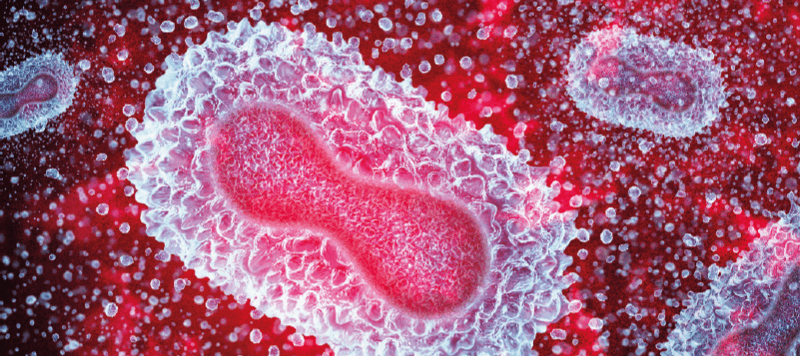
The LSDV (Lumpy Skin Disease Virus) belongs to the genus Capripoxvirus of the family Poxviridae, the same group that includes the sheep and goat pox viruses.
 Like all poxviruses, it has a lipid envelope that makes it sensitive to common disinfectants, but it also has an extraordinarily resistant capsid that allows it to survive for weeks in the environment, even under adverse conditions. Like all poxviruses, it has a lipid envelope that makes it sensitive to common disinfectants, but it also has an extraordinarily resistant capsid that allows it to survive for weeks in the environment, even under adverse conditions. |
This environmental resistance has direct consequences for fieldwork.
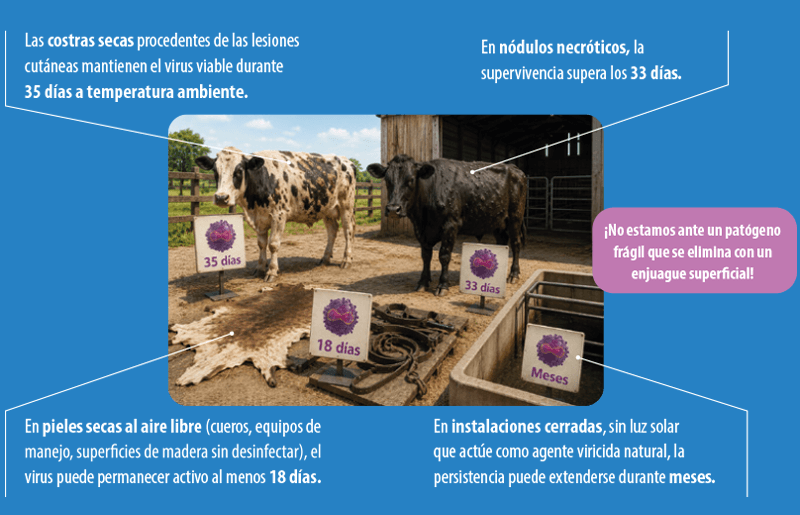
 The good news is that the virus is sensitive to commonly used veterinary disinfectants, as long as they are applied correctly. The good news is that the virus is sensitive to commonly used veterinary disinfectants, as long as they are applied correctly. |
Chlorocresol-based compounds with 2.0% glycolic acid, 1.5-2.0% potassium monopersulfate, iodinated compounds in a 1:33 dilution, or glutaraldehyde with quaternary ammonium at 0.5-1.0% are active against LSDV with contact times of between 10 and 20 minutes. Additionally, moist heat at 65°C for 30 minutes completely inactivates it.
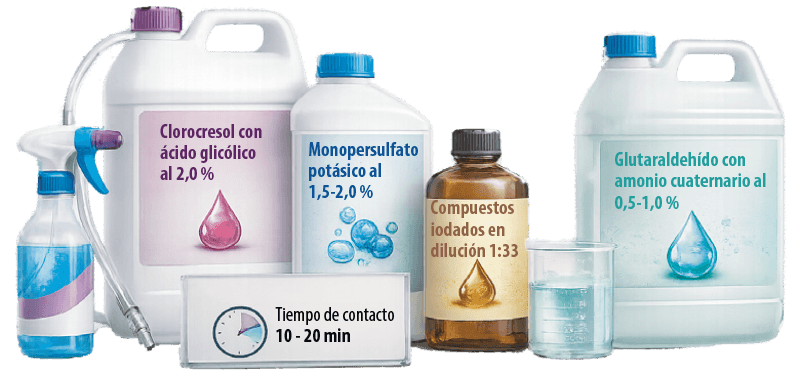
 Dirt neutralizes the disinfectant before it reaches the virus and, without prior mechanical cleaning, disinfection will be compromised unless the appropriate disinfectant is used and its efficiency is measured in the field. Dirt neutralizes the disinfectant before it reaches the virus and, without prior mechanical cleaning, disinfection will be compromised unless the appropriate disinfectant is used and its efficiency is measured in the field. |
It is recommended to systematically follow the five-step protocol:
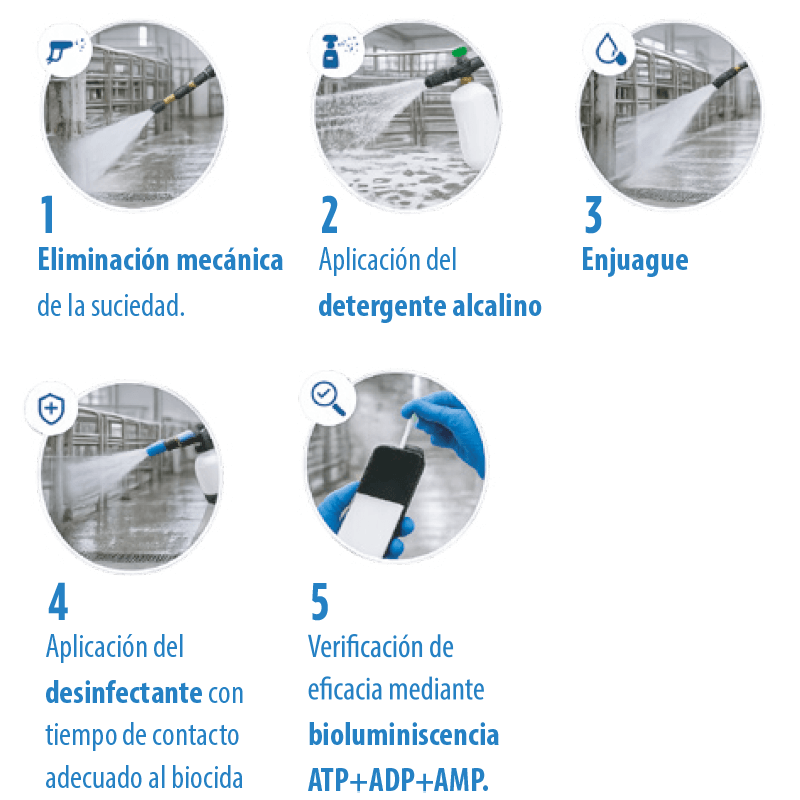
Without this fifth step, we do not know if what we have done has worked or not.
HOW THE VIRUS MOVES: VECTORS, TRADE, AND MYTHS
One of the most widespread misunderstandings about LSD is that it is mainly transmitted by direct contact between animals.
 It is an understandable mistake (most bovine diseases we are familiar with follow that logic), but in the case of LSD, the experimental data is compelling.
 In controlled studies where healthy cows cohabited for 30 days with animals with active lesions, in facilities completely isolated from insects, no healthy animal became infected. Direct contact, under natural conditions, plays a marginal role in transmission. In controlled studies where healthy cows cohabited for 30 days with animals with active lesions, in facilities completely isolated from insects, no healthy animal became infected. Direct contact, under natural conditions, plays a marginal role in transmission. |
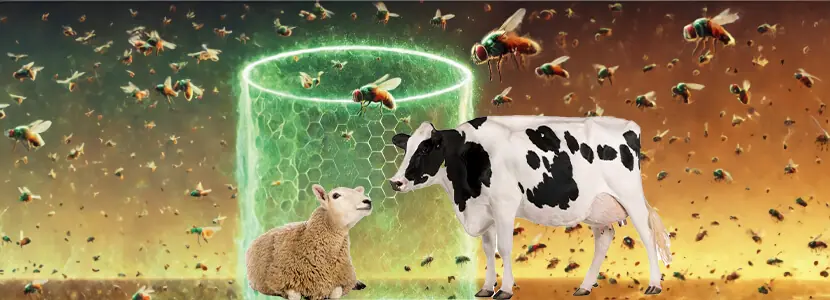
The real protagonist is the arthropod vector.
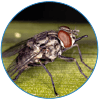 The stable fly, Stomoxys calcitrans, is the vector with the highest demonstrated competence in European outbreaks. It feeds on blood, is capable of feeding on multiple animals in a single day, and can travel more than 13 km with favorable wind.
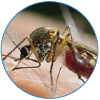 Mosquitoes of the genera Aedes and Culex also act as mechanical vectors.
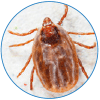 Some species of ticks -particularly from the genus Rhipicephalus– add an additional complication: they can transmit the virus transovarially,
That is, infected females transmit the virus to their eggs, meaning that new generations of ticks can be born already carrying the pathogen, maintaining vector pressure even in the absence of viremic animals in the environment.
The other major mechanism of spread, responsible for long-distance jumps, is the trade of animals.
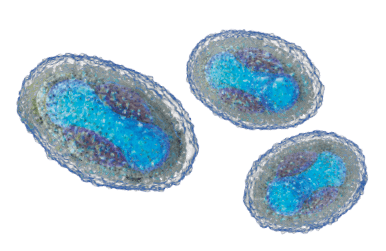 A bovine in the incubation period -with demonstrable viremia before the first visible lesions appear- can travel hundreds of kilometers before showing the first symptom.
Additionally, transmission through semen of infected breeders is experimentally documented, which adds a specific risk pathway for farms with a high rate of artificial insemination from collection centers in risk areas.
 Physical distancing measures between animals have a limited impact on LSD, while vector control —systematically underestimated in cattle farming compared to what happens in poultry or swine— can be the difference between a farm that withstands and one that does not. Physical distancing measures between animals have a limited impact on LSD, while vector control —systematically underestimated in cattle farming compared to what happens in poultry or swine— can be the difference between a farm that withstands and one that does not. |
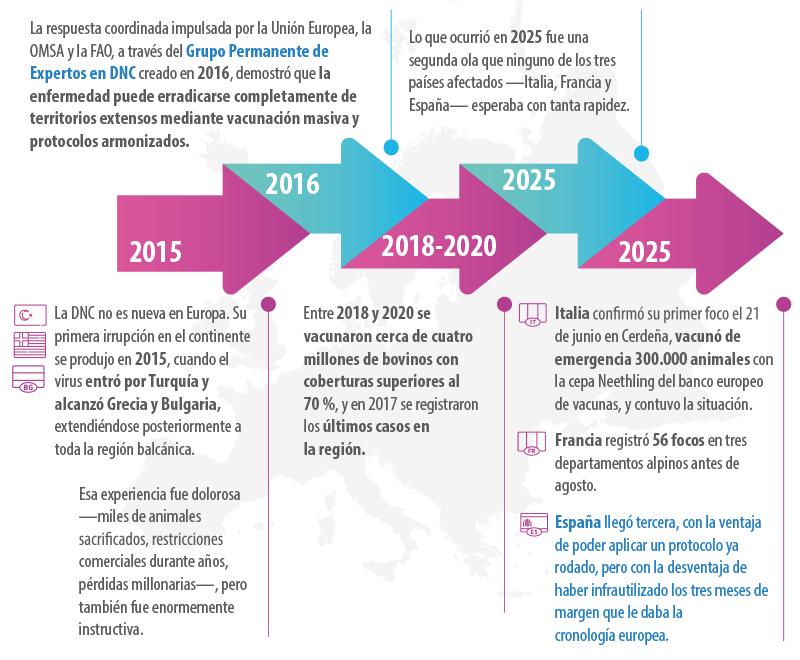
The honest analysis of the Spanish response yields a mixed balance.
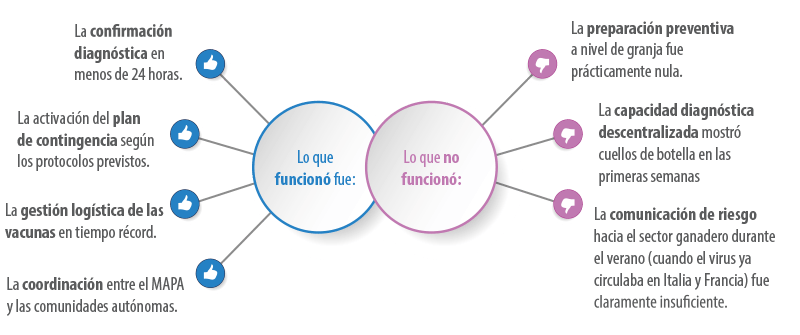
| The Spanish public investment in response to the outbreak exceeded 3.3 million euros solely in vaccines and control measures.
|
 The cost of having implemented preventive protocols on the farms in the affected area would have been a fraction of that figure.
PREVENTIVE BIOSECURITY: WHAT WORKS
AND HOW TO IMPLEMENT IT?
Preventive biosecurity against LSD rests on four mutually reinforcing pillars. None work in isolation, but it is also not necessary for all to be perfectly developed to achieve significant results.
 The key is to start, take the first step, be consistent and create that habit and measure, measure, and measure.
What has worked for us in applied biosecurity has been:
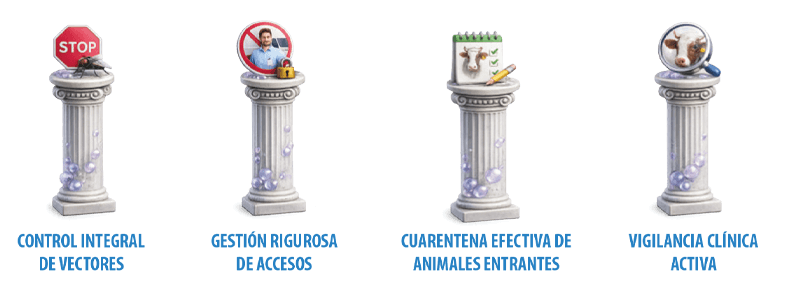
Comprehensive vector control
Vector control is, by far, the measure with the greatest relative impact in the Mediterranean context.
A serious vector control program does not consist of applying insecticides when flies are bothersome, but in:
Knowing the species present.
Identifying and eliminating their breeding niches (moist organic matter is the perfect habitat for Stomoxys calcitrans).
Establishing a treatment schedule with rotation of active ingredients to avoid resistance.
Installing physical barriers such as mosquito nets (as far as possible) and fans that generate currents greater than 2 m/s in resting areas.
Monitoring effectiveness through adhesive traps with periodic counting.
 Without capture data, the control program is a blind investment.
Strict access management
Each external visit to a farm (veterinarian, feed technician, transporter, buyer) is a potential introduction vector.
The minimum protocol requires:
Footwear disinfection in a footbath at the entrance.
Hand hygiene and, in times of high risk, changing clothes or using a disposable coverall.
Service vehicles (milk tankers, feed trucks) passing through an external disinfection point before entering the premises.
 The availability of an automatic disinfection arch with compounds based on chlorocresol and glycolic acid is an excellent effective and minimally disruptive solution for daily work.
None of this is complicated. The complicated part is maintaining it when daily pressures mount.
Effective quarantine of incoming animals
The minimum acceptable period for cattle coming from risk areas is 28 days in facilities physically separated from the rest of the herd.
This does not mean a different batch in the same barn, it means working a dedicated management circuit, with attention always at the end of the day and temperature control at least three times a week.
| An animal that develops fever during quarantine activates the notification protocol immediately, before any confirmed diagnosis. Waiting for laboratory confirmation to act is the mistake that turns a case into an outbreak.
|
Active clinical surveillance
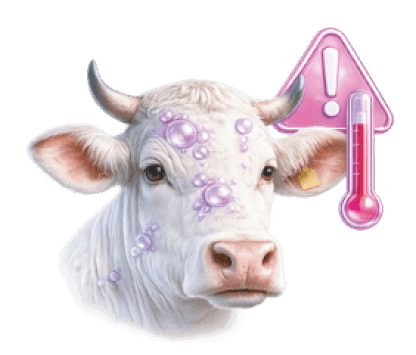
The complete picture of LSD (biphasic fever, well-circumscribed skin nodules of 2 to 5 cm, generalized lymphadenomegaly, and abrupt drop in milk production) is relatively characteristic.
But the prodromal phase, with fever and lethargy without visible lesions yet, can be confused with multiple processes.
| In areas of epidemiological risk, any bovine with unexplained fever deserves a second look and, in the presence of any multiple skin nodules, the correct attitude is to notify the competent authority and take samples before initiating any treatment that may mask the condition.
|

APPLIED BIOSECURITY AS AN INVESTMENT, NOT A COST
Biosecurity on cattle farms, regardless of their size or production system, should not be understood as a list of obligations to fulfill, but as a specific risk analysis and the available tools to reduce them sustainably and consistently over time.
This methodology starts with an initial diagnosis that considers five dimensions:
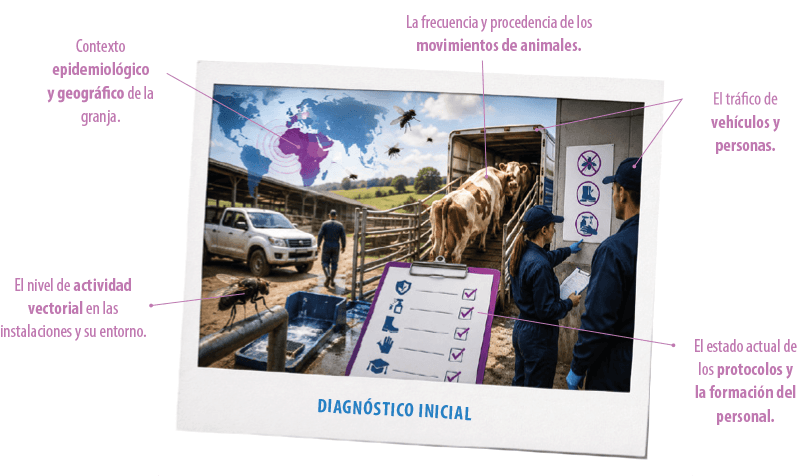
This initial snapshot allows for the design of a realistic improvement plan, prioritized by impact and cost, and phased over time to be manageable without halting production.
The implementation of an adapted preventive biosecurity protocol:
 Reduces the risk of pathogen introduction by more than 80%.
Decreases annual veterinary expenses by 30-50%.
Generates a return on investment of between 3-7 € for every euro invested over a three-year horizon.
These are not theoretical projections, but numbers that emerge when we analyze the health and economic history of farms before and after implementing the protocols.
Beyond the numbers, there is something that farmers who have experienced an outbreak up close understand viscerally and that is difficult to quantify: the peace of mind knowing that everything possible has been done to protect what has been built.
Preventive biosecurity does not guarantee that the virus will never arrive (that is beyond anyone’s control), but it does guarantee that, if it does arrive, it will reach a terrain that knows and is prepared to receive it.
| The LSD is not going to disappear from our environment. Its established presence in North Africa guarantees constant epidemiological pressure on the Peninsula. The question that every farmer and every veterinarian should ask today is not ‘if it will return,’ but ‘what have we changed since 2025 to be better prepared?’ |
CONCLUSIONS: THE TIME TO ACT IS BEFORE THE NEXT OUTBREAK
The Spanish experience with LSD in 2025 has been a costly reminder of something we knew but had not sufficiently translated into action: preventive biosecurity in cattle farming is not a luxury or a bureaucratic requirement.
It is the most efficient tool available to protect animal health, the economy of farms, and the continuity of a sector that is the foundation of many rural economies.
What the outbreak has highlighted, beyond the hotspots and restriction maps, is a gap in preventive culture that the Spanish cattle sector has been dragging for years.
| Correcting it is a long-term task that starts with small conversations: reviewing the quarantine protocol with the farmer on the next visit, installing a footbath at the farm entrance, establishing a vector control plan before the upcoming change of season. |
 No one can build these habits alone, but together —veterinarians, biosecurity technicians, and farmers— we can contribute to generating them.
You may be interested in: Comprehensive biosecurity strategies for the prevention and control of Foot-and-Mouth Disease