


 Latinoamérica
 Europa
Not Everything That Bites Is a Mosquito – Comprehensive Guide on Culicoides in Spain



 Avda. de Castilleja de la Cuesta, 26 (PIBO) Bollullos de la Mitación, Sevilla 41110
  + 34 955 77 65 77
The Culicoides, also known as biting midges, are tiny dipterans of the family Ceratopogonidae.
Although they often go unnoticed due to their small size, they can have a very significant impact on animal health.
 Some species transmit viruses such as bluetongue (Bluetongue, BTV), epizootic hemorrhagic disease (EHDV), and other arboviruses of veterinary importance. Some species transmit viruses such as bluetongue (Bluetongue, BTV), epizootic hemorrhagic disease (EHDV), and other arboviruses of veterinary importance. |
In Spain, recognizing which species are present, how they behave, where they breed, and when they are active is key to designing effective surveillance and control programs.
Species of Culicoides in Spain
In Spain, dozens of Culicoides species have been documented. Recent studies indicate that, in Andalusia, for example, 88 species have already been recorded.
 But of all of them, only a few are relevant as vectors of veterinary diseases.
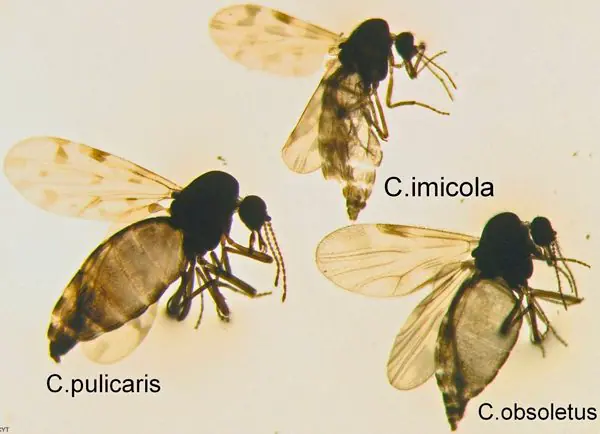
The most important species/groups in Spain in terms of transmission are:
- Culicoides imicola
- Obsoletus Complex (including C. obsoletus, C. scoticus)
- Pulicaris Complex (for example C. pulicaris, C. lupicaris)
- Other species such as Culicoides newsteadi also appear in studies related to BTV
Distribution of Culicoides
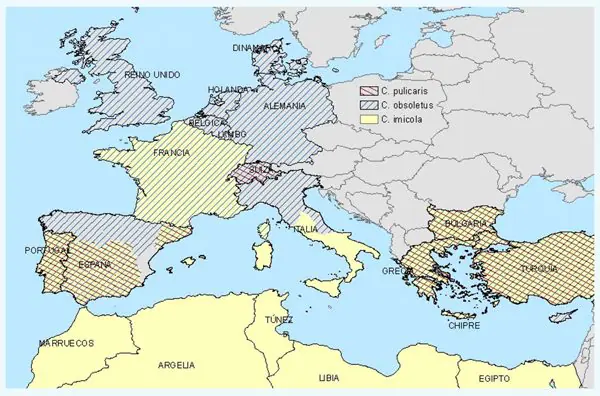
Map 1. Distribution of the three major species of Culicoides in Europe and North Africa. In yellow is C. Imicola, with red stripes C. Pulicaris, and with blue stripes Obsoletus Complex. Source: http://www.faunaeur.org/
What do Culicoides transmit in Spain?
 The Bluetongue Virus (Bluetongue Virus, BTV) is the most studied disease in this context. This virus primarily affects domestic ruminants (sheep, goats, cattle) and wild ones, causing fever, lesions, edema, production losses, and in some severe cases, death.
They can also transmit epizootic hemorrhagic disease (EHDV), especially in cervids and cattle, which, although it has not always had the same documented presence in Spain, is recognized as being transmitted by Culicoides.
C. imicola has been implicated not only with BTV but also in other arboviruses such as the hemorrhagic fever virus and equine diseases, although its main recognized role in Spain is as a vector of BTV.
Where do Culicoides breed?
Understanding where the larvae develop (stage before adult) is essential to be able to intervene effectively.
The larvae of C. imicola breed in humid areas of muddy microhabitats that do not become waterlogged.
 They are therefore found in edges of ponds and lakes, as well as in pond edges contaminated with animal feces.
Under optimal conditions, they take 15 days to develop into adults, but their cycle can last several months, overwintering as larvae in a state of diapause.
The larvae of C. obsoletus develop in tree holes and among moist leaf litter of trees.
 Larvae have also been found in stagnant water deposits and in swamp edges with shrubby vegetation.
Culicoides obsoletus presents very varied habitats that include marshes, swamps, leaf litter, decomposing vegetation, manure piles, organic soils of stables.
Biological cycle and activity
 The Culicoides go through the stages: egg → larva (I, II, III, IV) → pupa → adult.
The adult activity depends on the climate. In Spain, many Culicoides show activity from spring to autumn, with more intense months in summer and autumn, although this depends on the species and the region.
The vector-free period in some areas (when adult activity is very low or null) depends greatly on the climate and the presence of reproductive adult populations.
Practical veterinary importance and control
 Due to their role in the transmission of bluetongue and other viruses, the MAPA (Ministry of Agriculture) in Spain has national surveillance and control programs for entomological, serological, and clinical monitoring.
To control the disease, surveillance, vaccinations, restrictions when appropriate, and entomological monitoring are carried out to estimate vector-free periods.
Knowing which species are present in each area, when they are active, and where they breed allows for more effective interventions: for example, treatment of larval substrates, improvements in farm management, removal of manure near animal areas, drainage, etc.
Use of topical repellents to reduce the risk of insect bites and, therefore, reduce the risk of disease transmission.
Conclusion
In Spain, there are multiple species of Culicoides, but C. imicola, the Obsoletus complex, and the Pulicaris complex stand out for their veterinary relevance, especially for the transmission of the bluetongue virus.
Knowing their distribution, biological cycle, breeding habitats, and seasonality is key to preventing outbreaks, designing efficient control measures, and protecting animal health.
See more about Bioplagen