


 Latinoamérica
 Europa
Risk of Emerging Diseases in Ruminants in Spain: A Health, Productive, and Climatic Challenge for Future Livestock Farming



 Avda. de Castilleja de la Cuesta, 26 (PIBO) Bollullos de la Mitación, Sevilla 41110
  + 34 955 77 65 77
The health of ruminants in Spain is going through one of the most complex moments of the last decades. The emergence and spread of vector-borne emerging diseases is profoundly changing the national and European landscape.
 Diseases that until a few years ago were considered exotic or limited to tropical and subtropical regions have become part of the daily reality for veterinarians and farmers in Spain. Diseases that until a few years ago were considered exotic or limited to tropical and subtropical regions have become part of the daily reality for veterinarians and farmers in Spain. |
Epizootic hemorrhagic disease (EHD), bluetongue, or even potential threats such as lumpy skin disease and foot-and-mouth disease today represent real risks for cattle, sheep, and goats production.
 This scenario is not coincidental: climate change, rising temperatures, commercial globalization, animal movements, and the expansion of blood-feeding vectors are creating ideal conditions for the emergence and persistence of new pathogens in Europe.

One of the most determining factors in the spread of emerging diseases is the modification of climatic conditions. The increase in average temperatures and the reduction of cold winters favor the survival and activity of vector arthropods during increasingly longer periods of the year.
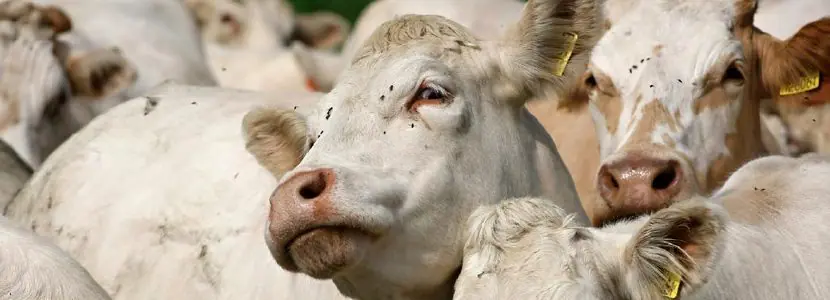
 In Spain, insects of the genus Culicoides —main vectors of bluetongue and EHD— currently find optimal environmental conditions in wide areas of the peninsular territory. This implies a prolongation of the vector season, a greater transmission capacity, and a progressive geographical expansion towards areas previously considered low risk.
In addition, Mediterranean extensive farming presents characteristics that increase exposure to the vector: presence of wetlands, water points, accumulated manure, and high interaction between wildlife and domestic livestock. 
EHE has probably become the most relevant emerging disease for Spanish cattle in recent years. First detected in the European Union in 2022, the disease quickly reached Spain, spreading explosively.  |
 It is a non-contagious viral disease caused by an Orbivirus from the Reoviridae family, closely related to the bluetongue virus. Its transmission mainly depends on the bite of Culicoides spp. and affects both domestic and wild ruminants.
In many animals, the sequelae persist for weeks or months, generating significant indirect economic losses due to decreased fertility, reduced milk yield, and growth delays.
 One of the main problems associated with EHE is that Europe lacked prior population immunity. This facilitated the rapid spread of the virus and increased the susceptibility of livestock. In Spain, during 2024 and 2025, numerous outbreaks were reported, consolidating the disease as endemic in certain regions.

BLUE TONGUE: A PERSISTENT AND CHANGING THREAT
Blue tongue is not a new disease in Spain, but its current epidemiological behavior does pose a growing challenge. The virus presents multiple serotypes and an enormous capacity for adaptation and dispersion.
Traditionally associated with sheep, the disease also affects cattle and goats, with the latter often acting as epidemiological reservoirs.
The simultaneous circulation of several serotypes in Europe significantly increases the complexity of health control. The emergence of serotype 3 in different European countries has necessitated the strengthening of vaccination programs and epidemiological surveillance.  |
In areas of high vector pressure, the risk of annual reinfection has become a structural concern for the sector.

THE ROLE OF WILDLIFE
The interaction between wildlife and domestic livestock constitutes one of the main current epidemiological challenges. Deer, wild boars, and other reservoirs can actively participate in the maintenance and spread of diseases.
 In the case of EHE, the deer acts as a very susceptible host and can promote viral circulation in extensive ecosystems. This situation greatly complicates eradication strategies, especially in regions with a high density of wild fauna.
| The growing expansion of wild populations in Spain also increases the risk of introduction and maintenance of other emerging pathologies. |

PRESENT AND FUTURE THREATS: LUMPY SKIN DISEASE AND FOOT-AND-MOUTH DISEASE
Although they are not currently found in Spain, there are emerging diseases whose surveillance is a priority.
Contagious lumpy skin disease (LSD)
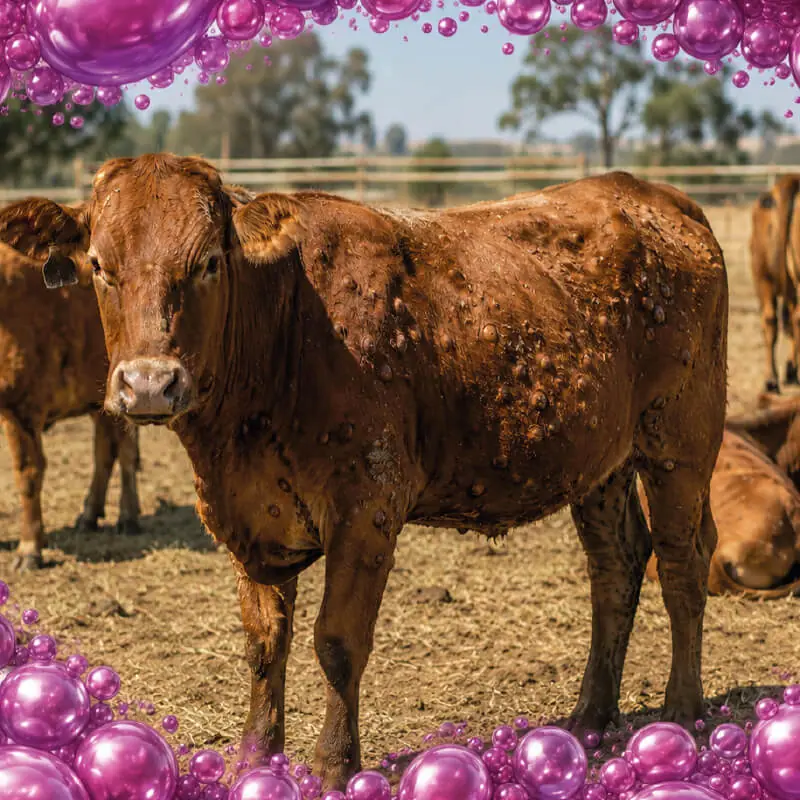
The contagious nodular dermatosis is a viral disease of cattle transmitted by blood-sucking insects. Its spread from Africa to Europe has generated great health concern. In 2025, the first case was reported in Spain, specifically in Catalonia.
Its vectorial diffusion capability makes this disease a particularly relevant risk.
Foot-and-mouth disease
Although Spain remains free, foot-and-mouth disease continues to be one of the greatest global health threats to animal production. The intense international commercial mobility and the increase in imports from endemic regions maintain the risk of introduction.
The economic consequences of a potential outbreak would be extraordinary due to the immediate closure of international markets and the mandatory control measures.
VECTOR CONTROL: AN ESSENTIAL TOOL IN PREVENTION
In the face of the advance of vector-borne diseases, the control of blood-sucking insects has become one of the main preventive strategies on ruminant farms.
 Prevention can no longer be limited solely to clinical surveillance or vaccination. In many cases, especially during the months of peak vector activity, reducing the pressure of bites is key to decreasing epidemiological risk.
| Modern biosecurity programs are increasingly incorporating integrated vector control measures:
|
 Environmental management and elimination of wet areas
 In extensive systems, where continuous contact with insects is practically inevitable, topical repellents represent an especially useful tool to reduce animal exposure. In recent years, plant-based repellents applied directly to the animal have gained relevance.
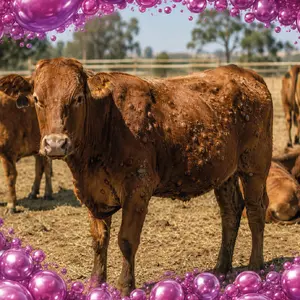
Among these solutions, Biozul® + from Bioplagen stands out, a topical repellent widely used in the ruminants sector.
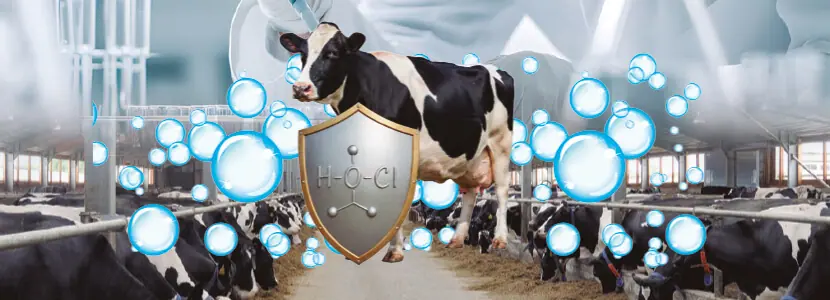
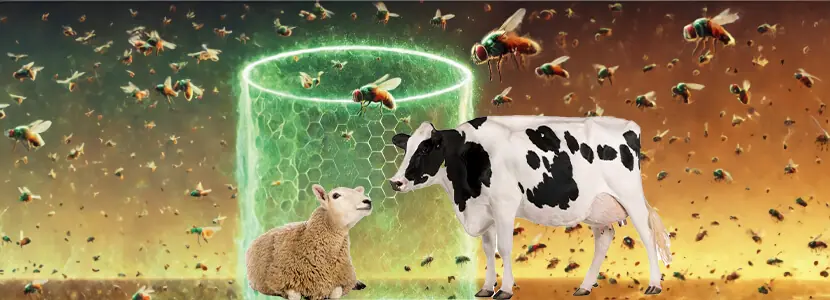
Biozul® + is formulated with vegetable oils such as neem and lavandin, and is used by topical spraying on cattle, sheep, goats, equines, and even cervids. Biozul® + works by creating a “bubble effect” around the animal that repels insects.
Additionally, one of the highlighted advantages is its persistence of up to approximately 10 days depending on environmental conditions, as well as the absence of a waiting period and the possibility of use in organic production.

TOWARDS A NEW LIVESTOCK EPIDEMIOLOGY
Everything indicates that emerging diseases will cease to be occasional episodes to become a structural reality of ruminant production in Europe.
Spain, due to its geographical location, climatic conditions, and extensive production model, is in a particularly vulnerable position against vector-borne diseases. The combination of climate warming, expansion of wildlife, and health globalization creates a dynamic and complex epidemiological scenario.
The future of ruminant health will depend on the sector’s ability to adapt to this new reality through early surveillance, research, vaccine innovation, and integrated strategies.
Because emerging diseases are no longer a future threat: they are the present of European livestock farming.  |