


 Latinoamérica
 Europa
Is a high-production dairy farm based on grazing possible?







| It is expected that the global per capita consumption of fresh dairy products will increase by 1% annually over the next decade due to rising per capita income in large countries such as India, China, or Pakistan (OECD, 2023).
In the EU, however, demand will slightly decrease due to low population growth and shifts towards sustainable production systems (OECD-FAO Agricultural Outlook 2023-2032). |
| However, survey data in the United Kingdom, France, Spain, Germany, Poland, and Sweden indicate that young people (18-35 years) consume more dairy than three years ago, prioritizing aspects related to consumer health and environmental sustainability. |
In North America, “millennials” place 20% more importance on environmental care than their elders, the “baby boomers” (Adams et al., 2023).
 Today, a good portion of Western consumers are willing to pay for products that, in addition to considering quality in traditional terms (taste, healthy components, and presentation), demonstrate care for the environment, Animal Welfare, and other attributes linked to social sustainability.
This trend is expected to continue rising, so companies are focusing their efforts on addressing these issues through, for example, the use of environmentally friendly packaging. We will agree that this is positive, but it is absolutely insufficient if we really want to contribute to sustainability.

We must take care of the way we produce milk from its origin, without losing sight of the fundamental sustainability to consider, which is that of the farmer themselves. In this context, we must reflect on our systems and, in particular, on the feeding of the cows.
|
The inclusion of fresh pastures in the diet of cows could contribute to meeting the new demands of consumers. Since its origin, pasture grazing has been linked to the nature of ruminants and allows obtaining one of the most valuable foods, milk, from inputs not usable by humans. In addition, it contributes to environmental sustainability, soil conservation, biodiversity, landscape, and the permanence of the population in rural areas. This trend is expected to continue rising, so companies focus their efforts on addressing these issues through, for example, the use of environmentally friendly packaging. |
| According to current data (Terrer et al., 2021), the role of pastures in carbon sequestration would be greater than that of trees. Properly managed, pastures could increase soil carbon retention by 8%.
|
 It is not surprising, then, the increasingly better perception of pasture-based production by society (Joubran et al., 2021).
 Van den Pol-van Dasselaar et al. (2020), based on more than 6,000 interviews conducted in Europe, report that scientists and consumers who positively value grazing in dairy production exceed 50%, while only 30% of farmers think the same.
The result is logical if we consider that it is the farmers who bear the limitations of pasture, linked to land availability and soil conditions, system management, and the difficulty of achieving high individual productions.
 For this reason, these authors consider that grazing will have a future in European dairy farming if it is economically compensated and point out that there is still a lack of scientific information on how to integrate pasture into high-production systems.
Below, research data is provided on feed management, the impact on final products, and the effect of including grass in dairy cow diets on methane production. |
HOW TO INCLUDE GRASSES IN HIGH-PRODUCTION DIETS?
The combination of grasses with TMR (Total Mixed Ration) diets, known as Partially Mixed Rations or PMR, would provide the recognized advantages of both systems—TMR and grazing—while reducing the limitations of each.
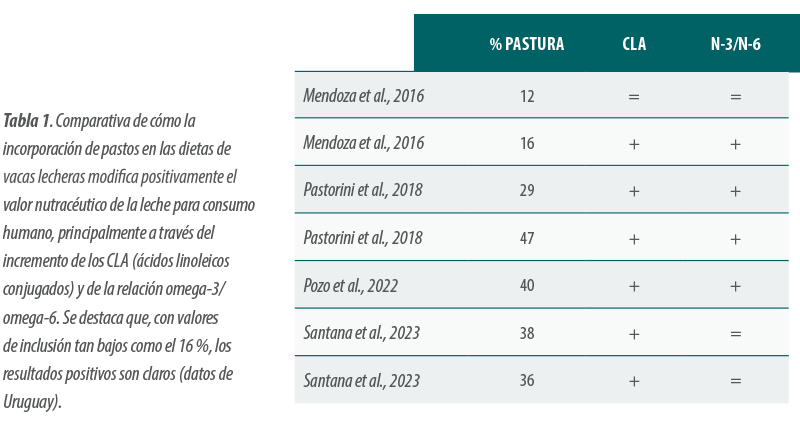
 The restricted inclusion of pastures positively influences costs (Soriano et al., 2001; Tozer et al., 2003) and improves the fatty acid profile of milk for human consumption, thanks to the increase in the proportion of omega-3 fatty acids and CLA, among others (Chilliard et al., 2007; Mendoza et al., 2016b; Pastorini et al., 2019).
Although in these systems it is difficult to exceed 30% pastures while maintaining high individual production (Wales et al., 2013; Pastorini et al., 2019; Wright et al., 2020), there are studies that report positive modifications in the fatty acid profile of milk with low pasture levels (16%, Mendoza et al., 2016 ).
Additionally, it has been observed that this profile is transferred to processed products, particularly to butters and cheeses (Cassarotto et al., 2023), also providing distinctive sensory characteristics that increase their added value (Carpino et al., 2004; Maniaci et al., 2023). |
|
The management of mixed feeding systems has its particularities, and science has not yet elucidated what the main factors determining their efficiency are.
In addition to the lactation stage, factors such as pasture quality, its height, density, and dry matter (DM) content, as well as the duration of grazing and the time of day it is consumed, can explain these differences (Pastorini et al., 2019; Pozo et al., 2022; Santana et al., 2023). |
 Some authors have observed decreases in intake and production with very low levels of pasture inclusion (below 20%), while others report a high intake and production with inclusions close to 40% (Morales-Almaraz et al., 2010; Mendoza et al., 2016a,b; Mendoza et al., 2018).
WHAT ABOUT METHANE EMISSIONS?
Let us remember that, according to classical literature, forage diets emit more methane than those with a high concentrate content. The fermentation of forage fiber produces more acetate, generating hydrogen ions that the rumen system neutralizes by forming methane.
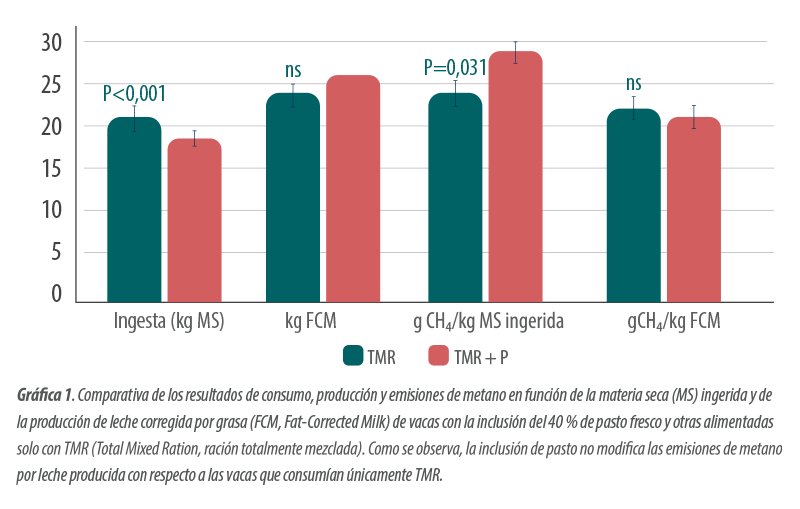
This approach, true but simplistic, must be nuanced according to the system and management. In Uruguay, Dini et al. (2018), when comparing the methane emitted by cattle consuming high or medium quality pastures, observed methane reductions comparable to those obtained through concentrate supplementation by improving pasture quality.
Recently, Fernández-Turren et al. (2024) have pointed out that dairy cows in mixed systems with a 40% inclusion of alfalfa in grazing emit the same amount of methane as confined cows fed with TMR.
 There are other aspects, such as the genetics and biotype of the animals, that impact the emissions outcome to an equal or greater extent than the diet (Dini et al., 2019; Silva, 2020). We will not address, for reasons of space, the role that rumen additives can play in reducing emissions, a topic that would deserve a presentation on its own.
In general, we can state, without fear of being wrong, that management practices aimed at improving the productivity of ruminants and, above all, at reducing inefficiencies, constitute the greatest contribution to the reduction of emissions. These management practices do not conflict with the inclusion of pastures in the diets. |
FINAL COMMENTS
The dairy market is evolving with a focus on sustainability and product quality, especially in Europe and North America. High-quality fresh forage, in addition to reducing costs, improves the composition of milk fat.
In intensive systems, its use has changed: it now constitutes a dietary supplement rather than its base, strategically managed in combination with other feeds.
Optimizing the productivity of ruminants and reducing inefficiencies are key aspects to decrease methane emissions.
High-quality forage does not increase emissions compared to TMR diets and contributes to carbon sequestration in the soil.
 In this context, nutritionists play an essential role in balancing sustainability and economic performance on dairy farms.