|
The transition is the most critical period of the production cycle in dairy cows.
The transition from the last phase of gestation to the start of lactation involves significant physiological, metabolic, and inflammatory changes that predispose to the occurrence of pathologies, affecting productivity and animal health during this period
|
THE TRANSITION PERIOD: THE GREAT METABOLIC CHALLENGE OF THE DAIRY COW
The transition period encompasses the three weeks before and the three weeks after calving (Grummer, 1995). In this stage, drastic changes occur at the metabolic, physiological, and nutritional levels aimed at adaptation for the lactation phase.
 The onset of lactation poses a significant challenge, as it involves an increase in the requirements for energy and important nutrients, such as calcium, while a generalized inflammatory process is established.
Added to this is the reduced intake capacity of the cow, which does not allow it to increase dry matter intake in this phase.
 This leads to a reduction in the supply of nutrients and energy, resulting in a significant nutritional imbalance that affects the animal’s health and productivity.
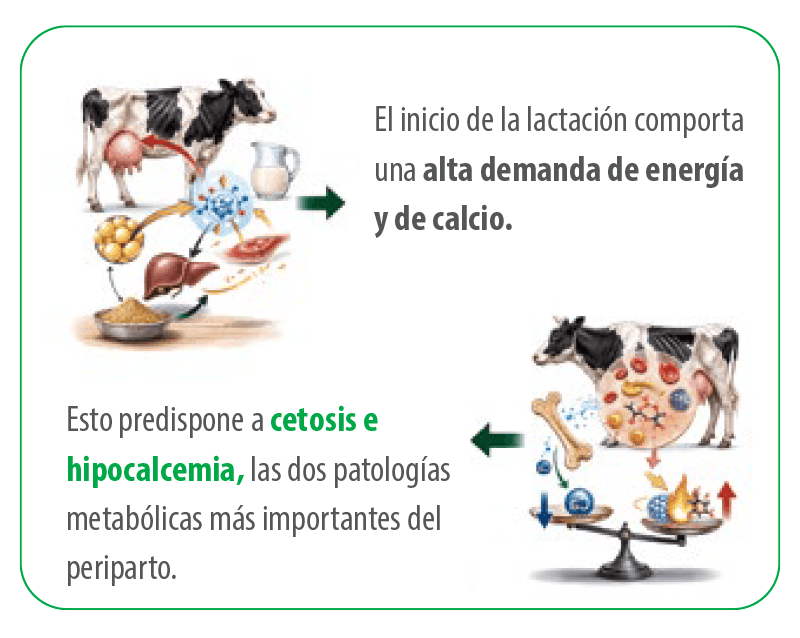
This situation is exacerbated by the generalized inflammation that is triggered. The activation of the immune system leads to an increase in energy demand (glucose) and, in turn, hormonally interferes with the recovery of calcium levels in the postpartum period.
KETONE BODIES: AN ENERGY SOURCE
 At the beginning of lactation, the energy requirement for milk production is much greater than the cow’s energy intake capacity, producing a negative energy balance (NEB) whose magnitude varies depending on the animal and its management.
 In BEN, the animal prioritizes milk production, adapting the metabolism of carbohydrates, lipids, proteins, and minerals to ensure milk synthesis.
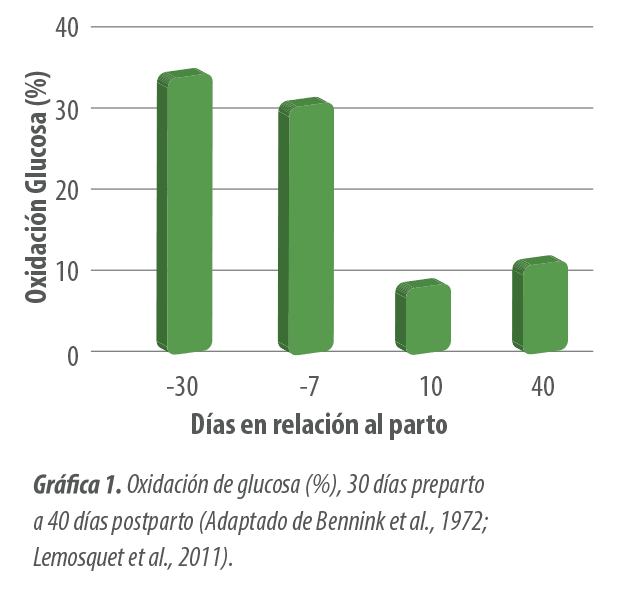
One of the main metabolic adjustments is the reduction of glucose oxidation as an energy source in tissues, allowing it to be redirected to the mammary gland, where it acts as a precursor of lactose (Bennik et al., 1972; Figure 1).
The mobilization of adipose tissue and the synthesis of ketone bodies used by tissues as an energy source is an alternative pathway to glucose.
This metabolic strategy in ruminants allows compensation for reduced energy intake and/or glucose precursors (Drackley et al., 2001).
At the same time, it ensures milk synthesis, having great importance in energy metabolism at the start of lactation.
 During this NEB, fat mobilization triggers the production of NEFA (non-esterified fatty acids) and beta-hydroxybutyrate (BHB) which, along with hypoglycemia, play an immunosuppressive role that favors the onset of metabolic diseases, such as ketosis. During this NEB, fat mobilization triggers the production of NEFA (non-esterified fatty acids) and beta-hydroxybutyrate (BHB) which, along with hypoglycemia, play an immunosuppressive role that favors the onset of metabolic diseases, such as ketosis. |
Clinical and subclinical ketosis predispose to significant pathologies that negatively affect cow health, compromising milk yield and fertility, causing significant economic losses on farms.
GLUCOSE: A KEY MOLECULE
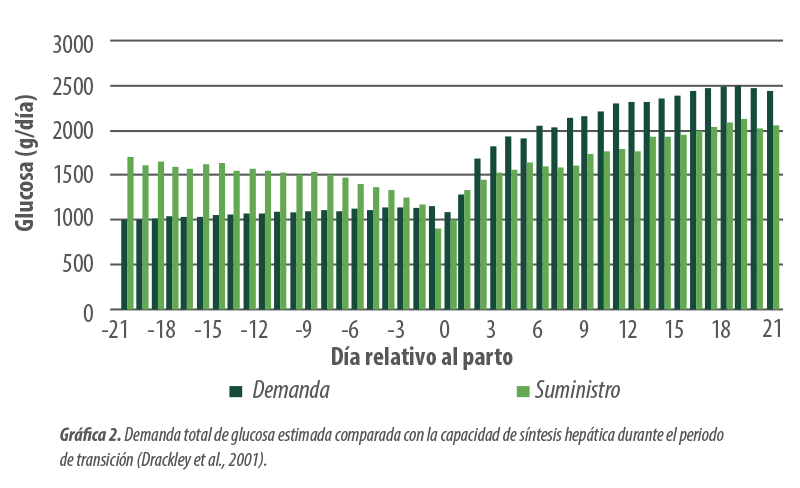
At the start of lactation, glucose requirements increase dramatically, exceeding the endogenous capacity for hepatic synthesis (Figure 2).
Hepatic gluconeogenesis is the metabolic pathway responsible for synthesizing glucose from different precursors (propionate, amino acids, lactate, and glycerol).
Reynolds et al. (2000) measured the glucose released by the liver during this period, observing a drastic increase from 1,356 g/d on day 11 pre-calving to 2,760 g/d on day 11 post-calving.
 This increase was associated with an 84% increase in hepatic blood flow, while the dry matter intake only increased by 44%.
Gluconeogenesis is a fundamental process in dairy cattle, as it allows them to meet the high glucose demand of the mammary gland, where it acts as:
 Metabolite for lactose synthesis (main osmoregulator of milk synthesis).
Essential nutrient for milk production.
It is estimated that a dairy cow producing about 31 kg of milk/day requires 2.7 kg glucose/day (Lemosquet et al., 2011), 85% of which would be produced through hepatic gluconeogenesis.
The substrates used in this process come from:
Rumen fermentation.
Fat mobilization.
Protein mobilization (amino acids).
The propionate, synthesized during rumen fermentation or from NEFAs in the liver, is the main substrate used in this process (32-73%), followed by amino acids (10-30%) and lactate (15%) (Drackley et al., 2001).
Traditionally, propylene glycol has been used as a precursor for glucose synthesis in animals with ketosis. Propylene glycol reaches the liver mainly in the form of propionate after being fermented in the rumen, but it can also be oxidized via the lactate pathway.
 It is important to note that not all substrates are used with the same efficiency in glucose synthesis and its release at the circulatory level.
|
To study the efficiency of glucose release into the bloodstream depending on the substrate, Lemosquet et al. (2009) conducted a study comparing the rate of appearance (Ra) of glucose in the blood of lactating cows after performing isoenergetic infusions of:
 Glucose at the duodenal level (GLC). Glucose at the duodenal level (GLC).
Propionic at the ruminal level (C3).
Mixture of 5 non-essential amino acids in the duodenum (NEAA): alanine (Ala), aspartate (Asp), glutamate (Glu), glycine (Gly), and serine (Ser).
|
The infusions were performed continuously, through peristaltic pumps, adapting the feeding to maintain stable plasma concentrations of blood metabolites and hematocrit.
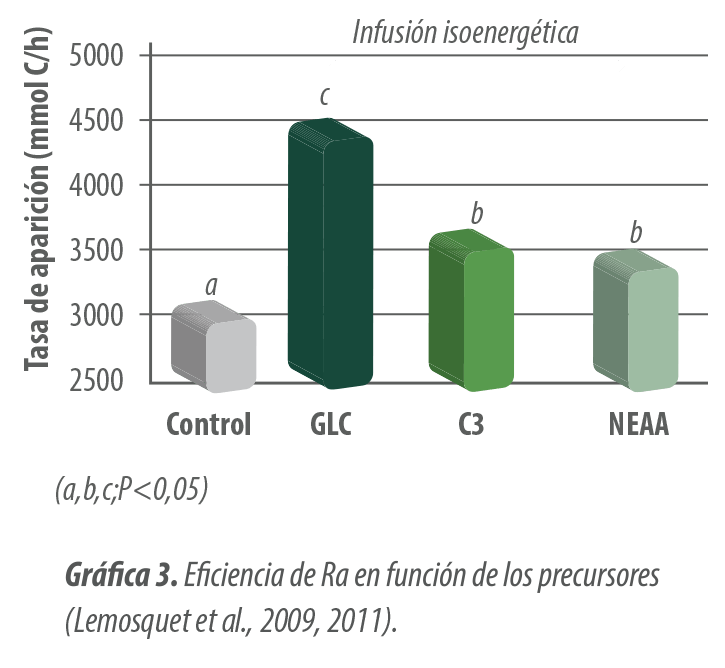
 The results in Graph 3 show that the infusion of duodenal glucose (GLC) significantly increased the Ra of glucose in blood compared to propionic and NEAA.
|
Although in this study no relationship was found with the amount of lactose in the milk, it was concluded that:
Greater availability of glucose in blood after duodenal infusion can promote a change in its use, both at the mammary level (as a source of metabolic energy) and systemically (by other tissues).
|
PROTECTED GLUCOSE
 The availability of glucose is a critical point during the transition period, with repercussions on the cow’s health and its milk production capacity. For this reason, the use of protected glucose has been studied as a strategy to increase its arrival at the duodenum, minimizing its degradation in the rumen.
|
McCarthy et al. (2020) evaluated the effects of adding protected glucose (RPG) in the diet on milk production, post-absorption metabolism, and inflammation in cows during the transition period.
In this study, a Maillard reaction was performed to protect the glucose, forming a sugar-amino acid complex, which was supplemented in the treatment group at 6% on DM in the ration.
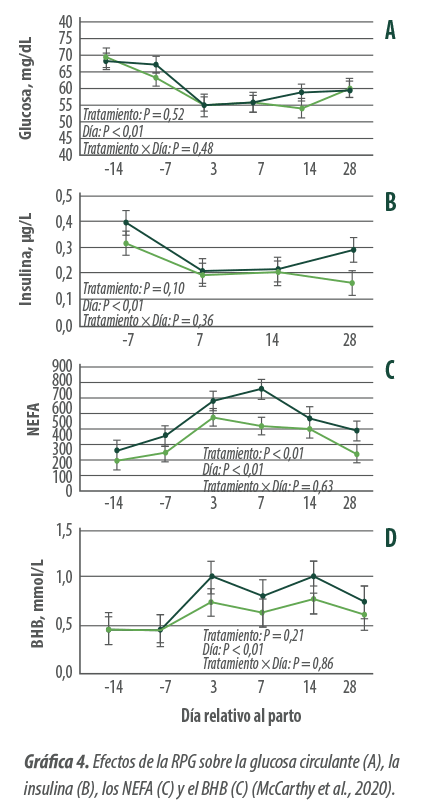
Although no differences were observed in productive parameters, there was a increase in circulating insulin (27%), as well as a reduction in NEFA (-28%) and BHB (-24%), thus reducing inflammation markers in the peripartum (Graph 4).
|
The early recovery of insulin levels postpartum is crucial postpartum, as these concentrations are related to fertility and the resumption of ovarian activity.
Recently, Yu et al. (2024) conducted another study with RPG, in this case protected with palm oil.
Three different doses of RPG (150, 300, and 450 g/day) were studied over 42 days and evaluated:
The intake.
The body condition.
Milk production.
Blood metabolites.
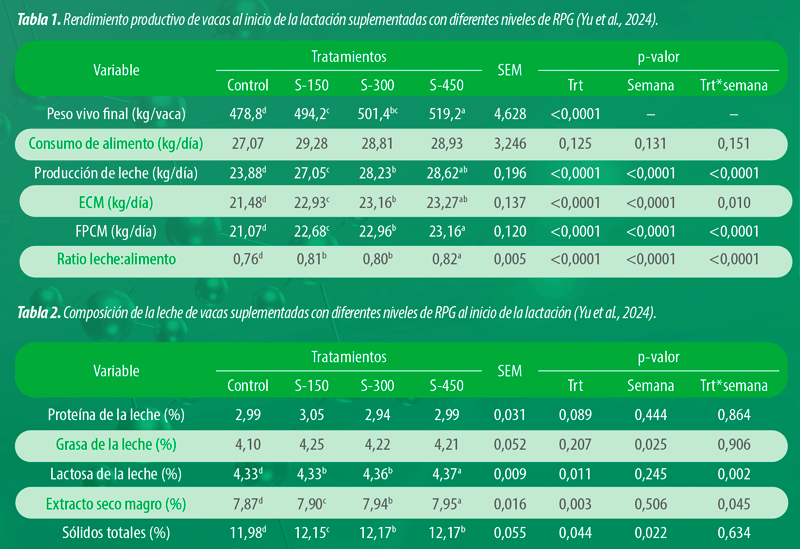
The dose of RPG at 450 g/day significantly improved live weight, milk production and its composition (lactose and total solids) (Tables 1 and 2) and circulating glucose levels.
In turn, the concentration of NEFAs and BHB were reduced, indicating a lower BEN and, consequently, a decrease in ketosis in cows supplemented with this dose of RPG.
CONCLUSION
Protected glucose can be a very useful nutritional tool in the transition phase, especially at the start of lactation, reducing the negative effects of BEN, improving health, fertility, and productivity, helping the cow reach its maximum potential.
|
Read more about Quimidroga




 Latinoamérica
 Europa



 calle Tuset 26 Barcelona 08006
  +34 93 236 38 19