


 Latinoamérica
 Europa
When the Thermometer Soars: Productive Resilience Against Heatwaves











In mid-August 2025, relatively prolonged heatwaves affected Israel and the Middle East region, and as expected, reports from various regions of the country indicated a significant decrease in milk production per cow.
To assess the impact of this extreme heat episode, the climatic changes recorded during the heatwave and the following days were analyzed, as well as their effect on milk production.
Additionally, information was gathered on the extent and duration of the decrease in daily milk production per cow and on the animals’ ability to recover their previous production levels.


The Graphs 1, 2, 3, and 4 show the minimum and maximum temperatures, as well as the daily milk production per cow during August 2025 in the different regions analyzed.


 |

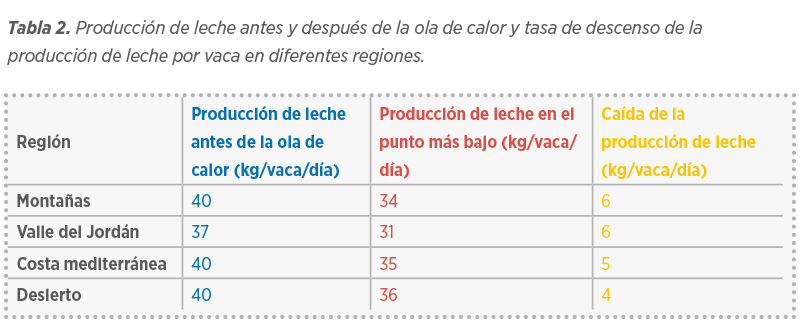
From the information presented in the two tables, the following conclusions can be drawn:
 At the peak of the heatwave, the minimum temperature was 6 °C higher than recorded before its onset and did not differ significantly between the different regions.
The maximum temperature at the peak of the heatwave was between 3 and 8 °C higher than recorded before its onset.
 The greatest increase was observed in the mountainous regions and the Jordan Valley, while the smallest was recorded on the Mediterranean coast, probably due to the moderating effect of the sea.
The decrease in milk production during the peak of the heatwave was relatively uniform, ranging from 4 kg/cow/day in the desert, 5 kg/cow/day on the coast, and 6 kg/cow/day in the other regions.
 The smaller drop observed on the coast could be explained by the moderating effect of the sea and, in the desert, by a more intensive application of cooling systems on the farms.
One of the most relevant findings is that, in all the regions evaluated, milk production recovered to pre-heatwave levels approximately one week after its end.
 This behavior could be related to the widespread application of intensive cooling measures on Israeli farms, which, although they do not completely prevent losses during extreme heat episodes, seem to favor a relatively quick recovery of production.
Assuming an average loss of 4 kg of milk per cow per day during the period affected by the heatwave (approximately 15 days), the accumulated loss would be about 60 kg per cow.
This amount is small compared to an annual production of over 12,000 kg per cow. Additionally, when estimating the economic impact on the farm, it should be considered that part of the income loss from reduced milk production may be offset by a reduction in feed costs associated with lower consumption.
| This analysis focuses exclusively on the effect of the heatwave on milk production and does not consider other possible impacts, such as those related to the health or fertility of the cows.
|
 Overall, the results suggest that the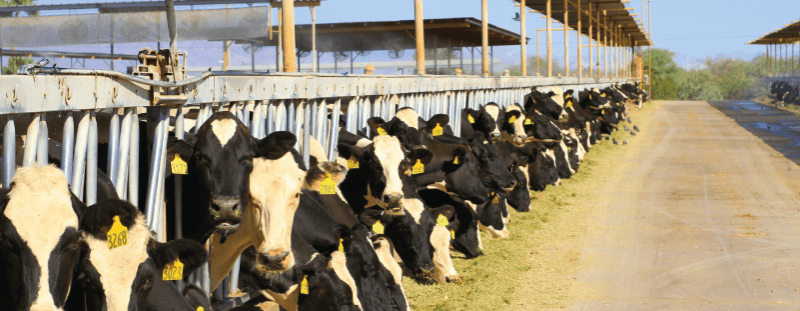
You may be interested in: The Art of Cooling Cows: The Science Behind Humidification and Forced Ventilation