


 Latinoamérica
 Europa
Suckling and Allonursing in Dairy Calves Raised in Systems with Maternal Contact










In cow-calf contact systems, where calves remain with their mothers during lactation, it is essential to ensure a proper milk intake and understand how their sucking behavior evolves.
 However, there is still little information available on how factors such as age or type of management influence the occurrence of allonursing (behavior of nursing from cows other than the mother).
| This study addresses these issues in dairy calves raised with their mothers in indoor systems with automatic milking. |
NURSING BEHAVIOR IN DAIRY CALVES
In intensive dairy production systems, calves are usually separated from the mother a few hours after birth and are raised artificially, leaving them with few opportunities to express their natural sucking behavior.
However, these animals have a high motivation to suckle and, when they are prevented from performing this behavior (for example, through feeding with automatic dispensers), it has been observed that they develop oral behaviors with no nutritional function.
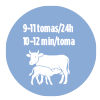 Based on studies conducted in semi-natural conditions, it is known that calves of beef breeds (Bos taurus) and zebu dairy breeds (Bos indicus) raised by their mothers perform 9-11 milk feedings in a 24-hour period when they are less than 3 weeks old, with an approximate duration of 10–12 minutes per feeding.
 This behavior changes with age, especially during the first months of life, reducing the number of feedings but increasing their duration.
 The dairy calves raised in cow-calf contact systems have the opportunity to suckle and display stimulation behaviors before and after suckling, more faithfully reproducing what occurs in semi-natural conditions.
 For this reason, interest in this type of system is increasing, as reflected in the recommendations of a recent European report on calf welfare, which promotes a prolonged contact (> 24 hours) between cow and calf. For this reason, interest in this type of system is increasing, as reflected in the recommendations of a recent European report on calf welfare, which promotes a prolonged contact (> 24 hours) between cow and calf.
|
 In these systems, calves are housed alongside lactating dairy cows, although the type of cow-calf contact (whether full or partial physical contact, with the mother or a nurse cow) and the duration of daily contact allowed can vary considerably depending on the system design.
To date, suckling behavior has been described in various cow-calf contact systems, with evidence suggesting that dairy calves modify their behavior with age, taking fewer but longer suckling bouts.
 However, these observations have been limited to 9 weeks of age, still below the weaning range currently described for European cow-calf contact systems (12–17 weeks).
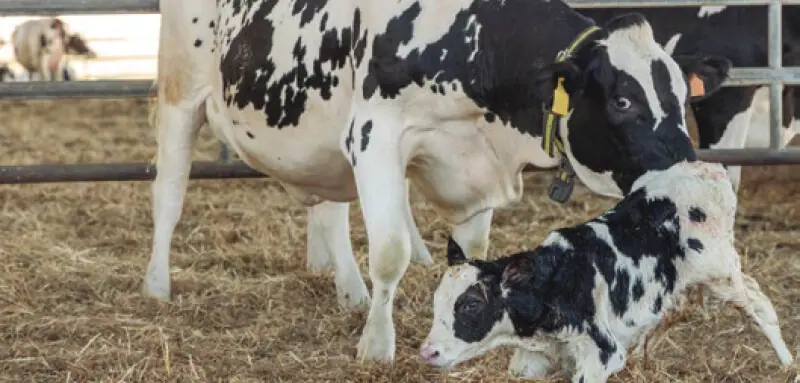
EVOLUTION OF SUCKLING AND ALLOLACTATION IN COW-CALF CONTACT SYSTEMS
Given the lack of studies that describe in detail how these behaviors evolve throughout the calf’s growth and under different types of contact with the cow, a study was designed to provide new data to better understand the dynamics of suckling and allolactation under current dairy production conditions.
Objective 1 
The first objective was to analyze how suckling behavior varies with age (duration and frequency of suckling bouts, and total time spent suckling per day) in dairy calves housed in indoor cow-calf contact systems, whether with contact controlled by the cow or the calf.
 The classification of the system as controlled by the cow or the calf depended on which individual (the mother or the calf) had the primary initiative to establish contact within the pen.
The ages studied (cow-controlled system: 3–15 weeks and calf-controlled system: 3–12 weeks) allow for a better understanding of calf behavior during a nursing period that more accurately reflects current practices, thus contributing to expanding the knowledge base for future management recommendations.
Objective 2
Current knowledge about allolactation in dairy calves remains limited, especially regarding how factors such as calf age or housing type (e.g., whether calves have access to part or all of the pen) influence it.
Therefore, the second objective was:
 Identify calf-dependent factors associated with the occurrence of allolactation in two distinct types of cow-calf contact systems.
 Describe the general frequency of allolactation in both systems, although comparisons between them are purely descriptive, as the experimental design differed in several aspects.
 Analyze descriptively the position of the calf and the occurrence of mutual grooming behaviors during nursing episodes to understand the differential characteristics between allolactation episodes and nursing
episodes with the mother.
MATERIALS AND METHODS
The study was conducted in continuous cow-calf contact systems where the calves could stay with their mothers all day, except during milking:
 In Study 1, with 21 cow-calf pairs (19 after exclusions), the contact was controlled by the cow, which decided when to stay with the calf or leave the contact area.
 In Study 2, with 24 calves and 23 cows, the contact was controlled by the calf, which could freely approach the cows in almost all areas of the pen.
In both cases, the animals were housed in indoor systems with free stalls and automatic milking, and the calves had exclusive areas with water, forage, and concentrate.
The behavior was recorded using cameras during 24-hour periods when the calves were 3, 6, 9, and 12 weeks old (and up to 15 weeks in the cow-controlled study).
| Episodes of suckling and close contacts with the udder were recorded, indicating:
|
 The cow and the calf involved.
The calves were weighed at birth and monthly to calculate the Average Daily Gain (ADG), episodes were classified as maternal suckling or allolactation, and the relationship between the relative frequency of allolactation and daily weight gain was evaluated.
The body positions and reasons for termination of the feedings were also described, as well as the temporal relationship between events near the udder and subsequent sucklings.
RESULTS
Suckling behavior
The study was conducted in continuous cow-calf contact systems where the calves could stay with their mothers all day, except during milking:
COW-CONTROLLED SYSTEM
In the cow-controlled system, the calves had an average of 4 ± 1.5 milk feedings per day, with no significant differences between sexes or as age increased.
 Similarly, the duration of the feedings did not vary with age, although allolactation feedings were significantly shorter than those with the mother (8 ± 0.6 versus 12 ± 0.5 minutes per feeding).
The duration and frequency of the feedings did not differ between males and females, but females tended to spend more daily time suckling than males (46 ± 2.9 versus 36 ± 3.8 minutes/day).
 No effect of age was observed on the total daily suckling time, which averaged 42 (17.0) minutes/day throughout the study period.
CALF-CONTROLLED SYSTEM
 In the calf-controlled system, as the calves grew, they had fewer daily milk intakes (3 weeks: 5 ± 0.3 intakes/day; 12 weeks: 4 ± 0.3 intakes/day), increasing the duration of each intake and the intakes with the mother were significantly longer than those of allosuckling at all ages (11 ± 0.5 versus 8 ± 0.8 minutes per intake).
In the intakes between mother and offspring, the average duration increased from 9 ± 0.6 minutes at 3 weeks to 13 ± 0.6 minutes at 12 weeks of age.
Additionally, there was a trend for calves to spend more total daily time suckling as they grew (3 weeks: 42 ± 2.0 minutes/day; 12 weeks: 47 ± 2.0 minutes/day), although this difference was not statistically significant.
ALLOSUCKLING BEHAVIOR
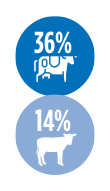 Out of a total of 380 intakes recorded in the cow-controlled system and 419 in the calf-controlled system, 36% and 14%, respectively, corresponded to allosuckling episodes.
Among the calves that practiced allonursing at least once, the proportion of nursings performed with non-maternal cows ranged between:
8–61% in the cow-controlled system.
4–61% in the calf-controlled system.
| The likelihood of allonursing increased significantly with age in both studies.
The presence of other calves nursing from the same cow had a great influence on the probability of allonursing.
|
 In the cow-controlled system, the likelihood increased by 4.4 times between 3 and 15 weeks, while in the calf-controlled system it was 7.3 times higher at 12 weeks than at 3 weeks of age.
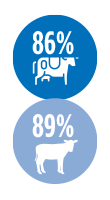 In 86% (cow-controlled system) and 89% (calf-controlled system) of the occasions when a calf joined a non-maternal cow that was already nursing another, the cow’s own calf was present.
| In general, allonursing was observed more frequently as a group behavior than individually, with other calves nursing from the same cow in 81% of the events in the cow-controlled system and in 62% of the events in the calf-controlled system. |
When only the episodes occurring while the mother was present in the contact area were analyzed, the likelihood of allonursing continued to increase with the age of the calf.
There was also a trend towards a weak positive correlation between ADG and the relative frequency of allonursing (% of all feedings that were allonursing) in the calves in the calf-controlled system, while no such correlation was found in the cow-controlled system.
Milk feeding attributes
POSITION
When nursing from their own mother, the calves primarily adopted an inverted parallel position, whereas in allonursing, this position was rarely observed, as the calves positioned themselves perpendicularly or behind the non-maternal cows while nursing.
GROOMING
Mutual grooming (allogrooming) was observed in 40% of the suckling sessions between cow-calf pairs in the cow-controlled study, while it was only recorded in 1% of the allosuckling episodes.
Similarly, in the calf-controlled study, grooming was observed in 49% of the sessions with the mother and in none of the allosuckling episodes.
END OF SUCKLING
Suckling sessions between a cow and her calf usually ended at the calf’s initiative. In contrast, approximately half of the allosuckling sessions (cow-controlled study: 49%, calf-controlled study: 53%) ended due to actions by the involved cow.
 The average duration of allosuckling sessions ended by the cow in the calf-controlled study was numerically shorter than those interrupted by the calves, a less marked difference in the cow-controlled study.
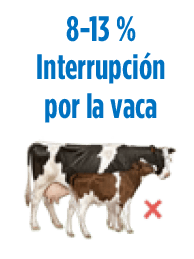 Sessions that ended due to a kick or other interruption (e.g., butting, lying down, or defecating) by the cow were proportionally similar between cow-calf pairs (8%) and unrelated cows (13%) in the cow-controlled study.
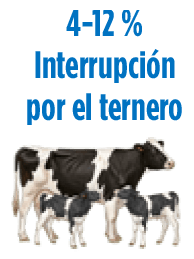 In the calf-controlled study, this type of interruption was more frequent during allosuckling episodes than in sessions with the mother (12% versus 4%).
Events of udder proximity
A total of 233 (cow-controlled study) and 265 (calf-controlled study) events of udder proximity were recorded throughout the different ages of the calves.
This behavior occurred between the calves and their mothers in 35% and 64% of the events in the studies controlled by the cow and by the calf, respectively. The duration of these events was generally very short.
COW-CONTROLLED SYSTEM
In the cow-controlled study, half of the udder proximity events occurred within the 16 minutes prior to the next feeding.
 These events were mainly interrupted by the cows (40%) or by the calves (56%), while a small number ended for other reasons.
The number of udder proximity events per calf that occurred within the 16 minutes prior to the next feeding showed a positive correlation with the number of allonursing episodes performed by the calf during the study period.
In contrast, no correlation was observed between the frequency of these events and the feedings performed with the mother. As the calves grew, the proximity events directed towards the mother decreased (from 59% at 3 weeks to 21% at 15 weeks), increasing their frequency towards unrelated cows.
CALF-CONTROLLED SYSTEM
In the calf-controlled study, the median time between proximity events and the next feeding was 71 minutes.
Of the events occurring within that interval, most ended by the initiative of the calves (66%), compared to 30% ended by the cows.
A moderate positive correlation was observed between the number of allonursing episodes per calf and the number of udder proximity events occurring within the 71 minutes prior to the next feeding, although it was uncommon for the calves in this study to perform more than one allonursing episode.
No correlation was found between the number of udder proximity events and the frequency of feedings with the mother.
In general, the events of proximity to the udder were mainly directed towards the mother in the calf-controlled study, although their proportion decreased with age (3 weeks: 84%; 12 weeks: 55%).
DISCUSSION
This work is the first to describe the suckling behavior in dairy calves beyond 9 weeks of age, a period that more closely approaches current weaning practices in cow-calf contact systems.
| Overall, the results showed that the calves in the cow-controlled study increased the frequency of allonursing with age, without significant changes in other aspects of suckling. |
In contrast, the calves in the calf-controlled study performed fewer daily sucklings, but of longer duration, and also increased their frequency of allonursing with growth.
In both studies, the allonursing sessions were 3 to 4 minutes shorter than the sessions with the mother, probably because many of them ended due to the cow’s intervention.
In general, the calves performed about 4–5 feedings per day, each lasting between 9 and 13 minutes, values consistent with previous studies.
The frequency of allonursing was higher in the cow-controlled study (36%) than in the calf-controlled study (14%), suggesting that calves resort to nursing from other cows when access to their mother is limited.
The design of the pen and the management of cow flow seem to play an important role in the occurrence of this behavior.
Additionally, the docility of dairy cows —a result of genetic selection for production and milking— could explain why they more frequently accept foreign calves.
| While allonursing cannot be avoided in systems where cows and calves coexist, the effects on the welfare of cows and calves remain a subject of debate.
In this study, calves that engaged in more allonursing episodes had weight gains similar to or slightly higher than the others. |
At an individual level, the probability of allonursing increased with age in both studies, especially in the cow-controlled system.
 This suggests a possible learning or reinforcement of behavior as successful experiences accumulate.
The presence of other calves nursing from the same cow also significantly increased the likelihood of allonursing, indicating a component of imitation or social facilitation.
Proximity events to the udder provided complementary information on failed or exploratory nursing attempts.
| In the cow-controlled study, many of these events immediately preceded a feeding and were often directed towards other cows, suggesting that the calves attempted to suckle when their mother was unavailable. |
In the calf-controlled study, the intervals between these events and the feedings were longer, reflecting a greater accessibility to the mother.
Since these behaviors correlated with allonursing, they could represent preliminary stages or learning attempts.
The authors recommend future studies with more precise direct observations and the integration of data on other feeding behaviors to better understand how calves balance milk seeking with the initiation of solid feed intake.
Dairy calves raised in cow-calf contact systems controlled by the cow did not modify their suckling patterns over time.
 In contrast, calves in calf-controlled systems did change their behavior, taking fewer but longer suckling bouts as they grew.
In both studies, the likelihood of allosuckling increased with the age of the calves and was higher when suckling in groups. Additionally, this phenomenon was observed more frequently among calves in the cow-controlled system, even when their own mother was present.
 These results indicate that allosuckling can be expected in different types of cow-calf rearing systems in dairy cattle, although its frequency may depend on calf-specific factors and the daily contact time available.
This behavior could offer calves an opportunity to satisfy their hunger when the mother is not accessible, allowing them to maintain good growth during the contact period.