


 Latinoamérica
 Europa
Pellet quality in cattle feed: factors that make the difference








Currently, due to the increasingly pronounced trend towards the incorporation of milking robots on dairy cattle farms, nutritionists are required to develop pelletizable formulas that meet a series of quality requirements, allowing the full genetic and productive potential of the animals to be extracted.
The pelleting has been the main improvement introduced in feed manufacturing technology since the incorporation of grinding.
It consists of subjecting the feed in flour form to a combined effect of compression and extrusion, through a mechanical process in which forces such as friction, pressure, and extrusion, along with temperature increases.
 As a result, certain characteristics of the raw materials are modified and the agglomeration of the particles occurs, resulting in granules or pellets.
 Originally, the goal of granulation was to adapt the physical presentation of the feed to new distribution systems, avoiding the flow and management problems associated with the use of flours. Originally, the goal of granulation was to adapt the physical presentation of the feed to new distribution systems, avoiding the flow and management problems associated with the use of flours. |
The process consists of three basic phases:
 1. Hydrothermal conditioning of the flour from the mixer.
 2. Compression-extrusion of the flour in the pellet press, which consists of three elements:
The die, whose holes determine the compression and the type of pellet desired.
The rollers, which compress the meal and facilitate its passage through the
die holes.
The cutting blades, installed at the die exit, which cut the pellets to the desired length.
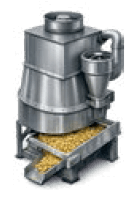 3. Cooling-drying of the pellets.
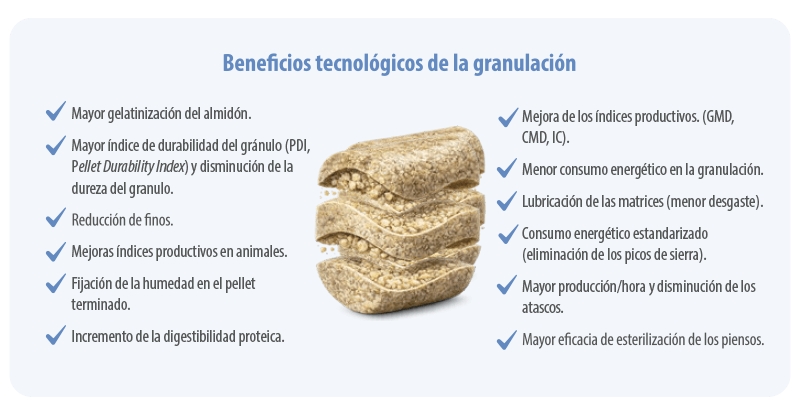
| When the pelleting process is carried out under controlled conditions, especially regarding moisture and temperature, significant improvements can be achieved both in pellet quality and in the efficiency of the manufacturing process. |
HYDROTHERMAL CONDITIONING: CONTROL OF STEAM, MOISTURE, AND TEMPERATURE
The conditioner is a fundamental piece in the preparation of the product before its entry into the matrix, as it allows granulation to be carried out under optimal conditions.
The physical and chemical transformations that occur during this phase depend on the combination of three main factors:
 Temperature
Moisture
Retention time
The addition of steam in the conditioner increases the temperature of the flour and simultaneously increases its moisture.
 The final goal is to reach the highest possible temperature, maintaining the longest residence time in the conditioner, but avoiding blockages in the pellet mill.
 It is essential to ensure a correct homogeneity of moisture in the mix. If all these factors are properly balanced, a good gelatinization of starches will be achieved. It is essential to ensure a correct homogeneity of moisture in the mix. If all these factors are properly balanced, a good gelatinization of starches will be achieved. |

COMPRESSION-EXTRUSION: PHYSICO-CHEMICAL PROCESS OF PELLETING
During this phase, the primary particles of the flour adhere to each other to form larger structures, composed of multiple dense and free-flowing particles, known as pellets, through a process that takes place in the pelletizer.
Physico-chemical process of wet pelleting
Wet granulation is the most commonly used system in today’s feed mills for livestock and is based on the incorporation of water, mainly in the form of steam.
The ultimate goal is to soften the particles to facilitate their subsequent compaction.
Steam provides:
Moisture and heat, improving the plasticity of the mixture and facilitating the compaction of the particles to form a durable pellet.
Thermal and chemical energy that contributes to partially disintegrating the starch structure, promoting its gelatinization.
Partial denaturation of proteins and softening of fiber, improving the cohesion of the pellet.
Forces involved in pellet formation
PHYSICAL FORCES
Cohesion forces
These are attractive forces between solid particles, considered less important due to their relatively large size.
The pressure exerted by the rollers on the pellet mill die places the molecules at bonding distance, acting:
 Electrostatic forces
Hydrogen bonds
Van der Waals forces
The Van der Waals attractive forces are proportional to the particle diameter and inversely proportional to the separation distance between them.
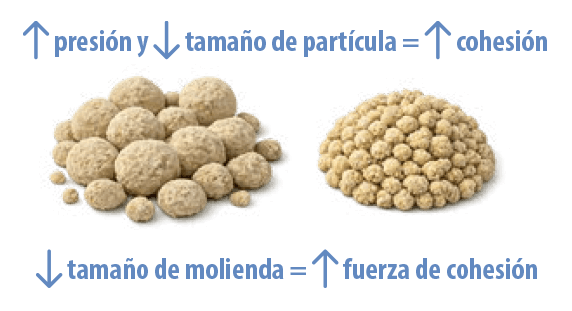
Interlocking Forces
Interlocking forces are of vital importance for granulation, as compression forces the particles to fit together, producing mechanical interlocking.
This force is directly related to the length/diameter (L/D) ratio of the die holes and, therefore, to the performance and energy consumption. The longer and narrower the path the flour must travel, the more push energy and time will be required.
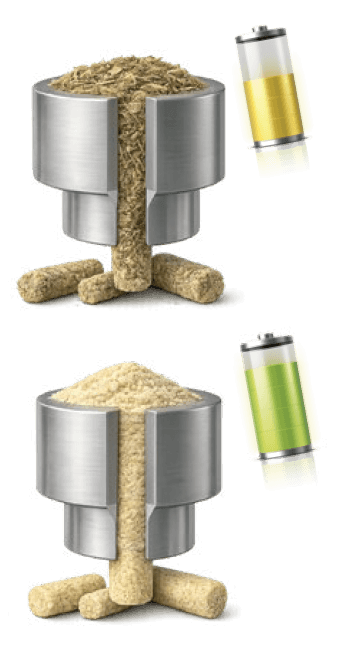 A high fiber content requires a large amount of energy to compress the flour to reach the pellet density.
In relatively dense raw materials, such as cereals or soybean meal, less energy is needed for compression. Therefore, a higher proportion of cereals favors bonding.
CHEMICAL FORCES
Adhesion Forces
The adhesion forces are based on the formation of capillary forces due to the presence of small “drops” of water between the particles. By adding liquid, a water film is formed with enough tension to hold the particles together.
The excess unbound water must be removed later during cooling, but if the cooling rate is too high, cracking may occur.
During the mixing and conditioning processes, where moisture is added, the density of the meal increases due to constant kneading. This decreases the pore size occupied by air and leads to a state of adhesion without the need to add more liquid.
| A longer homogenization and retention time of the moist meal in the conditioner provides greater adhesion. |
Moistening and water absorption capacity
Moistening refers to the ability of water to distribute evenly and penetrate into the meal mass.
All the physical properties of the feed are affected by water, so a uniform distribution of moisture is essential, and to facilitate this penetration, surface tension must be reduced.
In physics, the surface tension of water is defined as the amount of energy required to increase its surface, since water, when in contact with air or solids, tends to cluster. This tension is a manifestation of the intermolecular forces in water, known as hydrogen bonds.
Surface tension, along with the forces between water and the solid surfaces in contact, gives rise to capillarity.
As a result, water penetrates the contact area with the solid, being greater the lower the surface tension.
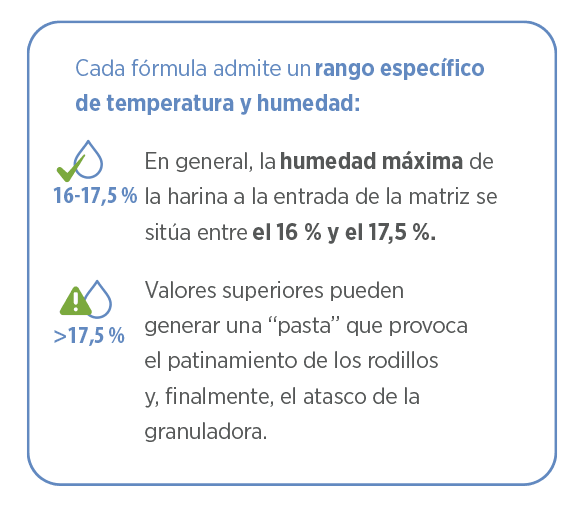
However, the maximum allowable moisture level of the flour (vapor + free water) should not be exceeded, as it can cause roller slippage and, ultimately, clogging of the pellet mill. This maximum water absorption level is called capacity.
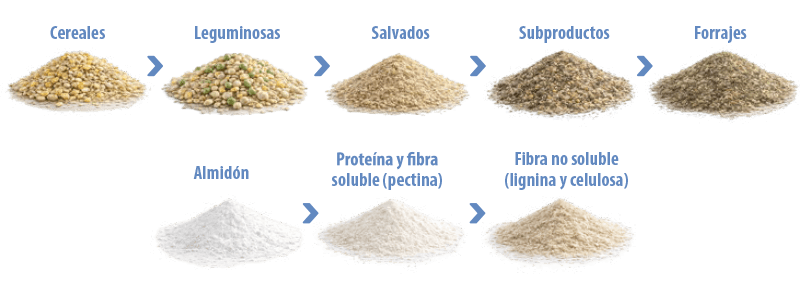
In general, this parameter is determined according to the type of raw material:
Solid bridges and agglutination
Solid bridges are mainly formed by two mechanisms:
Hardening of binders.
Crystallization of dissolved substances.
This is the most important mechanism in pellet formation, as many raw materials used have self-agglomerating capacity due to the presence of substances that act as natural adhesives.
GELATINIZED STARCH
Gelatinized starch is considered the most effective and economical binder, as it provides bonding strength and elasticity, contributing to improving pellet durability.
Pregelatinization can begin at 60 °C and with approximately 3% free water. Below are indicative values of amylose content and pregelatinization temperatures of different ingredients used in feed formulation:
 Wheat: 26% amylose; 53–65 °C
Wheat has a greater reputation as an agglomerate despite having less amylose than corn, due to other factors such as its lower oil content (1.5% in wheat versus 3.5% in corn).
Barley: 22% amylose; 56–62 °C
Corn: 28% amylose; 62–70 °C
Oats: 27% amylose; 56–62 °C
Pea: 35% amylose; 57–70 °C
OTHER BINDING AGENTS
In addition to starch, there are other components that promote the formation of solid bridges:
Soluble fiber (carboxymethylcellulose): forms liquid bridges that, when dried, generate solid bridges between particles.
Alcohols and sugars (molasses, products with lactose, lactic acid, glycerin or vinasse): crystallize when dried and act as hardened binders (caramelization).
Gums (guar and xanthan): polymers with high hygroscopic capacity and gelling ability that provide viscosity and elasticity, increasing resistance to breakage.
Solid clays (sepiolite, bentonite, calcium sulfate): they increase compression due to their swelling capacity and act as “cement” once dry.
| The addition of fat or oil before granulation is the factor that most reduces cohesion and adhesion, as it creates a hydrophobic film that prevents particle bonding and excessively lubricates the process, reducing the applied force. |
Factors affecting pellet quality
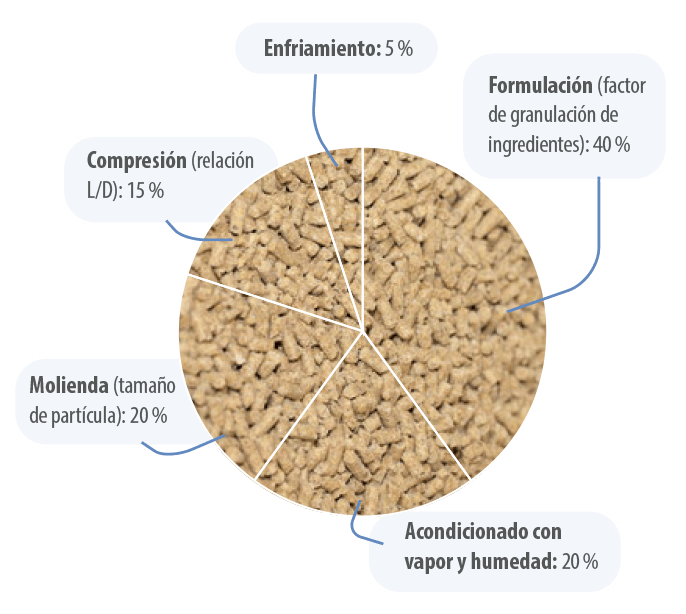
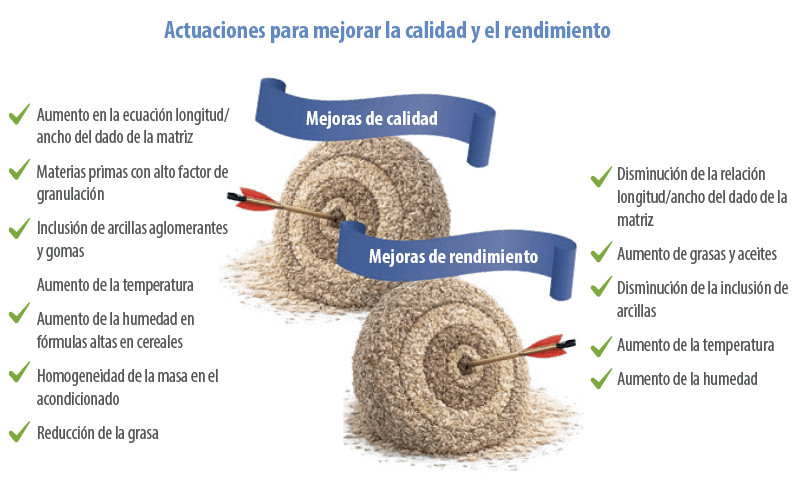
 There are three factors that most determine pellet quality:
 The conditioning of the flour.
The formulation of the feed.
The particle size after grinding.
In this regard, some authors propose the following indicative distribution of the influence of these factors on pellet quality:
COOLING-DRYING OF PELLETS: REDUCTION OF MOISTURE AND TEMPERATURE
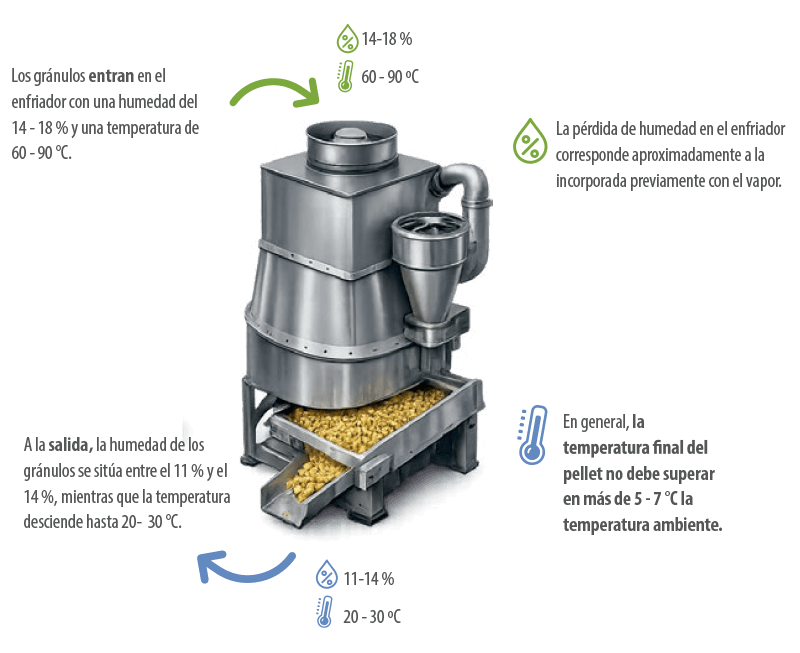
Upon exiting the die, the formed and hot pellet falls into the cooler, where its temperature is reduced to approximate ambient temperature and its moisture is decreased in order to promote its proper preservation.
PELLET QUALITY: CONTROL PARAMETERS AND FREQUENT DEFECTS
 Durability
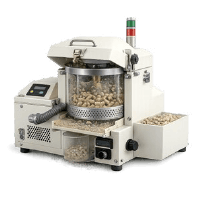
Durability is the most important parameter to evaluate, as the pellet must withstand transport and handling without breaking, generating the minimum possible percentage of fines.
In the laboratory, the journey of the pellet from the exit of the die to its arrival at the farm feeder is simulated.
 Durability is defined by the PDI expressed as a percentage. Generally, an optimal value in pelleted feed is above 90% at 90 seconds. Durability is defined by the PDI expressed as a percentage. Generally, an optimal value in pelleted feed is above 90% at 90 seconds. |
The most used system is the Holmen 100, a fast and versatile method that works with 100 g samples and allows selecting test times of 30, 60, 90, and 120 seconds. For its part, the Holmen 200 is a more modern version, incorporating weighing and automatic results.
 Hardness
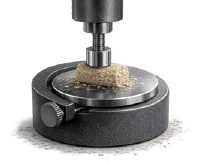
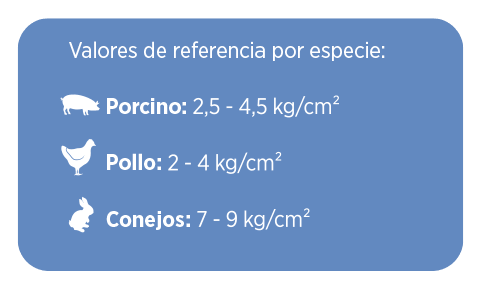
Hardness is defined as the pressure (kg/cm²) that the pellet withstands without breaking.
This parameter is measured with a durometer and is important for determining how it will withstand storage and transport, although it is not always correlated with durability.
Fines
Fines should be minimized as much as possible, as they directly affect the final quality of the pellet.
 To calculate them, a sieving of the feed using 2 to 3 mm screens is performed. In general, the result should not exceed 10%, with values between 5% and 10% considered a medium-high range.
 This percentage can vary significantly depending on the sampling point, as values of up to 8% can be found at the factory, while after transport and handling on the farm, fines usually increase due to handling.
| Therefore, beyond the value measured at the plant, what is really important is that a sufficient proportion of intact pellets is maintained in the feeder, ideally above 70%. |

 Water Activity
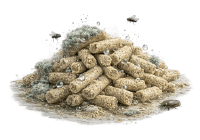
Water activity (aw) is a parameter that measures the free water that remains after cooling.
Free water is that which is not bound to nutrients or structures and can be used for fungal and bacterial growth, as well as to promote oxidations and, ultimately, the proliferation of insects. Therefore, controlling this parameter ensures feed stability and prevents its deterioration.
Although it is related to moisture, it is not exactly the same. Therefore, the manufacturer usually sets a moisture limit at the cooler outlet below which it is considered that there is no excess free water (usually 12 – 13%).
 The ideal water activity value is around 0.65 and should not exceed 0.70.
| An effective way to ensure that the pellet loses excess moisture during cooling is to maintain the temperature difference pellet/ambient below 5 °C (maximum 10 °C) at the equipment outlet. |
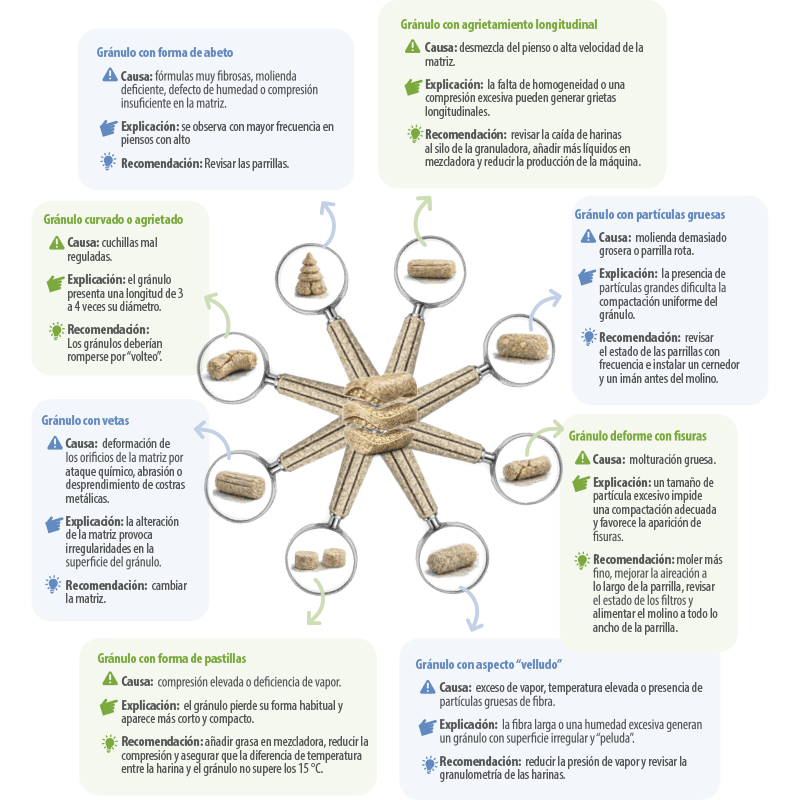
PELLET SHAPE: COMMON DEFECTS AND CAUSES
The shape and appearance of the pellet can provide very valuable information about the operation of the pelleting process.
Defects such as cracks, deformations, or irregular textures are often related to imbalances in conditioning, grinding, moisture, or compression in the matrix.
| Identifying these signs in time allows for quick correction of the problem and prevents quality losses, increase of fines, or production issues. Below are the most common defects and their possible causes. |
The current trend points to an increasing production of pelleted feed, which requires formulating diets specifically designed to be pelletable. However, not all factories apply the pelleting process in the same way, so the results can vary significantly.
 Raw materials evolve throughout the year and their pelleting capacity or potential can change, making it necessary to adjust the process and formulation according to their characteristics.