


 Latinoamérica
 Europa
Reconsidering Restricted Feeding in Lactating Calves



 Ronda de Pte., 9 - Tres Cantos Madrid 28760
  +(34) 918075420 // 900 101 954
Feeding in lactating calves – Recent scientific research on metabolic programming is driving new approaches in calf nutrition, allowing farmers to optimize early development to improve future productivity. 
The restriction of milk supply in calves during their lactation stage has long been considered a rational strategy on dairy farms worldwide.
 The logic seemed sound: limiting milk intake reduces rearing costs, stimulates earlier intake of solid feed, and encourages rumen development.
 Over time, restricted feeding became a common practice, rarely questioned and widely implemented.
Scientific research is now questioning this entrenched belief. There is increasing evidence suggesting that restricting nutrition during the early stages of life can compromise the welfare of calves, suppress their growth potential, and ultimately increase replacement pressure in the herd.
 What once seemed economically efficient is increasingly revealed as a biological and costly limitation in the long term.
EARLY STAGE NUTRITION: SCIENCE-BASED FEEDING FOR A STRONGER START
The first weeks of life represent a critical biological window during which organs, immune function, and the gastrointestinal system develop rapidly.
 Nutrition during this period determines long-term physiology through metabolic programming, influencing how animals grow, utilize nutrients, and respond to metabolic demands later on.
Calves exposed to restriction during this critical period develop an “austere” metabolism that prioritizes survival over intake capacity and resilience, a disadvantage in dairy systems that demand high sustained productivity.
 Modern scientific approaches translate this research into practical strategies that promote rumen development, intake capacity, and metabolic resilience.
QUESTIONING THE LOGIC OF RESTRICTED FEEDING
Calves will consume around 700 liters of milk in the first 3 months of life, but restricted practices (250 liters) are common. Research has directly questioned these assumptions.
Calves with larger volumes weighed significantly more at weaning and 9 kg more at 3 months. A higher intake did not affect rumen development; metabolomic analyses revealed a more advanced protein and energy metabolism.
The benefits extend beyond the rearing phase. A meta-analysis of 12 trials shows that each additional kilogram of average daily gain before weaning is associated with approximately 1,550 kg more milk in the first lactation.

A REVOLUTIONARY FINDING: CALVES FED WITH HIGHER LEVELS OF MILK STAY LONGER IN THE HERD
The long-term LifeStart study showed similar results. At the end of two lactations, cows fed higher levels of milk when they were calves produced 1,500 kg more fat- and protein-corrected milk than restricted calves (13,500 vs. 11,000 kg), with a higher amount of corrected milk (24.0 vs. 19.8 kg FPCM/day).
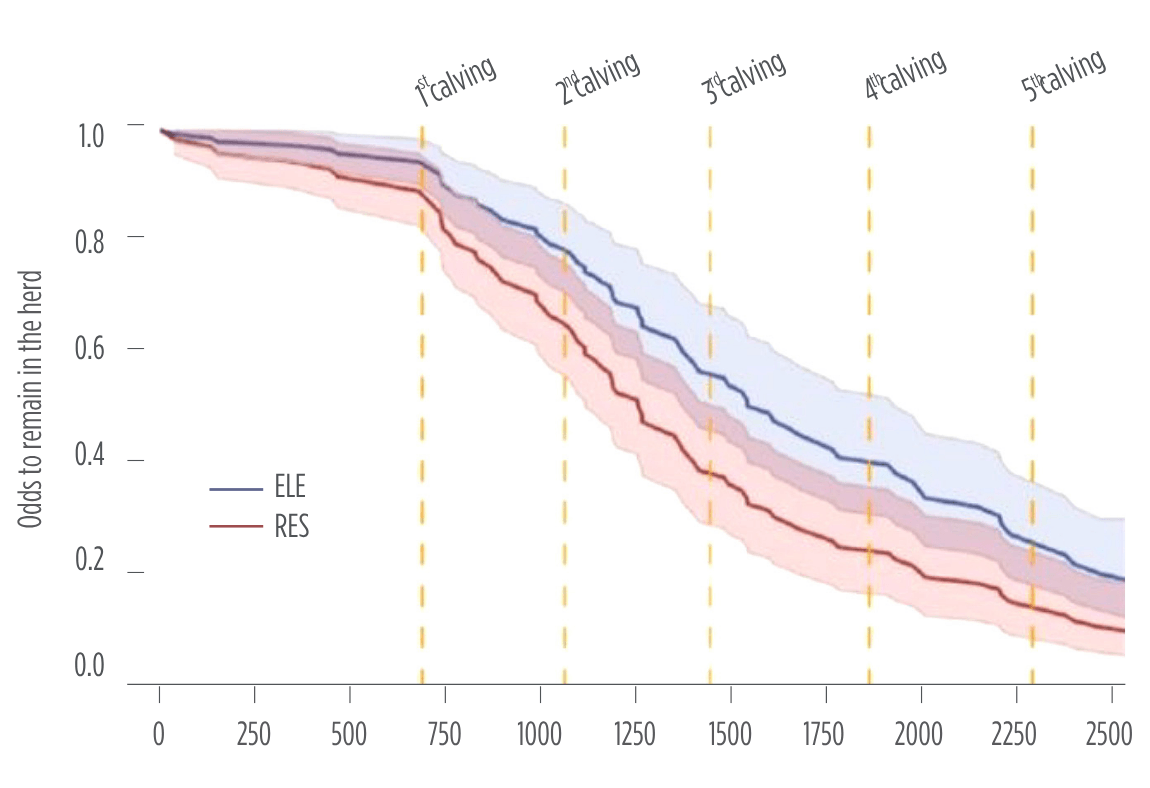
Figure 1: Probability of cows remaining in the herd and thus avoiding culling, in relation to the days from birth for cows fed with LifeStart (blue line) or with a restricted amount (red line) of nutrient intake before weaning. The hazard ratios (HR) were 0.46 (95% CI = 0.09-2.45, P = 0.36), 0.40 (95% CI = 0.15-1.07, P = 0.07), 0.49 (95% CI = 0.24-1.00, P = 0.05), 0.44 (95% CI = 0.22-0.86, P = 0.02) and 0.46 (95% CI = 0.24-0.87, P = 0.02) for surviving until the first, second, third, fourth, and fifth calving, respectively. The vertical dashed lines represent the average ages at calving. The solid lines are LSM, and the shaded areas represent the S
These cows were also significantly less likely to be culled, with approximately double the likelihood of reaching the third calving and an increasing survival advantage in the fourth and fifth calving, despite having a similar body weight at the first calving.  |

BEYOND VOLUME: RESTORING ENERGY AND FAT LEVELS
The science of LifeStart shows that composition is as important as intake.
 Cow’s milk contains approximately 30% fat in dry matter, a biologically suitable energy source.
 Traditional milk replacers have lower fat and higher lactose, reflecting historical concerns about fat accumulation and mammary development.
Dietary fat supports intestinal health, organ development, immune function, and metabolic stability. Calves with insufficient fat content are three times more likely to die before weaning. 
Replacing lactose with fats improves fecal consistency, intestinal integrity, and overall health, while maintaining growth performance.  |
SIGNS OF NATURE: THE IMPORTANCE OF INDIVIDUAL FATTY ACIDS
The milk fat contains more than 400 fatty acids, including butyric acid (C4:0), synthesized exclusively in the mammary gland.
C4:0 promotes intestinal maturation, strengthens the intestinal barrier, and signals rumen development, preparing calves for the transition to solid feeding.
Restoring natural levels of C4:0 through a spray-dried concentrate brings milk replacers closer to whole milk, improving starter feed intake at weaning and overall health.  |

FROM SCIENCE TO PRACTICE: APPLICATIONS IN MODERN NUTRITION
This scientific knowledge is being applied in the development of next-generation milk replacers designed to align calf nutrition with their natural biological needs.
Modern products aim to:
Restore fat levels close to those found in cow’s milk
Provide fatty acid profiles that include naturally effective sources of C4:0.
By aligning both nutrient supply and biological signals with nature, these approaches favor early gut development, metabolic stability, and healthy growth during the critical pre-weaning period.
 An example of this practical application is Sprayfo Ultimo, which incorporates these scientific principles into a commercial formulation that allows farmers to apply a calf-centered approach without increasing management complexity.
A MINDSET SHIFT FOR MODERN DAIRY SYSTEMS
As dairy systems face increasing pressure to improve efficiency, welfare, and sustainability, early-life nutrition has become a powerful lever for change.
Nutrition provides quantifiable benefits in terms of growth, longevity, and productivity throughout life.
 When calves are no longer restricted and start to be cared for, not only are better calves raised, but better cows are built, stronger herds are developed, and a more sustainable future for farming is created.