


 Latinoamérica
 Europa
Use of Hypochlorous Acid in Dairy Cattle Farms: Applications, Benefits, and Biosecurity Strategies



 Polígono Sur I Nave 9, Ctra. de Juneda a Torregrossa Juneda 25430
  + 34 973 151 158
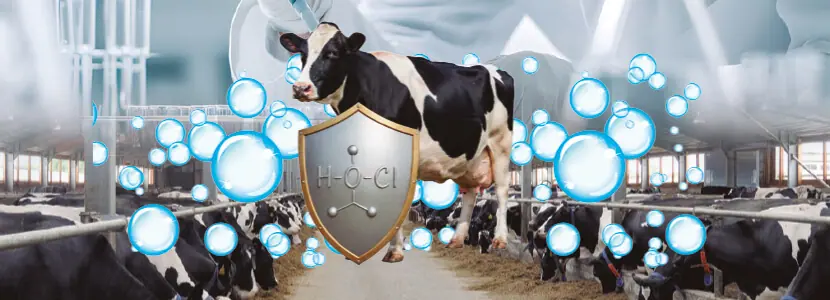
| In the context of modern dairy production, maintaining high standards of biosecurity, hygiene, and milk quality is an absolute priority.
|
 The cleaning and disinfection programs in dairy farms have evolved significantly in recent decades, incorporating more effective, sustainable, and safe products for both livestock and people.
Among the most prominent disinfectant solutions, hypochlorous acid (HOCl) has gained ground in recent years for its:

This article analyzes in depth what hypochlorous acid is, how it is used in dairy cattle farms, and what its operational, health, and environmental benefits are.
WHAT IS HYPOCHLOROUS ACID?
Hypochlorous acid is a mild oxidizing compound that is naturally formed when chlorine dissolves in water.
 Chemically, it is the undissociated form of hypochlorite and has the formula HOCl.
In nature, hypochlorous acid is produced by the white blood cells of mammals as part of the immune system to eliminate pathogens.
 This same principle is technologically harnessed to generate a potent and safe antimicrobial solution, generally through electrolysis of saline water.
The basic reaction consists of:
NaCl + H2 O → HOCl + NaOH
 The result is an aqueous solution with controlled pH, rich in HOCl, which has a high disinfectant capacity with a relatively low concentration of active chlorine. The result is an aqueous solution with controlled pH, rich in HOCl, which has a high disinfectant capacity with a relatively low concentration of active chlorine. |
MECHANISM OF ACTION
Hypochlorous acid acts on bacteria, viruses, fungi, spores, and biofilms through direct oxidation.
Unlike traditional sodium hypochlorite, HOCl is electrically neutral, allowing it to penetrate more easily into the cell membranes of microorganisms.
| Once inside, it denatures proteins, disrupts essential enzymes, and destroys cellular structures, leading to the rapid death of the pathogen. Its broad spectrum makes it effective against organisms such as:
|
 Escherichia coli
  Additionally, HOCl does not generate known resistances and its degradation is rapid and clean, transforming into water and traces of salt.
 APPLICATIONS OF HYPOCHLOROUS ACID IN DAIRY CATTLE FARMS
One of the most important advantages of this disinfectant is its versatility.
 In a dairy cattle farm, HOCl can be applied at multiple critical control points, reinforcing biosecurity, improving hygiene, and reducing the use of more aggressive chemicals.
Water treatment and disinfection 
Water is a key vector for the transmission of diseases and milk contamination. HOCl can be applied in:
 Its efficacy is high even at low concentrations (0.5–5 ppm) and does not alter the taste of the water or affect the animals’ intake. Its efficacy is high even at low concentrations (0.5–5 ppm) and does not alter the taste of the water or affect the animals’ intake. |
Cleaning and disinfection of facilities 
Hypochlorous acid can be sprayed or applied on surfaces of:
 Being a non-corrosive solution at recommended concentrations, it can be applied with nebulizers, disinfection arches, spray backpacks, or automatic systems, allowing frequent disinfection without material deterioration.
Udder hygiene: pre- and post-dippingOne of the most strategic uses of hypochlorous acid in dairy production is its direct application on the udder before and after milking: Pre-dipping: rapid elimination of microorganisms present on the skin and teats before attaching the teat cup.
Post-dipping: disinfection after milking to protect the teat canal when it is more exposed to infections.
|
 Helps prevent contagious mastitis and maintain a low somatic cell count in the tank.
|
HOCl does not irritate the skin of the animals and, in many cases, improves their skin condition as it does not contain harsh alcohols or iodine.
|
 Additionally, its rapid action and lack of residues make it an excellent alternative to conventional products.
Disinfection of vehicles, boots, and work equipment 
Biosecurity not only depends on the internal hygiene of the farm. Entry points are critical:
 The use of HOCl allows for control of external pathogens without risks to the environment or to the operating personnel. The use of HOCl allows for control of external pathogens without risks to the environment or to the operating personnel. |
Environmental nebulization and odor control 
Thanks to its safety, hypochlorous acid can be used for environmental nebulization in enclosed areas such as milking parlors, calving pens, warehouses, or transit areas. It helps to:
| Unlike other disinfectants, it does not require evacuation of animals or long safety times. |
BENEFITS OF HYPOCHLOROUS ACID IN DAIRY PRODUCTION
The adoption of HOCl in dairy cattle farms provides multiple operational and health advantages:
High disinfectant efficacy
Safety for animals and people
Sustainability and environment
Economy and efficiency
RECOMMENDED USAGE PARAMETERS
Guideline concentrations according to application:
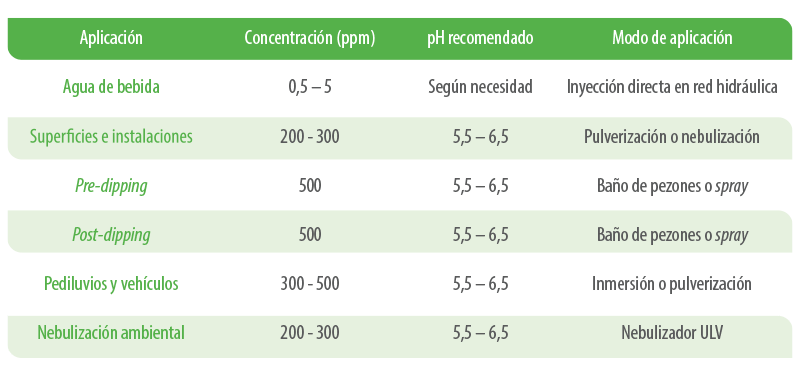
 It is essential to maintain the pH at slightly acidic values to maximize the proportion of HOCl compared to the hypochlorite ion (OCl–), as the former is 80 to 100 times more effective as a disinfectant. It is essential to maintain the pH at slightly acidic values to maximize the proportion of HOCl compared to the hypochlorite ion (OCl–), as the former is 80 to 100 times more effective as a disinfectant. |
IN SITU PRODUCTION VIA ELECTROLYSIS 
One of the reasons why hypochlorous acid is gaining prominence in the agricultural sector is that it can be generated on the farm from water, salt, and electricity. This allows:
 Electrolytic equipment is designed to produce volumes adapted to the size of the farm, ensuring traceability and safety. Electrolytic equipment is designed to produce volumes adapted to the size of the farm, ensuring traceability and safety. |
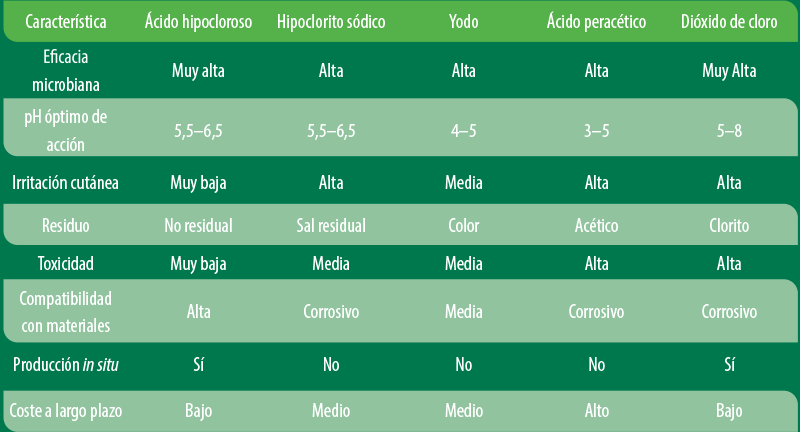
COMPARISON WITH OTHER COMMON DISINFECTANTS
HOCl is less corrosive, safer, and more sustainable than traditional products like sodium hypochlorite, iodine, or peracetic acid:
PRACTICAL CASES AND FIELD EXPERIENCES
Various dairy farms in Europe and America have incorporated hypochlorous acid systems into their hygiene programs. The most frequent results include:

 Reduction of total bacterial count in water and surfaces.
Decrease in clinical cases of bovine mastitis and reduced use of antibiotics.
Improvement in the hygienic-sanitary quality of milk (lower SCC and TBC).
Greater animal welfare due to reduced skin irritations.
Economic savings compared to traditional chemical products.
 Additionally, its use has allowed for increased disinfection frequency without increasing risks or operational costs. Additionally, its use has allowed for increased disinfection frequency without increasing risks or operational costs. |
TECHNICAL AND REGULATORY CONSIDERATIONS
To ensure correct use of HOCl on the farm, it is necessary to:
 In the European Union, hypochlorous acid is registered as a biocide for veterinary hygiene and water treatment, and its use must comply with the national and European authorizations in force. In the European Union, hypochlorous acid is registered as a biocide for veterinary hygiene and water treatment, and its use must comply with the national and European authorizations in force. |
IMPACT ON SUSTAINABILITY AND CONSUMER PERCEPTION
The dairy market is increasingly oriented towards responsible and sustainable production. Consumers value not only the quality of milk, but also the environmental and animal welfare practices of the farms.
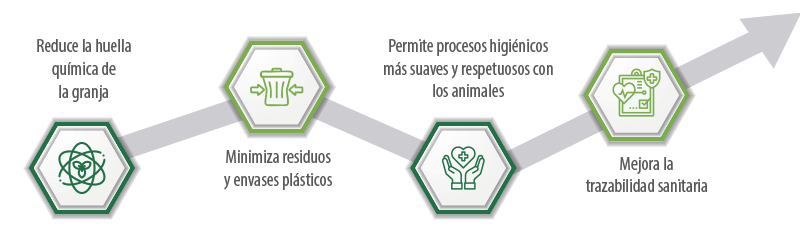
| These factors can become a differentiating element and contribute to sustainability certifications, animal welfare, and organic production, as long as the corresponding regulations are met. |
CONCLUSIONS
Hypochlorous acid represents a modern, effective, and safe alternative to improve biosecurity and hygiene on dairy cattle farms.
Its broad antimicrobial spectrum, low toxicity, sustainability, and versatility make it a key tool for:
The integration of HOCl into well-designed hygiene programs, along with good management practices and animal welfare, can significantly contribute to the profitability and sustainability of modern dairy farms.
Read more about Raesgra & Biojuneda