


 Latinoamérica
 Europa
Comprehensive Biosecurity Strategies for the Prevention and Control of Foot-and-Mouth Disease










The Foot and Mouth Disease (FMD), known internationally as Foot and Mouth Disease (FMD), represents one of the most pressing and economically damaging health challenges for the livestock sector on a global scale.
 This viral disease, characterized by its extremely high contagiousness, primarily affects cloven-hoofed ungulates (biungulates), including species of fundamental zootechnical and economic importance such as cattle, pigs, sheep, and goats.
Although FMD does not constitute a significant risk to human public health –with infections in people being extremely rare and mild–, its consequences for the agricultural industry are catastrophic, resulting in huge economic losses and profound disruptions of the social and commercial fabric.
 Given the almost explosive spread capacity of the virus and the drastic international trade restrictions imposed by the detection of the disease, PREVENTION emerges not as just another strategic option, but as the cornerstone and imperative necessity to safeguard animal health and the economic viability of the sector.
 This article aims to unravel the intrinsic complexity of Foot-and-Mouth Disease, addressing its etiological and clinical nature, uncovering the multiple and efficient ways through which the virus spreads, quantifying the socioeconomic impact that an outbreak entails, and outlining the rigorous and multifaceted biosecurity strategies that constitute the first and most robust line of defense to prevent the entry of the pathogen into farms and free territories, as well as to control and mitigate its spread in case of incursion.
We will analyze with particular attention:
 The vectors involved in viral transmission and the essential preventive measures to control each of them.
The action protocols that must be implemented immediately and in a coordinated manner during the event of an outbreak.
The disinfection tools available in the health arsenal, highlighting the relevance and comparative advantages of innovative formulations such as powdered disinfectants for specific and strategic applications in the context of biosecurity.
 Biosecurity cannot be understood as a mere compendium of isolated measures, but as an integral, strategic, and multilevel approach, representing the non-negotiable axis on which all health policies and productive practices aimed at effective risk management of Foot-and-Mouth Disease for global livestock must pivot. Biosecurity cannot be understood as a mere compendium of isolated measures, but as an integral, strategic, and multilevel approach, representing the non-negotiable axis on which all health policies and productive practices aimed at effective risk management of Foot-and-Mouth Disease for global livestock must pivot. |

UNDERSTANDING THE THREAT: NATURE AND PRESENTATION OF FOOT-AND-MOUTH DISEASE
 Etiological characteristics of the Foot-and-Mouth Disease virus
Foot-and-Mouth Disease is a viral disease caused by a virus of the genus Aphthovirus, belonging to the Picornaviridae family.
The epidemiological complexity of the FMD virus is accentuated by the existence of seven distinct serotypes of the virus: A, O, C, SAT 1, SAT 2, SAT 3, and Asia 1.
The antigenic diversity of this virus implies that the immunity developed after infection by a specific serotype does not confer significant cross-protection against the other serotypes.
This particularity hinders the design and implementation of universal vaccination programs and underscores the critical need for constant epidemiological surveillance to identify circulating serotypes and viral strains, thus allowing the selection and use of homologous vaccines in case of emergency vaccination.
 Clinical presentation of Foot-and-Mouth Disease
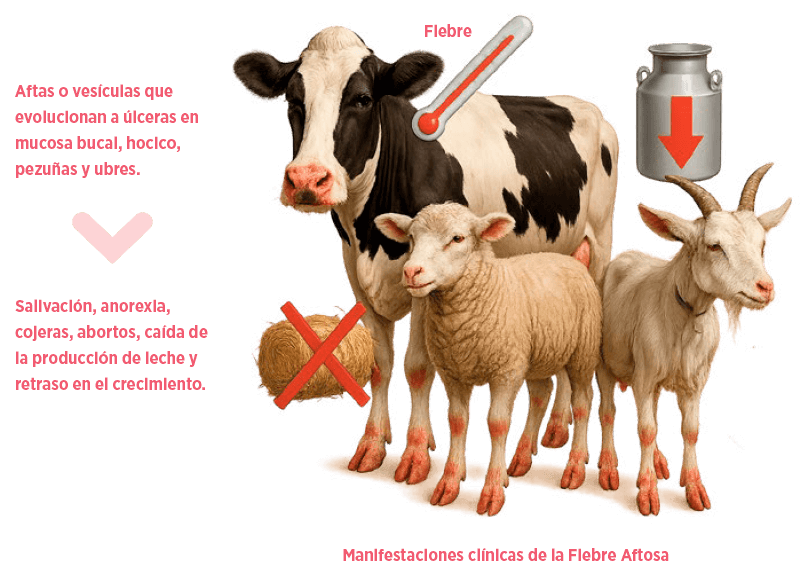
The clinical signs that define Foot-and-Mouth Disease are, in many cases, pathognomonic and reflect the virus’s tropism for epithelial tissues.
The disease typically begins with an acute febrile syndrome, followed by the appearance of vesicles or aphthae.
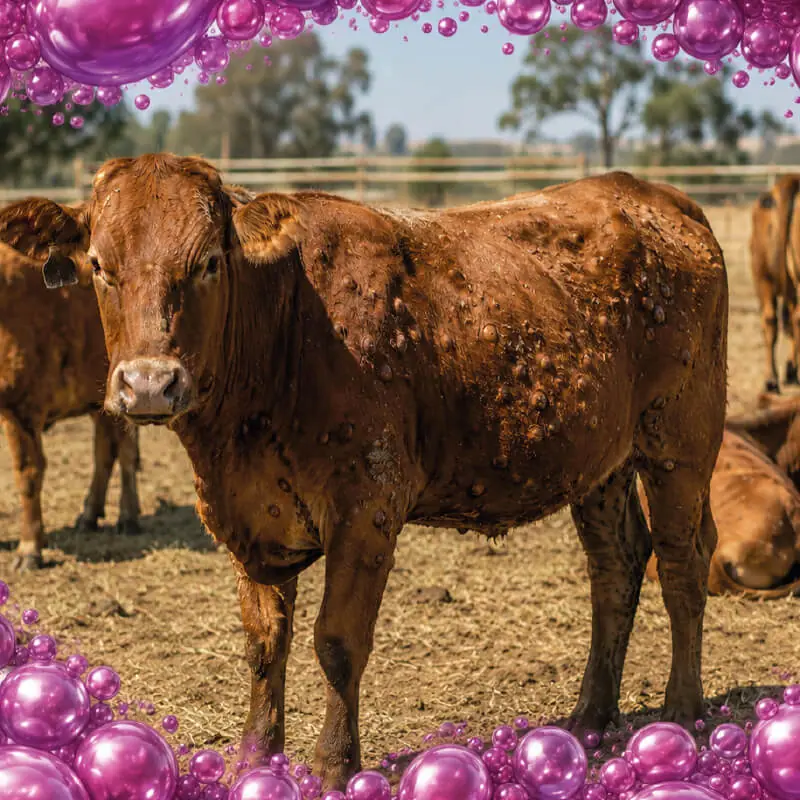
| These lesions, which cause intense pain and considerable discomfort, are preferably located in the oral mucosa (tongue, gums, palate), the snout or muzzle, the interdigital space, and the coronary bands of the hooves.
|
Other cardinal symptoms of the disease include:
Profuse and foamy salivation (sialorrhea), often hanging from the mouth (“drooling”).
Marked lameness and reluctance to move, a direct consequence of the pain caused by hoof lesions.
Drastic reduction or total cessation of appetite (anorexia).
Abrupt drop in milk production and growth rates.
| The disease can cause abortions in pregnant females. Although mortality in adult animals is generally low –except for secondary complications or the impact of sanitary slaughter–, in young animals, particularly piglets and lambs, Foot-and-Mouth Disease can manifest as a severe acute myocarditis, often fatal, which can occur without the presence of typical external vesicles, complicating early diagnosis in these populations. |
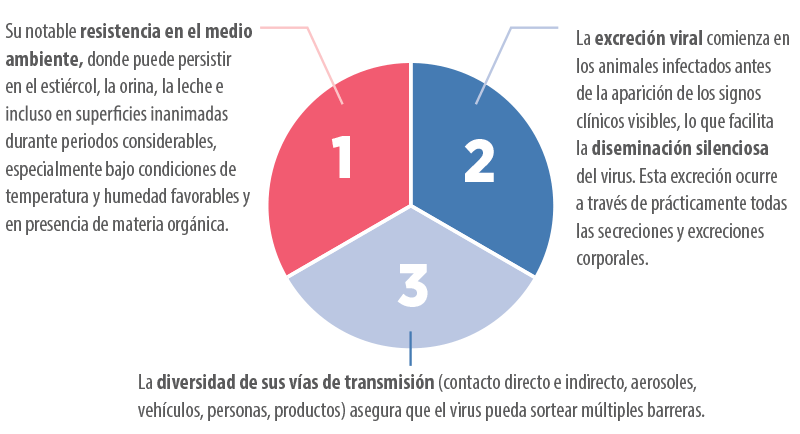
The extremely rapid spread capability of the FMD virus is due to a combination of key factors, such as:
THE DEVASTATING SOCIOECONOMIC IMPACT OF A FOOT-AND-MOUTH DISEASE OUTBREAK
The repercussions of a Foot-and-Mouth Disease outbreak far exceed the direct losses of animals, devastatingly affecting the national and regional economy, as well as the social fabric of farming communities.
The costs and consequences manifest in various dimensions:
Paralyzing trade restrictions
The confirmation of the virus’s presence in a country leads to the immediate imposition of severe restrictions or bans on the export of susceptible live animals, fresh meat, dairy products without adequate heat treatment, and other animal products by importing countries that enjoy FMD-free status.
 These trade barriers, which can last months or even years, result in massive economic losses for exporting industries and can destabilize entire markets.
Exorbitant costs for eradication and subsequent control
The control and eradication strategies for an FMD outbreak are extraordinarily costly and include the direct expenses of:
 Intensified epidemiological surveillance.
Diagnosis
Mass sanitary culling of infected and contact animals.
Safe management and disposal of carcasses.
Thorough cleaning and disinfection of facilities and surroundings.
Possible purchase and application of vaccines in emergency vaccination programs.
| Historical outbreaks have shown that these costs can amount to billions of euros. |
Significant production losses
The disease causes a drastic drop in milk and meat production, a reduction in growth rates, fertility problems, and an increase in mortality (direct in young animals or due to culling), resulting in significant economic losses for farmers, even if the animals do not die directly from the disease.
Profound social and psychological impact
FA outbreaks generate immense stress on farmers and their families.
Economic uncertainty, disruption of their livelihoods, and the emotional trauma associated with the culling of their animals can have devastating consequences for mental health of individuals and disrupt entire rural communities that depend on farming.
Possible costs for the consumer
Although less direct, the reduction in the supply of livestock products caused by production and movement restrictions can, in some cases, lead to increases in consumer prices.
The magnitude of these potential losses underscores the economic rationality and the imperative of proactively investing in preventive biosecurity measures. The cost of implementing and maintaining strict biosecurity protocols is considerably lower than the costs associated with managing a declared outbreak.
 Investing in Biosecurity today is not an expense, it is the best policy for peace of mind tomorrow! Investing in Biosecurity today is not an expense, it is the best policy for peace of mind tomorrow! |
BIOSECURITY AS A CENTRAL AXIS: TRANSMISSION VECTORS AND PREVENTIVE MEASURES
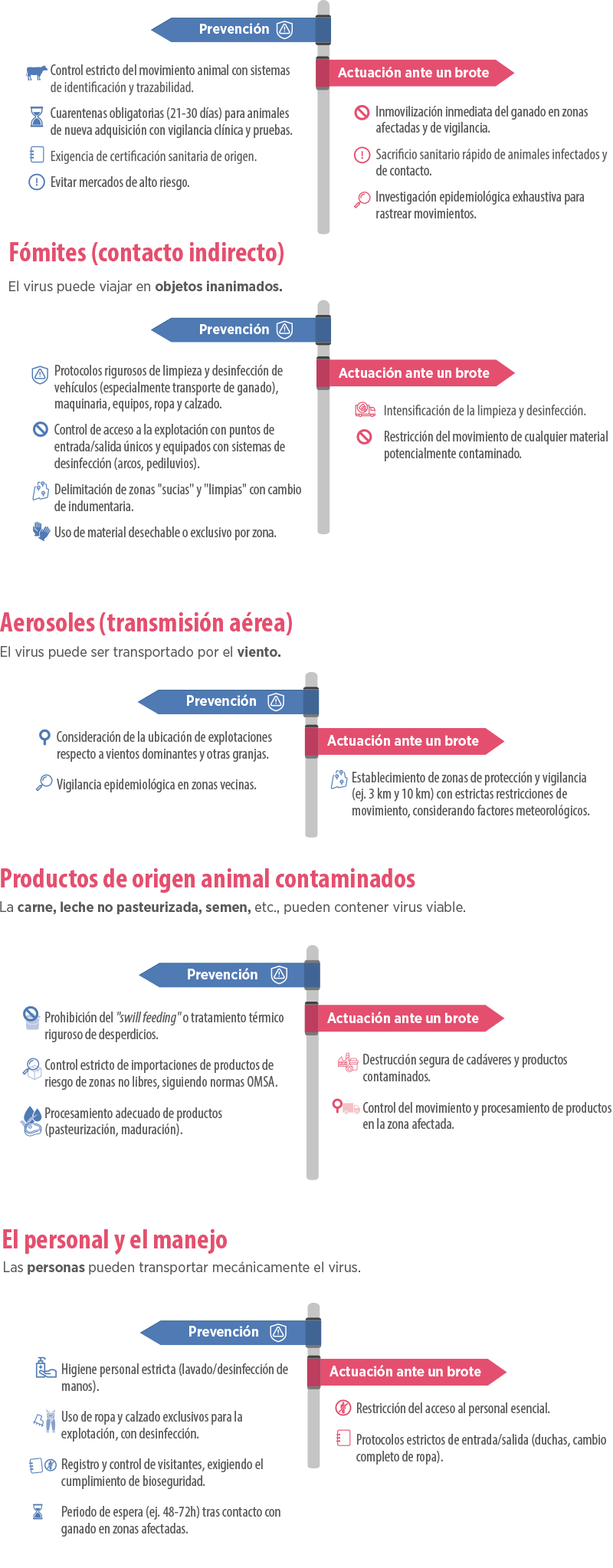
An effective defense against Foot-and-Mouth Disease is based on a detailed knowledge and rigorous control of all possible entry routes of the virus into a farm or disease-free area and, once inside, its spread.
 In this context, biosecurity involves a set of planned and managed measures to reduce the risk of introduction and spread of infectious agents.
The main transmission vectors of the Foot-and-Mouth Disease virus and the specific biosecurity strategies to counteract them are:
Movement of infected animals (direct contact)
The introduction of virus-carrying animals is the most efficient transmission route.
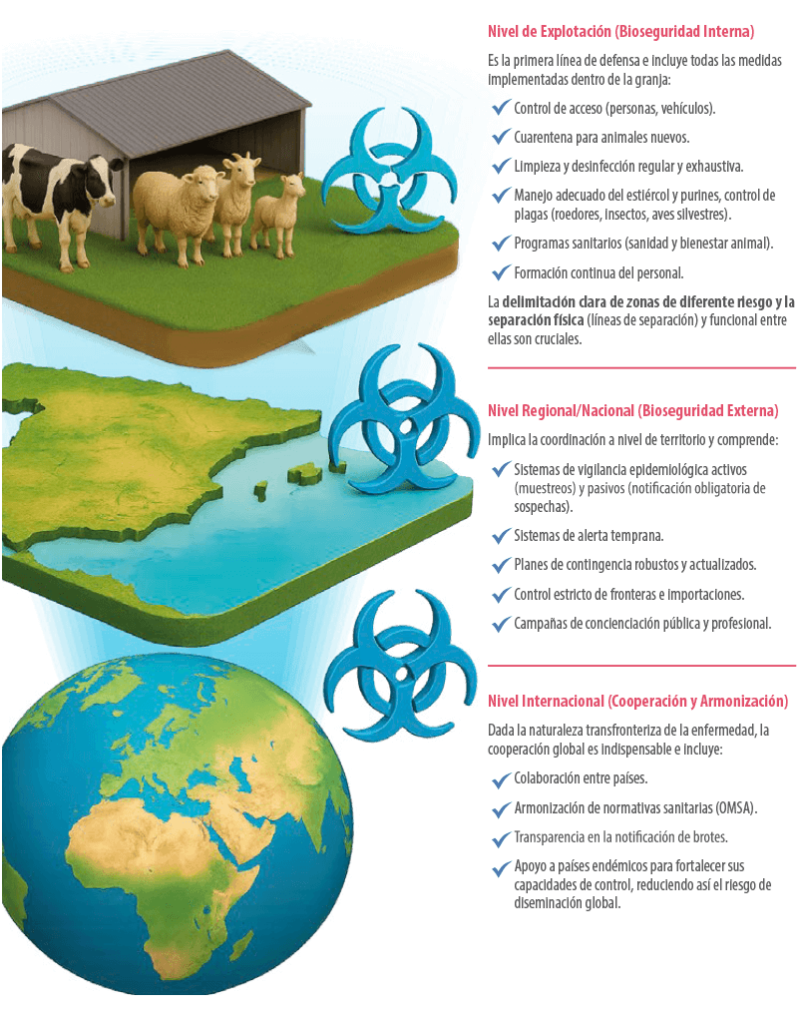
BIOSECURITY: A STRATEGIC AND MULTILEVEL APPROACH
Effective biosecurity against Foot-and-Mouth Disease requires an integrated approach that operates at different levels of responsibility and action:
DISINFECTION: A CRITICAL TOOL IN BIOSECURITY
Disinfection is an irreplaceable component of any biosecurity program against Foot-and-Mouth Disease.
 Its objective is to inactivate the virus present on surfaces, equipment, and facilities.
The FMD virus is relatively resistant in the environment, especially protected by organic matter, but it is sensitive to extreme pH levels (<6.0 or >11).
The choice of disinfectant should be based on:
 Its efficacy against the virus.
The surface to be treated.
The presence of organic matter.
The temperature.
The contact time.
The safety.
Below is a comparative table of different types of disinfectants:
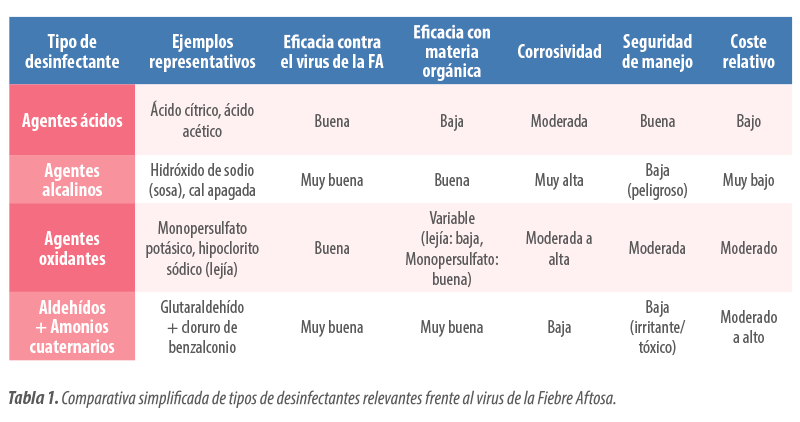
It is essential to emphasize that the effectiveness of any disinfectant is drastically reduced if surfaces have not been thoroughly cleaned beforehand.
Organic matter protects the virus and can inactivate the active ingredients of many disinfectants. Therefore, pre-cleaning (physical removal of dirt, washing with detergent, and rinsing) is an indispensable step before disinfection whenever the surface, environment, or facility allows it.
THE STRATEGIC ADVANTAGE OF POWDER DISINFECTANTS
Within the range of disinfection tools, powder formulations for dry application (dusting) offer complementary advantages, especially in the context of biosecurity against FMD:
 Persistence and prolonged action: they remain active on surfaces longer than liquids, reacting with environmental moisture or direct contact (saliva, urine), making them ideal for dry areas or those with intermittent humidity (corridors, entrances, bedding material).
 Application in hard-to-reach areas: their format, especially in micronized powders, allows treating porous or irregular surfaces (dirt floors, straw/sawdust bedding) where liquids do not penetrate effectively.
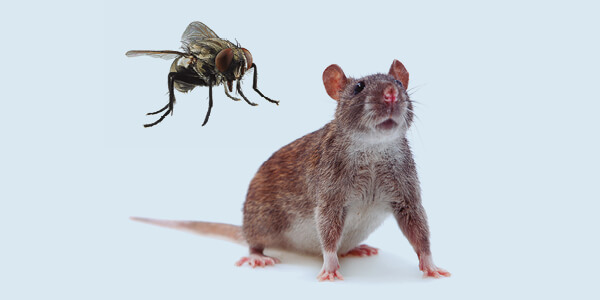
Moisture control: some act as absorbents, helping to create a drier and less favorable environment for pathogens, especially insects and their larvae (flies, mosquitoes, etc.).
Ease and speed of application: dusting is a quick and simple method over large areas or where moisture addition is not desired.
Use in critical points: they are useful for creating dry sanitary barriers (dry footbaths) or for application in high animal traffic areas.
Lower risk of freezing: they do not freeze at low temperatures, unlike liquid disinfectants.
| Powder disinfectants are, therefore, a valuable complement to maintain disinfectant barriers, as well as active and durable insecticides in strategic points of the farm, reinforcing biosecurity. |

BIOSECURITY FOR GRAZING LIVESTOCK: SPECIFIC GUIDELINES
The production of grazing livestock presents unique challenges for biosecurity, given the greater interaction with the environment and wildlife.
The specific protocol for grazing livestock emphasizes the need for a strict, clear, concise, and well-managed biosecurity plan, focused on prevention and on the continuity and viability of the business.
This protocol includes key aspects such as:
Management and written plan
Designation of a biosecurity guarantor and the development of a written plan that includes facility maps, separation lines, controlled access points, as well as cleaning and disinfection (C+D) stations.
Staff training
Documented annual training for all staff, visitors, and service providers on biosecurity protocols.
Protection of livestock and separation lines
Establishment and clear demarcation of these lines to separate areas with susceptible animals from external zones.
Strict control of access points through the use of perimeter fencing with points for L+D.
Designation of external parking areas.
Maximize distance from susceptible livestock of neighboring properties.
Vehicles and equipment
Mandatory cleaning and disinfection of vehicles and equipment crossing the separation line, through disinfection arches.
Maintenance of movement records.
Plans for deliveries that minimize risk.
Cleaning and disinfection of livestock transport vehicles (empty).
Avoid full transport vehicles crossing the separation line (use specific loading/unloading zone by stages).
Personnel
Shower and use clean and exclusive clothing/footwear when entering areas with livestock.
Visitor registration.
Biosecure entry/exit procedures in the fenced area (dedicated or disposable clothing/footwear, footwear disinfection).
Animal movement
Entry of animals only from certified health origin and without evidence of FMD.
Recommendation of prior isolation before movement (at least 7 days).
Detailed movement records.
Communication of biosecurity protocols to sources/destinations and transporters.
Contingency plan for movement interruptions.
Safe management of loading/unloading areas.
Animal product movement
Semen and embryos from sources with clearly documented biosecurity protocols and free of FMD, transported in containers that can be disinfected.
Disposal of carcasses
Biosecurity protocols for disposal (preferably incineration) complying with regulations.
Carcass collection vehicles must not cross the separation line.
Manure management
Storage and disposal to prevent exposure of susceptible livestock.
C+D of external manure vehicles/equipment before crossing the separation line.
Control of wildlife, rodents, and other animals
Measures to minimize interaction (cleaning, clearing and weed control, physical exclusion, etc.) that may act as vectors.
Feeding
Feed delivery trucks crossing the separation line must be properly cleaned and disinfected.
Secure feed storage to limit pest access.
Immediate cleaning of spills.
| These guidelines adapt the general principles of biosecurity to the particularities of grazing, recognizing the importance of controlling movements, interaction with the environment, and the need for planning for business continuity. |
FOOT-AND-MOUTH DISEASE IN THE EUROPEAN UNION: CONSTANT SURVEILLANCE AND COORDINATED RESPONSE
The European Union has achieved and maintains a status of “Foot-and-Mouth Disease Free without vaccination” in most of its Member States, a significant health and commercial achievement. This has been accomplished through:
Non-preventive vaccination policy: favors rapid detection of viral circulation.
Strict epidemiological surveillance: continuous monitoring systems for early detection.
Robust contingency plans: detailed plans in each Member State (based on EU Directives) for immediate response (zoning, immobilization, sanitary slaughter, cleaning/disinfection, possible emergency vaccination).
Rigorous import control: strict standards for animals and risk products from non-free countries.
Antigen and vaccine banks: strategic reserves for rapid production of emergency vaccines.
The general policy is common, but the differences between countries (livestock density, resources, geography, borders) influence the risk and response.
The rapid eradication and biosecurity strategy is shared and coordinated, with emergency vaccination as a complementary tool.
However, the recent outbreaks of 2025 in Germany, Hungary, and Slovakia underline that, despite the measures, the risk of introduction persists and demands unwavering surveillance and biosecurity.

CONCLUSION: BIOSECURITY IS A CORNERSTONE FOR PREVENTION
Foot-and-mouth disease remains one of the most significant threats to global livestock farming.
Maintaining the disease-free status and minimizing the impact of potential outbreaks critically depend on constant surveillance and rigorous implementation of biosecurity measures at all levels.
Thoroughly understanding the transmission vectors and applying specific solutions, from proper cleaning and disinfection (considering tools like powdered disinfectants for strategic applications) to the biosecure management of movements and people, is essential.
Preventing FMD is a shared responsibility!
Farmers, veterinarians, biosecurity technicians, transporters, industry, and administrations must work together.
A proactive approach, science-based and focused on biosecurity, is the only effective way to protect the livestock sector, the rural economy, and food security.
The investment in prevention today is the best guarantee for a safe, sustainable, and prosperous farming future, mitigating the devastating impact that Foot-and-Mouth Disease can generate.
You may be interested in: Comprehensive Biosecurity Strategies for the Prevention and Control of Foot-and-Mouth Disease with David García