


 Latinoamérica
 Europa
Continuous Temperature Monitoring in Cows: Key to Tackling Heat Stress










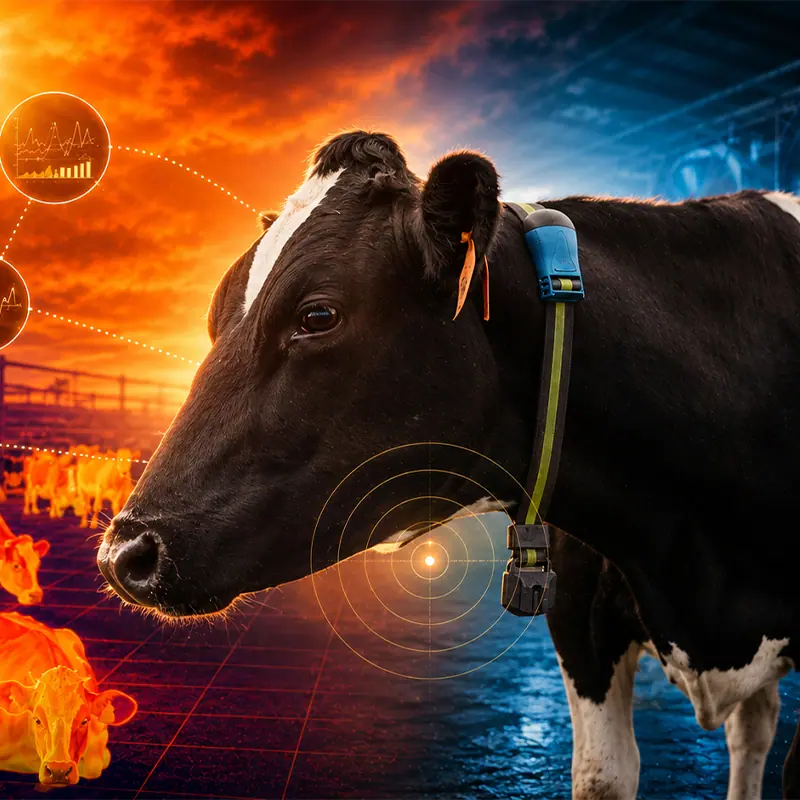
Monitoring and transmitting the body temperature of cows in real-time and continuously is now a reality, allowing the optimization of cooling treatments applied to the animals and maximizing their benefits.
 This article compiles the accumulated knowledge in Israel over recent years from experiences and studies focused on the monitoring of cows’ body temperature using intravaginal data loggers, as well as the benefits obtained in facing the summer heat load.
IMPACT OF COOLING TIME ON BODY TEMPERATURE AND PERFORMANCE
In one of my early cooling projects, carried out on a large-scale dairy farm, we used intravaginal data loggers during the summer in a group of 30 cows, cooled using a combination of wetting and forced ventilation in the holding area before each milking session.
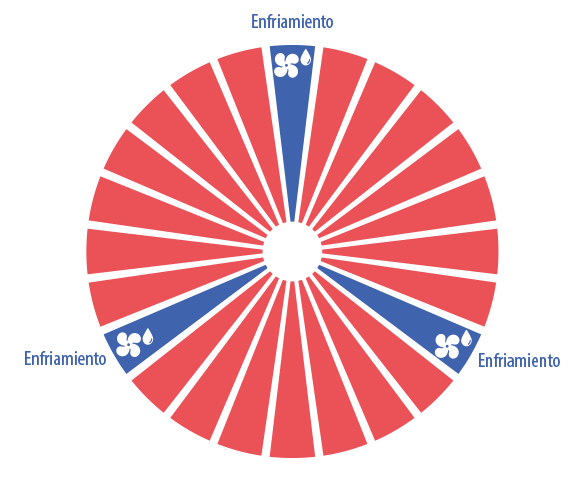
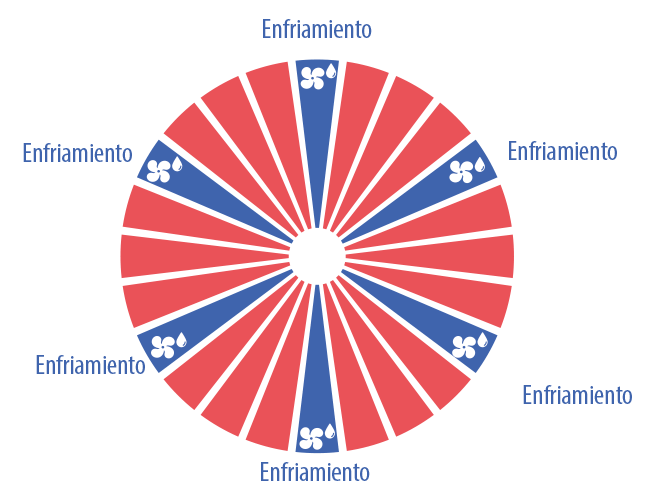
 Initially, the cows were cooled for a total of 3 hours/day, distributed in intervals of 1 hour every 8 hours.
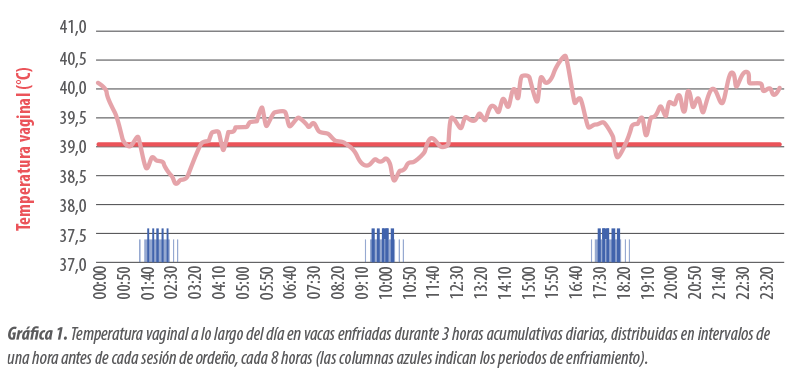
In Graph 1 the body temperature of the cows subjected to this treatment is shown.
 The cows under this cooling regime did not manage to cool down adequately, maintaining for most of the day a body temperature above 39.0 °C, considered the threshold from which heat stress is experienced.
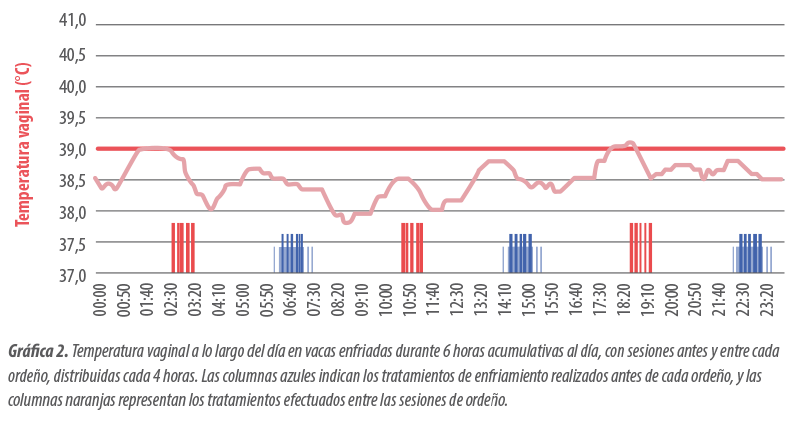
 Given the unsatisfactory results, we opted to double the cooling time, offering the cows more frequent treatments (one every 4 hours, 6 cumulative hours a day). Given the unsatisfactory results, we opted to double the cooling time, offering the cows more frequent treatments (one every 4 hours, 6 cumulative hours a day). |
Cooling the cows for 6 cumulative hours a day, with 1-hour sessions every 4 hours, allowed to maintain their body temperature within normal ranges throughout the day.
The results obtained are presented in Graph 2.
In parallel, a study was conducted at the experimental dairy farm of the Ministry of Agriculture of Israel.
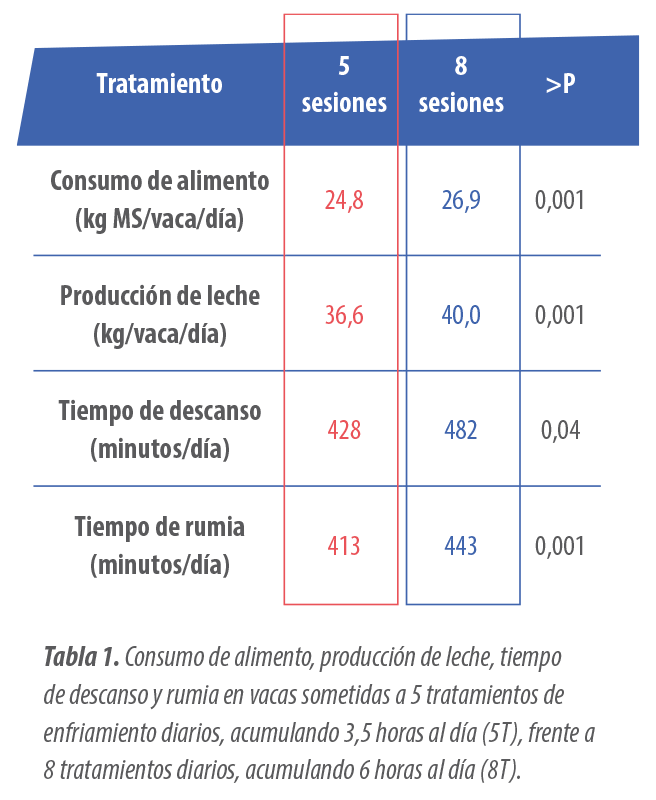
 In this study, the behavior and performance of cows cooled for 3.5 cumulative hours a day, distributed in 5 cooling sessions of 45 minutes each, was compared with that of cows cooled for 6 cumulative hours a day, divided into 8 sessions of 45 minutes each (Honig et al., JDS 95:3737, 2012). The results obtained are detailed in Table 1. In this study, the behavior and performance of cows cooled for 3.5 cumulative hours a day, distributed in 5 cooling sessions of 45 minutes each, was compared with that of cows cooled for 6 cumulative hours a day, divided into 8 sessions of 45 minutes each (Honig et al., JDS 95:3737, 2012). The results obtained are detailed in Table 1. |
The data presented in Table 1 confirm, as evidenced in the previous study, that cooling cows for 6 cumulative hours a day allows them to maintain a normal body temperature throughout the entire day.
 This translates into a increase in resting and rumination time, as well as a higher feed intake and a higher milk yield.
| The data presented reflect the results obtained through intensive cooling, an approach that can be difficult to implement in typical commercial dairy farms.
In practice, many of these farms do not achieve such effective results and cows often spend several hours a day with body temperatures above the heat stress threshold.
|

RELATIONSHIP BETWEEN HEAT STRESS AND FERTILITY IN SUMMER
A study conducted by researchers from the Research Institute of the Ministry of Agriculture of Israel explored the relationship between the number of daily hours that cows experience heat stress and their fertility characteristics when artificially inseminated in summer.
Intravaginal data loggers were inserted into 32 cows from each of 12 farms located in the central region of Israel. Data were collected during two periods of 3 days each, between July and September.
| Based on the information obtained, the farms were classified into three groups according to the number of daily hours in which the cows’ vaginal temperature exceeded the threshold of 39 °C:
|
 Short period
The conception rates corresponding to the inseminations carried out that summer for the three groups of farms are summarized in Table 2.
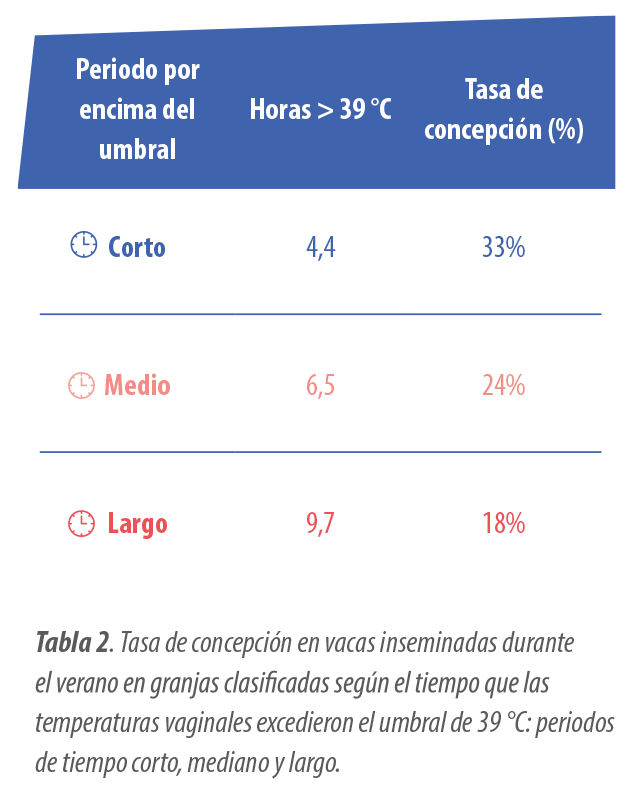
 The farms whose cows maintained a body temperature above the threshold for 4.4 hours a day achieved a summer conception rate of 33%, almost double compared to the farms where the cows experienced 9.7 hours a day with body temperatures above the threshold. The farms whose cows maintained a body temperature above the threshold for 4.4 hours a day achieved a summer conception rate of 33%, almost double compared to the farms where the cows experienced 9.7 hours a day with body temperatures above the threshold. |
This 33% conception rate level is similar to that obtained in farms with “good cooling” in Israel, where the milk production ratio index between summer and winter was close to 1.0 (Famenbaum et al., J. of Reproduction and Development Vol. 56, 2010) and the summer conception rate was less than 10 percentage points lower than the level reached in winter.
However, the question remains:
 Can cows that remain in complete thermal comfort (below 39°C for 24 hours a day) completely close the gap in conception rate between winter and summer?
Answering this question would require monitoring the body temperature of a large number of cows under different conditions.
 The expansion of the use of advanced technologies for continuous body temperature monitoring in a large number of cows, along with the ability to process and transmit these data digitally, has enormous potential to optimize the effectiveness of cooling treatments.
 Additionally, it will allow us to answer the question of whether cows can tolerate, during certain hours of the day, body temperatures above the threshold without negatively affecting their performance.
This information could have a high economic value, as it would help to reduce the operating time of cooling systems, decrease associated costs and, ultimately, improve the profitability of dairy farms.