


 Latinoamérica
 Europa
Feeding Cows with Autonomous Feed Carts


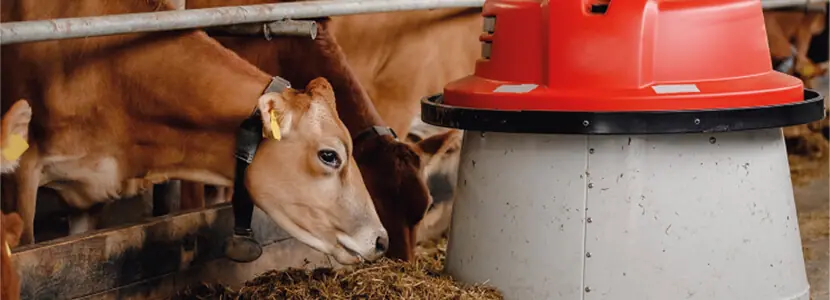






The automated feeding systems, which through a robot prepare and distribute the ration to the livestock, are beginning to be implemented in some dairy cattle farms.
In the not-too-distant future, these systems, combined with robotic milking, advances in genetics, and the use of Artificial Intelligence, will allow us to have more sustainable, efficient, and profitable animals.
The feeding robots can be partially or fully automated systems, in which one or several robots work together and in sync.
 Their function is to prepare and distribute the feed at the right time and in the right way, without the need for human intervention.
The operating principle of these systems is similar to that of total mixed ration (TMR): feeding the animals with homogeneous, uniform, and nutrient-balanced rations.
 The goal is to mix all the components of the ration —wet and dry forages, concentrates, agro-industrial by-products, and vitamin-mineral compounds— to offer a complete diet.
|
|
 These systems:
 Facilitate the preparation of rations adapted to different production batches.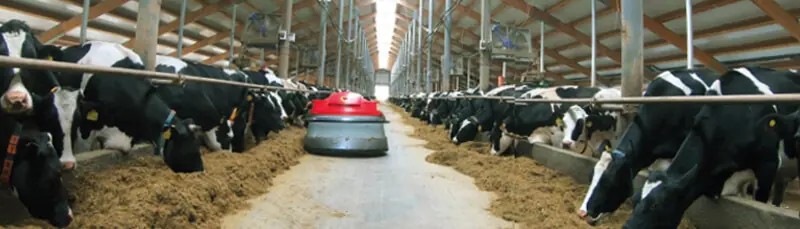
KEY COMPONENTS OF THE AUTOMATED FEEDING SYSTEM
1 Silos
 Intended for forage and concentrates, they constitute the raw material storage area, such as corn silage, grass, feed, straw, among others.
2 Kitchen
 This is a physical space or building with designated areas where a phase of the process is carried out that is not yet fully automated, as some ingredients require manual handling (dry and wet forage).
 From there, a bridge crane or conveyor belts are responsible for collecting and supplying the components.
| Every 1-3 days the feed must be replenished, depending on the type of forage, its preservation, and the time of year, so that the robot can prepare the ration intended for distribution. |
 3 Mixing
This involves the incorporation of the different ingredients into the mixer wagon.
 4 Distribution
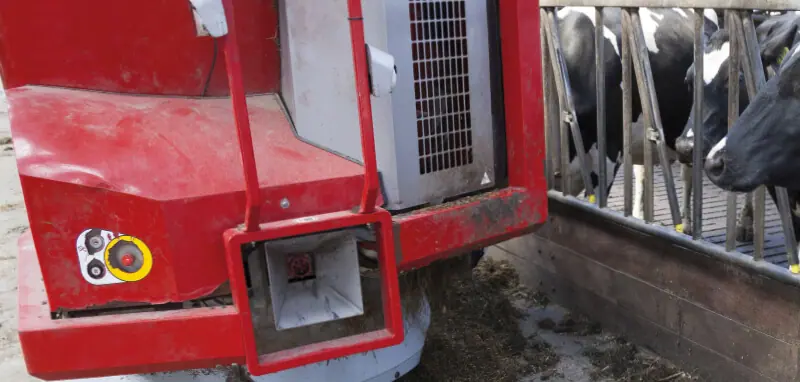
Once the mix is done, the wagon moves —either on wheels or suspended by a rail— to the feed bunk line, where the ration is unloaded.

ROBOTIZED FEEDING IN DAIRY CATTLE: EFFICIENCY, PRECISION, AND SUSTAINABILITY
FEED MANAGEMENT
These systems, supported by Artificial Intelligence and combined with robotic milking, allow the concept of precision nutrition to reach its fullest potential.
 Thanks to this, it is possible to implement more effective and sustainable feeding strategies, which benefit both animal health and the improvement of their production.
| Additionally, they offer great flexibility, as they allow for the establishment of multiple feeding schemes: from providing several rations a day to adjusting the diet based on the needs of each group of cows. |
THE ROLE OF THE KITCHEN IN THE ROBOTIZED SYSTEM
The kitchen of the feeding system is an open space intended for the storage of different ingredients, and it is a key component for its proper functioning.
 Each ingredient must be placed in its corresponding location and renewed as frequently as necessary to ensure the quality of the ration.
The preservation of the silage is a critical aspect, as the time that elapses from when it is removed from the silo, passes through the kitchen storage area, and reaches the trough determines its stability.
 In winter, with low temperatures, the corn silo can be maintained without the risk of fermentation for about 48 hours after ensiling.
 In summer, the risk appears much sooner, even at 24 or 12 hours.
| Before installing a robotized feeding system, it is essential that the farm has well-preserved forages, correctly ensiled, and with the ability to supply them to the kitchen in optimal quality conditions. |
PUSHER AND LASER TO MEASURE FEED HEIGHT
These systems operate continuously, detecting where and when fresh feed is needed throughout the 24 hours of the day, to then prepare and supply it.
Thanks to laser sensors that measure the height of the feed at the feed bunk, it is possible to accurately know the amount of feed available. Additionally, these devices can act as pushers autonomously or in connection with other specific devices that manage this function.
This promotes a higher frequency of consumption, which can increase dry matter intake by up to 3.5% and, at the same time, reduce feed waste.
SCALABILITY IN ROBOTIZED FEEDING
Robotized total mixed ration (TMR) systems must adapt to the growth of the farms where they are installed.
In this regard, it is essential that they are capable of increasing their volume or work capacity to meet the growing needs of the farm if necessary.
ENERGY EFFICIENCY IN ROBOTIZED FEEDING
These systems are 100% electric and do not require fossil fuels for their operation.
The daily energy consumption of a feeding robot is less than €3, which represents a significant saving compared to a conventional mixer wagon.
As a reference, a total mixed ration (TMR) wagon consumes around 16 L of fuel per hour of operation.
In contrast, in a robotized feeding system, the “kitchen” is loaded about three times a week, with operations lasting between 1 and 2 hours. When this task is performed with a telescopic handler or a tractor with a loader, the consumption is much lower than that of a mixer wagon.
 Overall, this translates into a significant and sustainable energy saving.
TIME SAVINGS AND IMPROVED QUALITY OF LIFE FOR THE FARMER
One of the most evident advantages of automatic feeding systems is the improvement in working conditions and the reduction of necessary labor.
 Various published studies indicate that the time dedicated to the preparation and distribution of the ration can be reduced by up to 55%. Of that time, approximately 60% is spent supplying the kitchen and the rest on tasks such as cleaning, programming, or maintenance.
In practice, the only requirement is to refill the kitchen and clean it periodically. It is common to load it about three times a week, which represents a considerable labor saving compared to the use of the total mixed ration (TMR) wagon.
This reduction not only implies less work but also less stress for the farmer, freeing up time to dedicate to the comprehensive management of the farm.
 One aspect that is almost never considered when changing the feeding system is the real cost of labor. In many cases, it is the farmer himself who performs the mixing with the total mixed ration (TMR) wagon, but if this cost is calculated with a rate of 12 €/hour, the economic difference between both systems becomes even more evident. One aspect that is almost never considered when changing the feeding system is the real cost of labor. In many cases, it is the farmer himself who performs the mixing with the total mixed ration (TMR) wagon, but if this cost is calculated with a rate of 12 €/hour, the economic difference between both systems becomes even more evident. |
MEASURABLE AND SUSTAINABLE PRODUCTIVE RESULTS
There are numerous studies that demonstrate the increase in milk yield in farms that have incorporated automatic feeding systems.
The data indicate that:
 During the first year after the system’s installation, an average increase of 1.42 liters of milk per cow per day is obtained.
Two years after its implementation, this increase reaches 1.65 liters per cow per day, consolidating the positive impact of smart feeding on productivity.
REDUCTION OF FEED WASTE
It is essential to know and measure the amount of feed that cows can ingest in 24 hours, as there are almost always leftovers that the animals do not consume.
These wastes are easily quantifiable and represent an economic factor to consider.
In many cases, the leftovers are discarded, resulting in economic loss, or they are allocated to animals in the growth phase.
However, various published studies reflect a substantial saving with robotic feeding: while in a conventional total mixed ration system, the leftovers in the feed bunk average 180 kg of feed per day, with an automated system this figure is reduced to just 10 kg.
DISTRIBUTION FREQUENCY
With the conventional mixer wagon, the ration is usually distributed between 1 and 2 times a day. However, in farms analyzed in France with robotic feeding systems, it has been found that the average frequency reaches 7.5 distributions per day.
This ensures that the feed is always fresh and available for the animals, promoting their consumption and improving feeding efficiency.


AUTOMATION IN FEEDLOTS: PRECISION AND EFFICIENCY IN BEEF CATTLE
This system will tend to be increasingly implemented in calf feedlots, especially in larger ones, as it allows for the application of precision nutrition based on the age, weight, sex, or growth rate of the animals.
Automation will, therefore, be a key element in achieving maximum effectiveness and efficiency in production.
|
|
The time saving is one of the most evident benefits.
Currently, manual feeding can take around an hour and a half daily, depending on the facilities. In contrast, an automated system reduces this task to between 15 and 30 minutes a day.
While the investment costs must be analyzed for each farm in particular, their amortization is spread over the system’s useful life, making it a increasingly attractive alternative for calf feedlots.
CONCLUSIONS
The incorporation of technology in animal feeding systems promotes Animal Welfare, reduces costs, improves feed conversion, and increases the profitability of the farm.
However, before implementing an automatic feeding system, it is essential to carry out an individualized diagnosis of each farm.
| These systems allow for the optimization of feed use and, in combination with robotic milking, precisely adjust each phase of the animals’ production cycle. |

You may be interested in: The revolution of artificial intelligence: a new boost to productivity and sustainability in the livestock sector?