


 Latinoamérica
 Europa
The Art of Cooling Cows: The Science Behind Sprinkling and Forced Ventilation


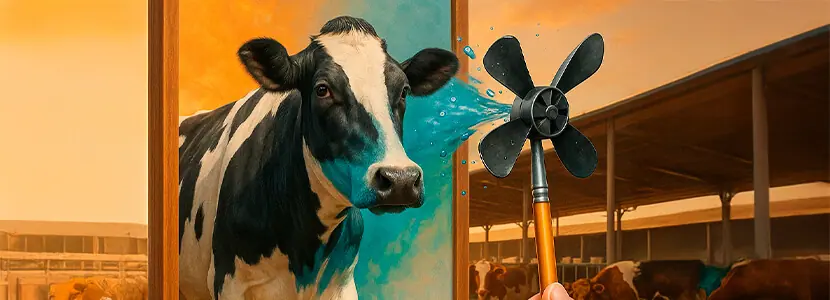







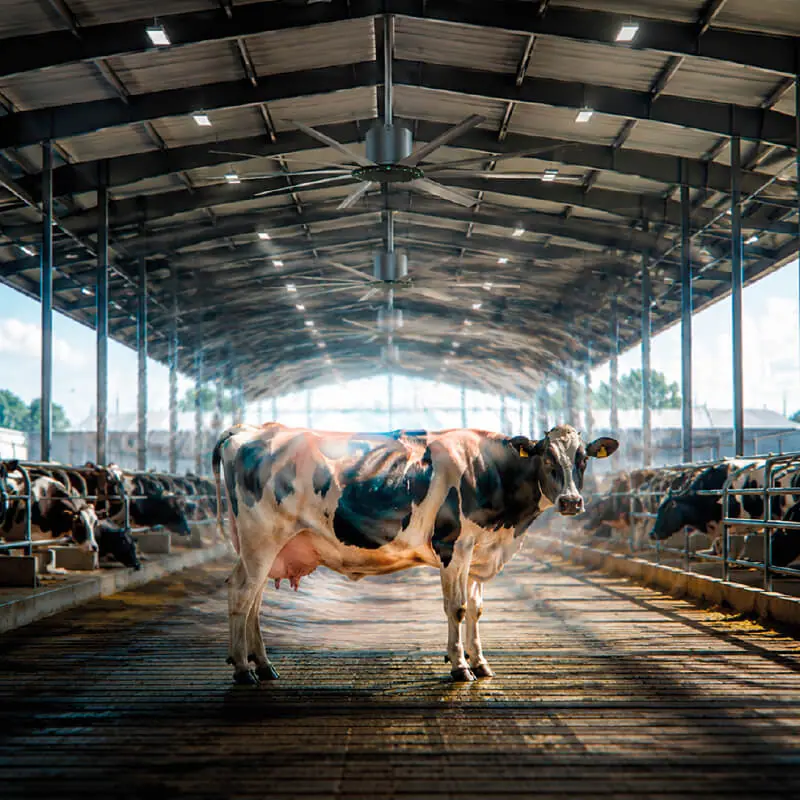
Cow cooling through a combination of wetting and forced ventilation has become the most common method worldwide. In fact, it is estimated that more than 80% of cows subjected to some type of cooling today do so through this system.
Today, the necessary requirements for cooling to be effective throughout the day and year are precisely known:
 Quality of wetting
Air speed
Duration
 This article outlines the evolution of the knowledge that has allowed the establishment of current technical recommendations used by dairy producers worldwide. This article outlines the evolution of the knowledge that has allowed the establishment of current technical recommendations used by dairy producers worldwide. |
A PRACTICE WITH HISTORY: THE SCIENTIFIC BASIS OF MODERN COOLING
The first scientific reference to this type of cooling dates back almost 80 years.
 In 1948, researchers from the Louisiana State University (Seath & Miller, JDS 31:361) conducted an experiment in which cows exposed to the sun for two hours were then moved to a building where they were cooled by wetting with a garden hose, with or without forced ventilation using fans.
 The combination of wetting with forced ventilation tripled the heat loss compared to wetting alone, allowing the cows to reach their normal body temperature in half the time.
Decades later in Israel, in the early 1980s, experimental studies were conducted with the aim of evaluating:
 1. The effects of cooling based on wetting and forced ventilation in dry cows and milking cows.
2. The impact of cooling based on wetting and forced ventilation on the productive and reproductive performance of the cows.
As part of the study (Flamenbaum et al., JDS 69:3140, 1986), work was done on the optimization of this cooling practice in terms of duration of wetting (10, 20, and 30 seconds) and duration of cooling (15, 30, and 45 minutes), performing the wetting once every 5 minutes.
 The results indicated that the best effect was obtained by wetting the cows for 30 seconds every 5 minutes, in 45-minute sessions.
 Applying this format four times a day (once every six hours), the cows were kept in thermal comfort (body temperature below 39 °C) throughout the day.
 In contrast, the cows in the non-cooling group exceeded this threshold for much of the day.

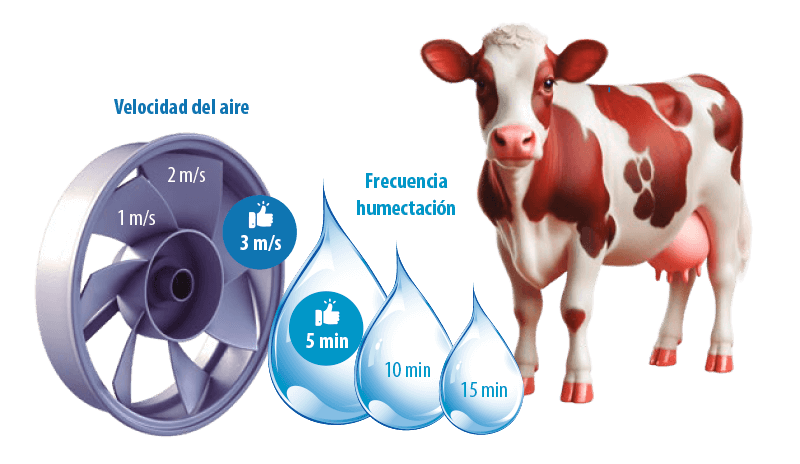
In the early 2000s, researchers at Kansas State University (Brouk et al., 2002 and 2004) compared different air speeds (1, 2, and 3 m/s), concluding that the highest (3 m/s), combined with wetting, offered the best results.
Subsequently, they analyzed the optimal wetting frequency (every 5, 10, and 15 minutes, with continuous ventilation) and confirmed that doing so every 5 minutes was the most effective, coinciding with previous findings in Israel.
ADAPTATION TO THE NEW COOLING NEEDS OF COWS
 Over time, the need to cool cows has intensified, both due to global warming and the increase in milk yield, which generates more body heat.
 Therefore, the cooling intervals used in previous decades are no longer sufficient. Currently, it is necessary to increase the frequency and the cumulative daily duration of the cooling sessions.
Real-time temperature recording
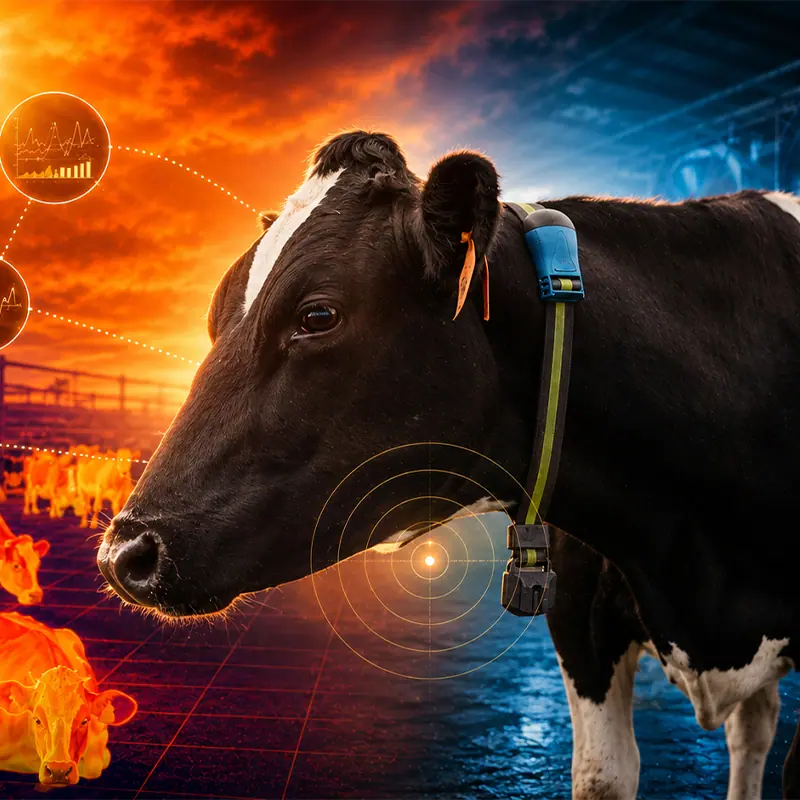
In recent years, numerous dairy farms have incorporated intravaginal temperature loggers to monitor the cows’ body temperature daily. This technology allows:
Evaluate the effectiveness of cooling.
Identify the times of day with the highest heat stress.
Adjust the cows’ cooling parameters to keep them within the desired thermal range.
 Today there are devices that remain in the animal’s body for long periods and transmit data in real time. Thus, their use contributes significantly to improving thermal management and optimizing resources. Today there are devices that remain in the animal’s body for long periods and transmit data in real time. Thus, their use contributes significantly to improving thermal management and optimizing resources. |
A representative example was developed on a large-scale farm in northern Mexico, with 3,000 cows.
 Initially, the cows were cooled one hour before each milking, totaling 3 hours/day. However, records showed body temperatures above 39 °C for much of the day. Initially, the cows were cooled one hour before each milking, totaling 3 hours/day. However, records showed body temperatures above 39 °C for much of the day. |
|
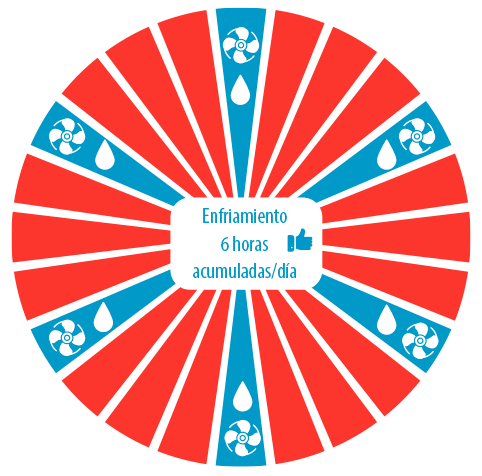
 By doubling the number and duration of the sessions (6 sessions of 1 hour, totaling 6 hours/day), it was possible to keep the temperature below the threshold throughout the day. By doubling the number and duration of the sessions (6 sessions of 1 hour, totaling 6 hours/day), it was possible to keep the temperature below the threshold throughout the day. |
 |
 |
Paralelamente, un grupo de investigadores en Israel (Honig et al., 2012, JDS 95:3736) estudió el efecto de enfriar vacas durante 3,5 y 6 horas diarias (5 u 8 sesiones de 45 minutos).
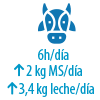 Las vacas con 6 horas de enfriamiento consumieron 2 kg más de materia seca y produjeron 3,4 kg más de leche al día que las que recibieron menos tiempo de enfriamiento. Además, descansaban y rumiaban durante más tiempo.
THE OPTIMAL COOLING MODEL AND ITS IMPACT ON PRODUCTION AND PROFITABILITY
 Los resultados acumulados permiten definir un protocolo eficaz:
Combinar humectación cada 5 minutos con ventilación forzada a 3 m/s, en sesiones de 45 a 60 minutos, distribuidas a lo largo del día hasta alcanzar un total de 6 horas diarias (1 vez cada 4 horas).
 Este esquema permite mantener la temperatura corporal en niveles normales durante el verano, con beneficios claros sobre el bienestar y la productividad.
In Israel, more than two decades ago, a summer-winter ratio index (Flamenbaum and Ezra, 2007, JDS 90:345) was developed to measure the impact of the cooling system.
 On farms with intensive cooling, cows reached 98% of their winter performance in summer, compared to the 88% observed in farms with less demanding systems.
The conception rate was also less affected, with a difference of only 10 percentage points between seasons, compared to declines of over 30 points in farms without intensive cooling (Flamenbaum and Galon, 2010, J. Reprod. Dev. 56:536).
An economic analysis shows that the investment required to properly install and operate this system can be recovered in less than a year.
 In temperate regions, the annual income per cow can increase by between 100 and 200 dollars.
In warm regions the benefits can reach 1,000–1,500 dollars per cow per year. In these areas, intensive cooling can reduce economic losses associated with heat stress by up to 80%.
| With the available knowledge and the right tools, cooling cows properly is not only possible but essential. The decision now lies in the hands of the producer. |
You may be interested in: Continuous temperature monitoring in cows: key to tackling heat stress