


 Latinoamérica
 Europa
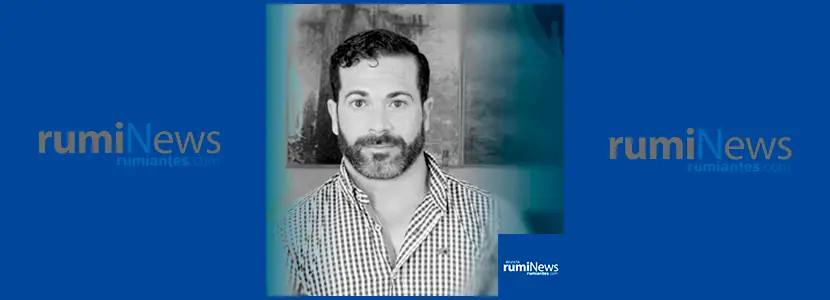
Interview with Isidro Escalante – IGE Incineradores



 C/ Vitoria 4, Edificio Avenida, Oficina 607 Burgos 09004
  947 740 222 // 900 831 217 // 630 689 114
Isidro Escalante, General Director of IGE Incineradores – Exclusive Authorized Official Distributor in Spain of Addfield Environmental Systems Ltd.-, is a firm believer in the advantages of incineration in the livestock sector compared to the outdated current systems of animal carcass disposal. He emphasizes that it is perfectly authorized and regulated, and the practice of animal incineration, due to biosecurity and costs, is unstoppable.
What is an incinerator? What type of fuel does it use?
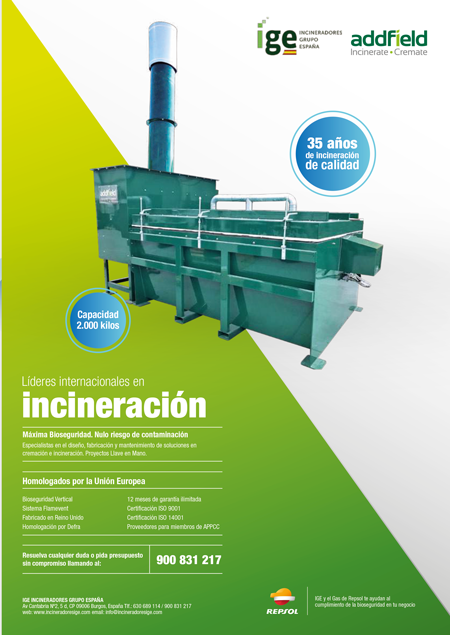
An incinerator is composed of two parts:
- A main or combustion chamber where we will incinerate our waste.
- A secondary or post-combustion chamber where gases are managed and purified to achieve 0% odor emissions and 0% “visible” smoke emissions.
Our machines are available for various fuels such as diesel, propane (LPG), or natural gas.
The vast majority opt for LPG for several reasons, including:
The agreement with REPSOL that we currently offer our clients, which gives them the opportunity to access a large number of advantages over diesel.
On the other hand, LPG is “cleaner” than diesel in terms of odors and would prevent fuel theft.
What clear and direct advantages does incineration offer in sheep and goats?
VERTICAL BIOSECURITY
We achieve the elimination of 100% of contamination vectors that could develop due to the entry of the insurance collection truck on the farm. In this way, animals die on the farm and are incinerated on the farm. There is no transfer of mortality.
Independence in the management and disposal of our waste, avoiding its storage and the risks it entails.
MINIMAL ENVIRONMENTAL IMPACT
Thanks to advances in the management of purification and treatment systems for gas emissions, the environmental impact is minimized to the maximum, producing 0% “visible” smoke emissions and 0% odor emissions.
Incineration is the most biosecure system currently, as there is no transfer of animal carcasses
ECONOMIC MANAGEMENT OF WASTE
Currently in Spain, the prices for animal carcass removal, according to the latest studies, range between 0.17 – 0.34 €/Kg.
With IGE incinerators, the most advanced on the market, the cost for the disposal of 1kg of waste, with a combustion speed < 50 Kg/h (low capacity), is 0.05 €/Kg – 0.07 €/Kg* for the smaller models like the MINI AB, MINI, MINI+ and SB (750Kg).
In the superior models, such as the TB (1,300 Kg) and TB AB (2,000 Kg), the incineration cost of a Kg ranges between 0.07-0.10 €/Kg*.
*Consumption estimates are based on a calorific value of the waste of 4,000 Kcal/kg. Figures will change if different types of waste are introduced. Propane (LPG) cost 0.80€/kg.
RAPID INVESTMENT AMORTIZATION
Thanks to the low cost of incineration and the rising prices of removal insurance, the initial investment can be recovered in a very few years (2-5).
The current incinerators have a lifespan of up to 30 years.
MINIMAL MAINTENANCE
The high quality of the materials with which our incinerators are manufactured means that their maintenance is minimized to the maximum with really low costs.
 Is incineration in livestock perfectly authorized and regulated?
Regulatory-wise, all Addfield incinerators, distributed by IGE Incineradores, are homologated, certified, and CE labeled.
On the other hand, we work with Ip65 homologation to be able to install them outdoors with total guarantee and security and with ISO 9001 (Quality Certificate) and ISO 14001 (Environmental Certificate).
It is an authorized, regulated, and fully permitted system in Spain, strictly complying with the regulations according to the CE1069/2009, CE1774/2002, CE142/2011, EU Commission Regulation of February 25, 2011, and the Royal Decrees of Spain 1528/2012 and 476/2014.
Currently, we have facilities in Castilla y León, Navarra, Aragón, Andalucía, and the Canary Islands.
What advantages do we have by abandoning carcass removal services and destroying them on the farm?
Fundamentally, when it comes to having 100% Vertical BioSecurity on our farm.
I regularly hold meetings with veterinarians, and there is one thing they all agree on, which is their opinion regarding the current system of casualty removal and the biosecurity it offers.
I always put myself in the farmer’s shoes. It makes no sense to spend real fortunes on developing exceptional genetics, vaccines, feeding… and leave this last and fundamental process in the hands of others.
Will my farm smell bad if I use an incinerator?
Of course not.
We guarantee 0% odor emissions and 0% “visible” smoke emissions in all our incinerators.
Do you have different sizes of incinerators for different types of businesses?
Exactly. Depending on the volume of carcasses to be disposed of, we have several models starting from a loading capacity of 250 to 8,000 kg.
The choice of model depends on the size of the farm and the expected mortality level, which varies greatly depending on the farms.
For small ruminants (sheep and goats), the recommended incinerators are:
- MINI > 350Kg
- MINI+ > 500Kg
- SB > 750Kg
- TB > 1,300Kg
Another of our main functions is advising on the choice of incinerator size that best suits the needs of each farm.
Thanks to the 38 years of experience in the sector of our parent company AddField, we recommend starting the incinerator on average 2 or 3 times a week and not filling it to 100%, although if necessary, which no one desires, we can use it 7 days a week 24h a day.
How do you ensure that the farmer correctly sizes their incinerator?
One of the data we request as soon as we contact the client is the amount of monthly/annual waste they usually have on the farm.
 Based on that amount and the farm’s working hours, we adjust the size of the incinerator.
What is the distinguishing feature of your incineration solutions compared to other equipment?
- Firstly, our extensive experience of 35 years in the incineration market sets us apart.
- On the other hand, we have incinerators designed and built specifically for each sector and type of waste.
- The lifespan of our equipment, up to 30 years, is a significant difference compared to other equipment available on the market. This is possible thanks to the high-quality materials used by Addfield.
- Fuel consumption, up to 40% less thanks to the EcoCycle™ badge. They are the most ecological incineration and cremation machines on the market.
- Addfield is the only company in Europe in the incinerator manufacturing sector with the Ip65 certificate.
- Another aspect is that we control gas emissions through a sophisticated software with the post-combustion chamber burner. In this, we follow the guidelines of the World Health Organization.
Is the incineration process complicated?
Thanks to Addfield’s “Know How”, it has been possible to design an incinerator for which, with 1 person, we can carry out the entire process: opening the lid, loading the animals, starting the incineration cycle, and removing the ashes.
Do you offer a maintenance or spare parts supply service?
The installation, commissioning, and training include a simple 15-20 minute course to teach the operator how to handle the incinerator and use it most efficiently.
One of our main functions is the technical support after installation.
We offer a recommended annual maintenance service to tune up the incinerator and its components.
However, I want to highlight that the interesting thing about our incinerators is that their high-quality materials guarantee long-term use with minimal maintenance. Our machines have a 12-month warranty. We also have full availability of spare parts.
What does the agreement with Repsol bring to the incinerator buyer?
This agreement is a clear commitment to innovate and improve biosecurity in the sheep and goat sector, as well as representing a significant saving for the farmer, who has access to all the services offered by Repsol:
- Turnkey gas installation
- Maintenance
- Logistical capacity
- Financing
- Competitive price
Is it easy to install an incinerator on my farm?
Thanks to the agreement of IGE Incineradores with one of the main engineering companies in the sector, we optionally offer the Turnkey Administrative Processing and Legalization service, carrying out the administrative procedures prior to the installation and commissioning of the incinerator for its authorization and legalization.
Moreover, all our clients will have the possibility to access 100% financing of the purchase, including VAT, for up to 6 years with some of the main banks in the country.
The incinerator is increasingly an element already included from the start of the farm design. It is not taken as an option but is considered an essential element for biosecurity. Currently, we are witnessing a significant demand for information and quotes from the small ruminant sector, where more and more are opting for the installation of this type of machinery.