


 Latinoamérica
 Europa
Mobile slaughterhouses as an innovative tool to support small farms


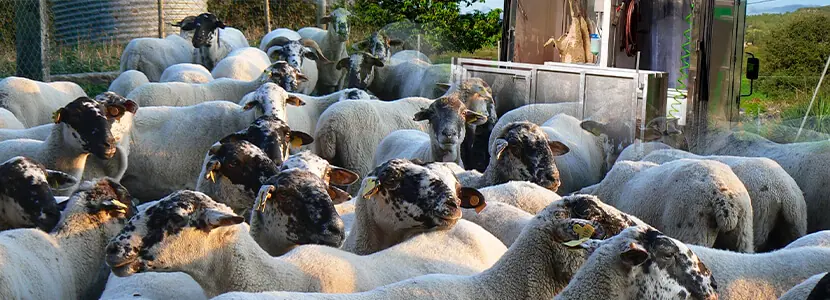







The number of small ruminant slaughterhouses in Spain, especially the smaller ones, has been decreasing for years. Moreover, high-capacity slaughterhouses often do not accept small volumes of animals and are closing lines that are economically unproductive.
 All this means that farmers in rural areas are forced to make long journeys to slaughter their animals or are directly left without an alternative to slaughter their sheep and goat products.
| For this reason and as an alternative for the slaughter of small ruminants outside conventional slaughterhouses, the mobile slaughterhouse pilot project emerges to address the challenges faced by extensive farming in rural areas. |
The project is part of the Operational Groups of the European Innovation Partnership (EIP) and is led by the Association for Rural Development of Central Catalonia.
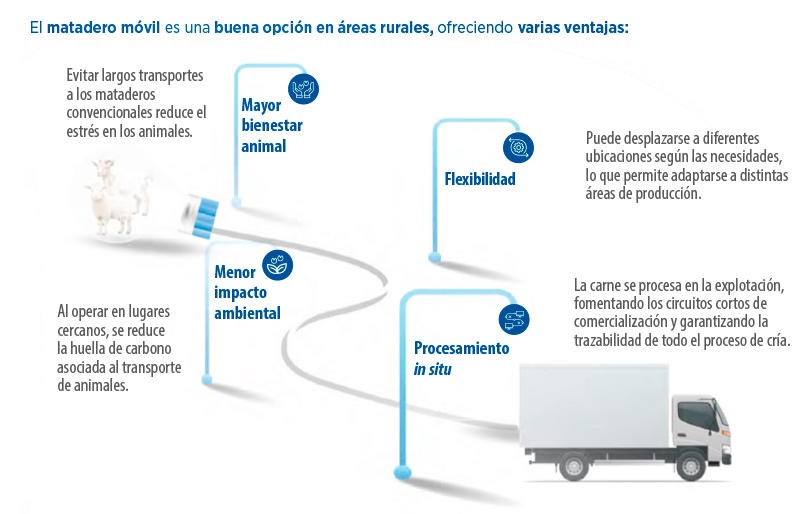
LEGAL REQUIREMENTS REQUIRED FOR MOBILE SLAUGHTERHOUSES
The Royal Decree 1086/2020 sets the requirements that mobile slaughterhouses must meet, as well as the flexibilities.

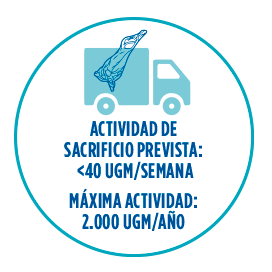 The mobile slaughterhouses must comply with the slaughter limits applicable to small slaughterhouses, meaning that the planned slaughter activity does not exceed 40 LSU per week, with a maximum of 2,000 LSU annually.
The basic legal requirements and their flexibility can be summarized in 4 points.
|
1. Location The mobile slaughterhouse can be located in any area of the farm, as long as the necessary infrastructure and equipment are adapted. This area should:
|

 Be located in an area where there is no risk of contamination from dirty areas.
|
2. Hygienic requirements Basic hygienic and sanitary requirements established in the regulations must be met, as well as specific requirements related to exceptions and adaptations of Royal Decree 1086/2020.
When the mobile slaughterhouse operates within the livestock farm, an effective system for cleaning and disinfecting wheels, vehicle undercarriage, and the designated area must be ensured, with a biocide that guarantees the inactivation of pathogens. |

 All flexibility measures adopted must be documented and be
|
3. Animal Welfare The requirements related to animal welfare established in the regulations must be met, including the Royal Decree 695/2022, which establishes measures for the control of welfare in slaughterhouses through the installation of video surveillance systems. Compliance with animal welfare requirements is not subject to flexibility. |

|
4. Staff Training The staff performing the slaughter tasks must have training to carry out their functions, and this training must be accredited. |

THE MOBILE SLAUGHTERHOUSE: THE EXAMPLE OF CENTRAL CATALONIA
The justification and reason for the implementation of this mobile slaughterhouse arise from the need created by the lack of public or private slaughterhouses near farms in Central Catalonia and at reasonable distances that allow for the slaughter and subsequent collection of carcasses in optimal conditions.
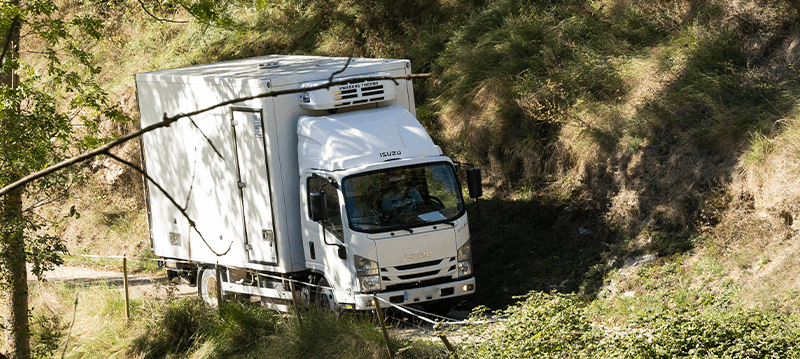
The vehicle (Figure 1) used is equipped with all the necessary equipment to carry out the slaughter.
The slaughterhouse is designed to reach the farms and perform the slaughter of those animals from the farm that have been previously selected and, if necessary, the transport of the carcasses to other meat reception centers.
| The final commercialization of the product never falls on the slaughterhouse, but it will be the farmers/butchers themselves who sell the product.
|
 In this way, direct or short circuit sales are guaranteed.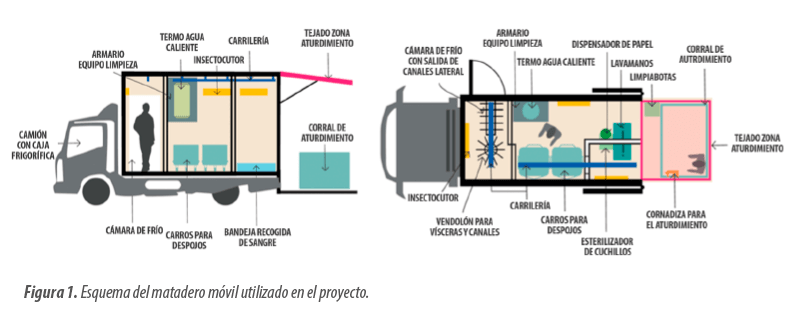
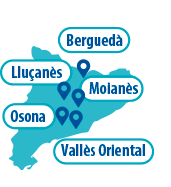
| The participating sheep farms (a total of 9) in the project belong to 5 regions of Central Catalonia: Berguedà, Lluçanès, Moianès, Osona, and Vallès Oriental.
These farms had to meet a series of prerequisites to be able to carry out the slaughter.
|

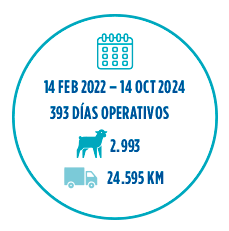
 The data presented corresponds to the period between 14/02/2022, the day slaughtering began, and 14/10/2024. The data presented corresponds to the period between 14/02/2022, the day slaughtering began, and 14/10/2024.
Over 973 days, the mobile slaughterhouse has been operational for a total of 393 days, performing a total of 501 slaughter services on the farms, and a total of 2,993 lambs have been slaughtered. In the case of slaughtering a few animals, it is possible to schedule 2 services in one day (at different farms), if the distance between them allows. The mobile slaughterhouse has traveled a total of 24,595 km.
|
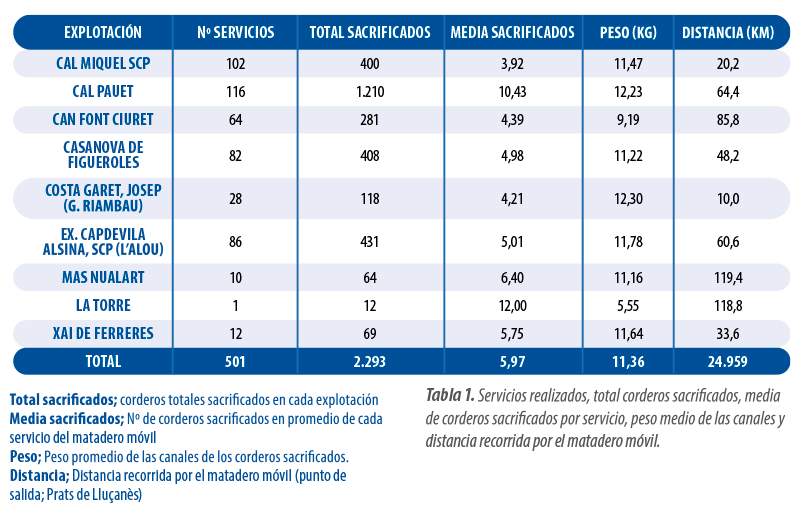
In Table 1 the services per farm, animals slaughtered, and average carcass weights can be observed. On average, 6 lambs/service are slaughtered at an average carcass weight of 11.36 kg, with the mobile slaughterhouse traveling an average of 49.8 km for each service.
 If we analyze the stratification of slaughters per day, we can observe that in 47% of the services, at most, 4 lambs/service have been slaughtered, and only in 21% have more than 9 lambs/service been slaughtered (with a maximum of 17). If we analyze the stratification of slaughters per day, we can observe that in 47% of the services, at most, 4 lambs/service have been slaughtered, and only in 21% have more than 9 lambs/service been slaughtered (with a maximum of 17). |
The main problem with this type of facility lies in the costs and the daily operational management.
 The initial investment involves expenses associated with the purchase, adaptation, and equipment of the truck to convert it into a mobile slaughterhouse, complying with administrative regulations and being able to travel safely on the road.
Operational costs: mobile slaughterhouses have high costs and a territorially complicated slaughter management.
A mobile slaughterhouse cannot slaughter as many animals because it has a smaller space and must be driven from one farm to another during the workday, with equipment and the truck needing to be sanitized between each farm.
|
As a conclusion of the experience of this project, the technical feasibility of the mobile slaughterhouse as a support tool for small rural farms has been demonstrated.
|
 Institutional collaboration and cooperation with other agents (in this case the Association of Rural and Maritime Initiatives of Catalonia -ARCA- and the Association for the Rural Development of Central Catalonia) have made it possible to carry out this project, to promote viability and competitiveness of the livestock sector in rural areas.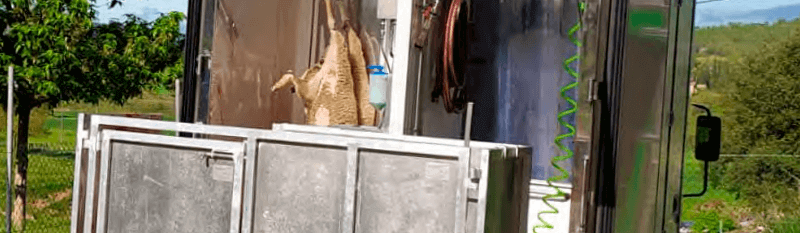
You may be interested in: Slaughterhouse truck that travels through Galicia