


 Latinoamérica
 Europa



 Avda. de Castilleja de la Cuesta, 26 (PIBO) Bollullos de la Mitación, Sevilla 41110
  + 34 955 77 65 77
Fly Control in Ruminants

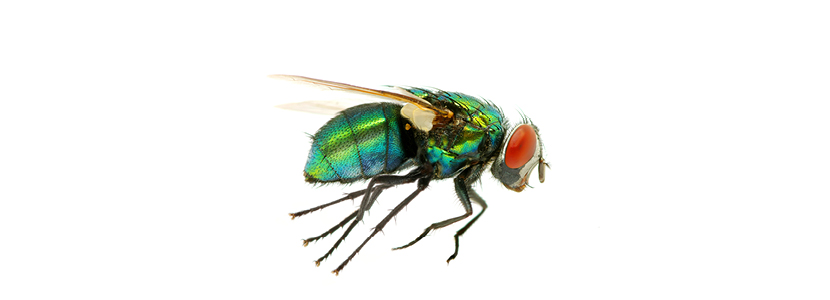
Flies are insects (Ord. Diptera), holometabolous (they go through 4 morphological phases), pathogen carriers on their exoskeleton and capable of flying up to 3.5 Kms. Their control in animal production units is essential because:
- They transmit pathogens that can cause diseases in both animals and humans.
- They contaminate food: Feed, water, milking parlors, boxes, etc., as well as other materials and utensils within the farm facility.
- They irritate cows, calves, horses, goats, and sheep, etc.
- They bother workers, in addition to giving a bad image of the facility.
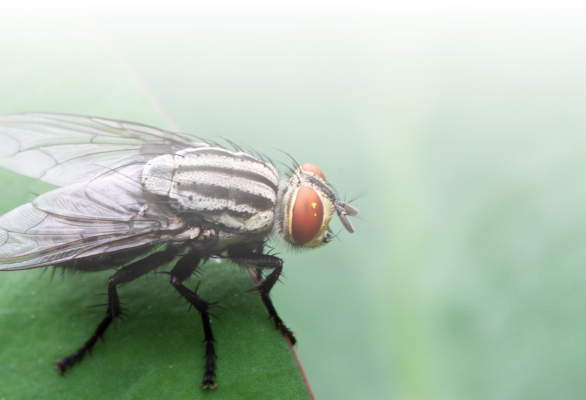

We can make a classification based on their presence in ruminants, into 3 groups of diseases:
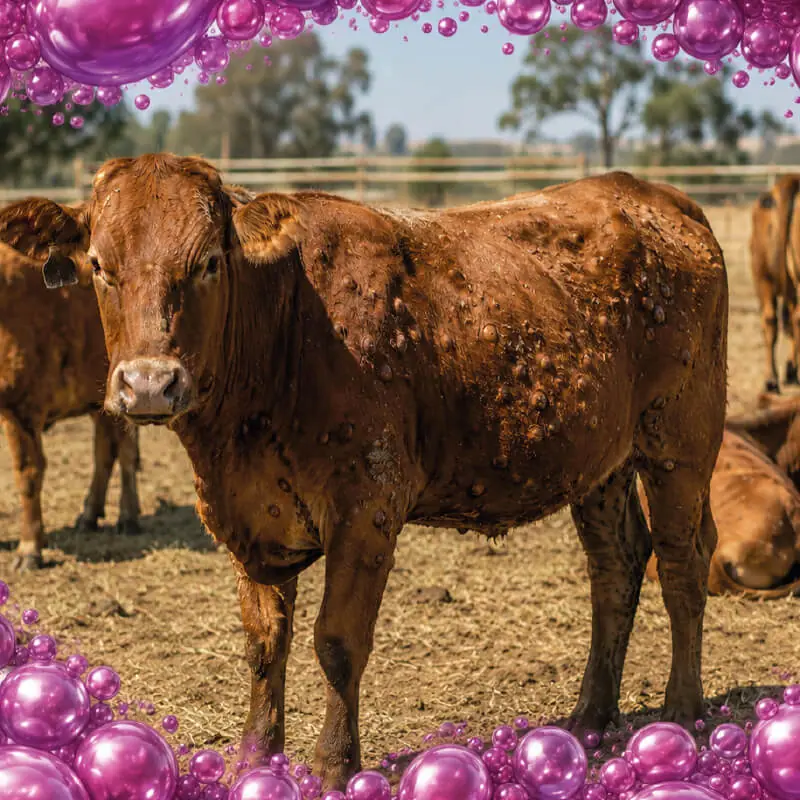
- Myiasis in skin and wounds
- Mastitis in dairy cattle
- Transmission diseases:
- Enteric diseases: Salmonellosis, Shigellosis, Colienteritis, Campylobacteriosis, etc.
- Non-enteric diseases: Aujeszky’s disease (in small ruminants), helminth parasitosis, etc.
- Protozoan parasites: Cryptosporidium parvum, Toxoplasma gondii and Sarcocystis spp.

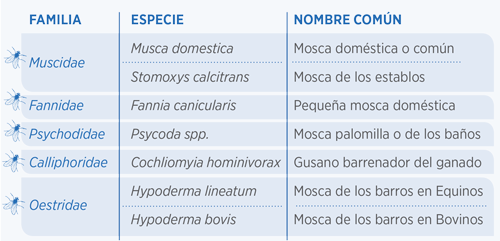
The species of greatest medical and veterinary importance for cattle, equine, sheep, and goats are:
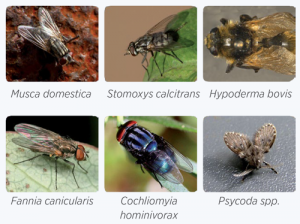

The fly is an insect that feeds mainly on decomposing organic matter such as fecal matter, wound discharge, sores or ulcers, saliva, and any other moist material that is in the process of putrefaction.
The transmission of pathogens, which occurs mainly where it lands to rest, occurs through 3 main mechanisms:
- Mechanical shedding of parts of the exoskeleton.
- Fecal deposits produced when the fly goes to feed.
- Regurgitation of incompletely digested food from its stomach.

 EGGS
EGGS
- 100-150 eggs in each cycle (5-8 cycles in their entire life); 600-1200 in total life
- The eggs are elongated like grains of rice
- They are laid on moist and dark surfaces
- They are mainly located in the bedding manure and in decomposing organic matter
- They do not survive direct light, heat, or dryness of the surface they are on
 LARVAE
- They hatch from the egg 8-20h. after being laid
- They feed for at least 1 week, before pupating, on all kinds of organic waste (manure seepage, feed, detritus, etc.)
- They avoid light (“Negative phototropism”) especially in early stages
- They will eventually seek a cool and dry place to pupate
 PUPAE
PUPAE
- They have the shape of dark and hard shells
- They are brown (young pupae) to black (adult flies about to emerge)
- They can remain in this state for a long period of time
- They emerge in less than 24h.
- When flies emerge from the pupae, they are ready to mate again
 ADULTS
- Adult females live between 15-25 days
- They only need to mate once to lay eggs throughout their life
- They feed on all kinds of organic waste (fecal matter, milk, feed, water, etc.)
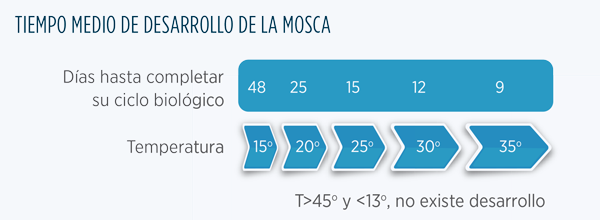
- The microclimate inside the facilities helps the proliferation of the cycles
- They multiply exponentially if their population is not controlled (spring-summer)
- They are sensitive to cold

- Temperature
- Humidity
- Manure management
- Facility microclimate
In addition to these factors, there is an aspect that depends on each facility, which is the state of cleanliness, so that the lower the hygienic conditions, the higher the fly population.
“A half-hearted treatment can cause the entire biocontrol program to fail.”

- Effective fly control must be comprehensive.
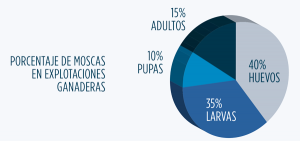
- Eliminating only the adult fly is a futile act, as the remaining 85% are precursor forms (egg, larva, pupa), which will give rise to adults.
- The use of Larvicides should be recommended ALWAYS to successfully tackle the control of their biological cycle.
- Additionally, the simultaneous use of an Adulticide will make the treatment completely effective.
It is highly recommended:
- Good manure management
- Hygiene and cleaning plan; as appropriate as possible to the farm in fly control
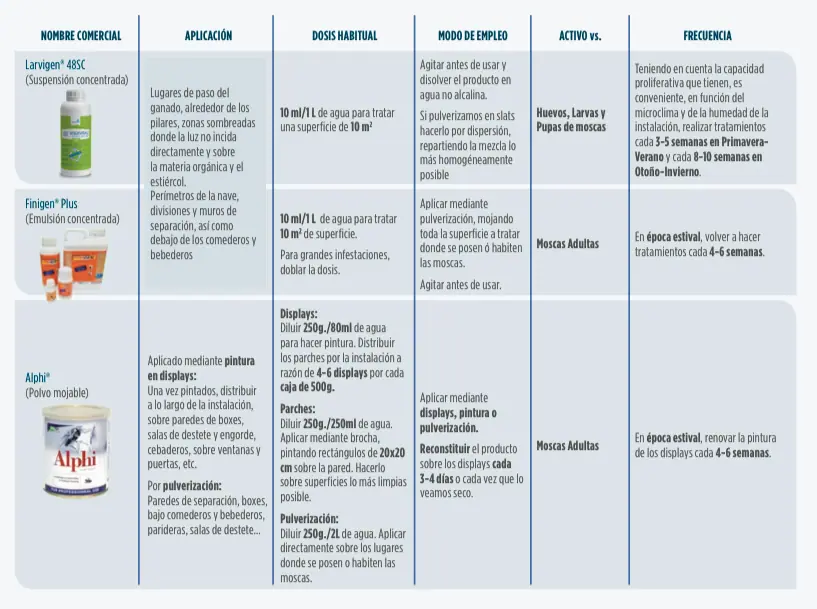
LARVIGEN® 48SC – Diflubenzuron 48%
- -I.G.R.- Chitin synthesis inhibitor.
- Interferes with the formation of the epidermis cuticle.
- Acts by contact and ingestion.
- Intervenes at the time of molting or egg hatching.
- Mainly used in the control of flea, fly, mosquito larvae, and all those insects with egg or larval stage.
- Has great residual action both in soil and water, without affecting warm-blooded animals.
- These properties make it suitable for inclusion in integrated control programs due to its safety.
- Should not be mixed with alkaline solutions.
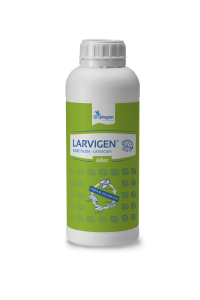
“Essential product in fly control in ruminants. Without it, the treatment is not complete.”
FINIGEN PLUS®
Acetamiprid 3%
- -Neonicotinoid- Systemic insecticide that acts by contact and ingestion.
- Very effective in treating flies as well as other crawling insects.
- Acetamiprid remains for prolonged periods on the treated surface after administration.
- Does not irritate mucous membranes or skin in warm-blooded animals.
- 92% is excreted by the renal system 24h. after absorption.
- The high elimination rate of this active substance and its metabolites suggests that it does not generate bioaccumulation, making it considered very low toxicity for mammals.
Cypermethrin 3%
- -Pyrethroid-
- Acts on the sodium channels of insect nerve cells, disrupting their neuronal function.
- Produces a lethal knock-down effect on the central nervous system. Death occurs by starvation as the insect becomes paralyzed.
- In general, at recommended doses, cypermethrin is harmless to birds and mammals.
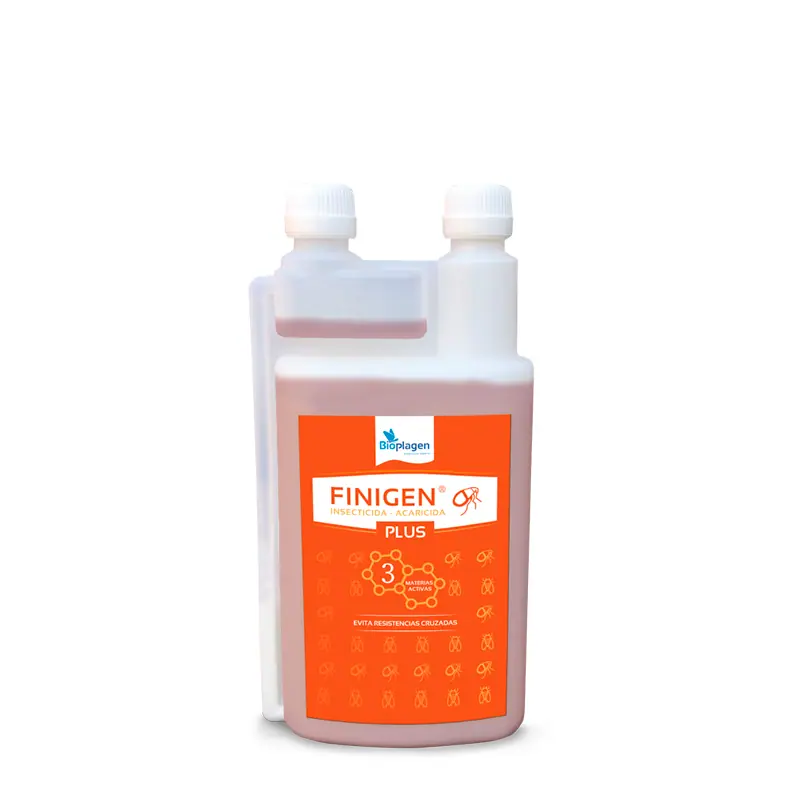
“Excellent choice for eliminating adult flies and larvae. Great action capacity and high persistence.”
ALPHI® – Azametiphos 10.52%
- -Organophosphate-
- Very versatile insecticide for fly control that can be applied in the form of paint on displays, patches, or sprayed.
- The varied mode of application makes this a very safe product to handle for livestock.
- Highly effective for fly control in ruminants.
- Azametiphos is a systemic insecticide that acts by contact and ingestion, causing the insect’s death instantly when it goes to feed, thanks to its attractive capability.
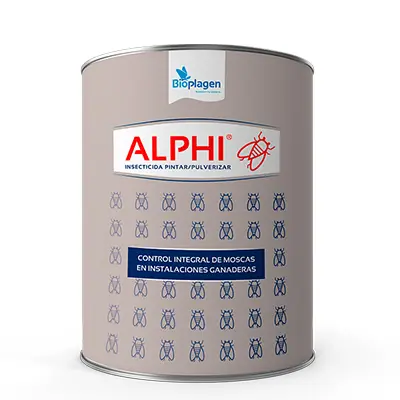
“High attraction and efficacy, without resistance. Ideal adulticide for fly treatment in farm facilities.”