


 Latinoamérica
 Europa
Farm Management for Suckling Calves & Calf Fattening


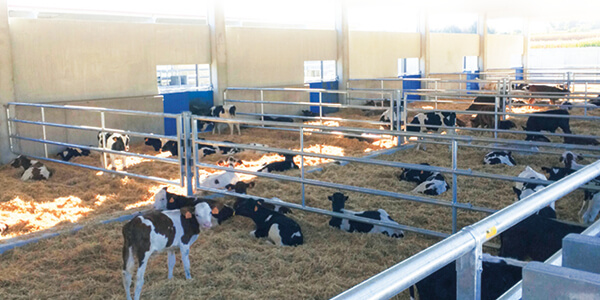







We purchase calves at one month of age and fatten them up to approximately eleven months, carrying out two phases:

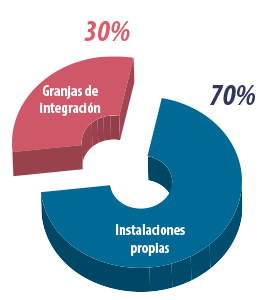
70% of the animals are housed in our own facilities and the remaining 30% in integration farms.
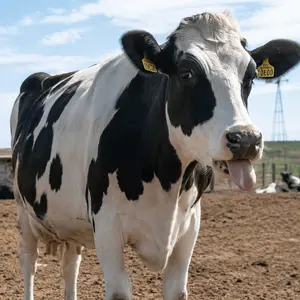
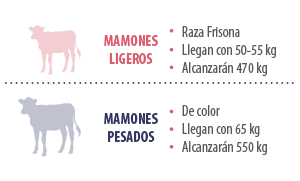
We manage two types of animals. On one hand, suckling calves of the Friesian breed or light sucklings, which arrive at the farm with 50-55 kg of live weight and will reach 470 kg, and on the other hand, heavy sucklings or colored ones that arrive with 65 kg of live weight and will reach approximately 550 kg.
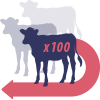 Depending on availability and price, these calves are purchased from various origins (France, Spain, Ireland, Germany, Belgium, etc.). Upon arrival at the farm, they are grouped into batches of 100 animals that will always stay together and receive the same management protocol throughout their stay at the company’s facilities.
 MANAGEMENT
 SUCKLING AREA
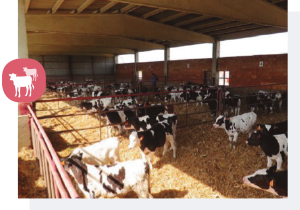
The lactation or suckling barns are perfectly clean and disinfected with straw bedding prepared so that the animals are in the best possible space after a day of transport.
Upon arrival, they are divided into groups of 6-10 calves according to different criteria:
- Breed
- Age
- Sex
- Size of the animals
The calves remain in this area for 45-60 days, until they reach 100-120 kg of weight, at which point they are moved to the feedlots.
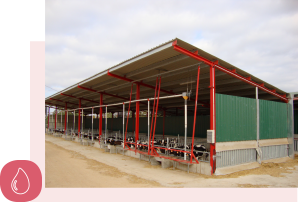
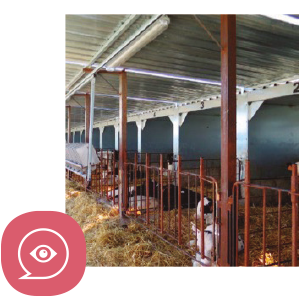 Grouping in pens/huts with a reduced number of animals (6-10 calves) is very important because it allows us to perform a rigorous daily control of each animal, individually monitoring feeding and all health aspects such as clinical signs (nasal discharge, eyes and ears, cough, mucous membranes, etc.), treatments, and diseases.
 FEEDLOT
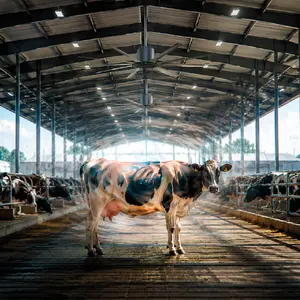
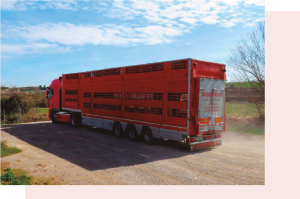
When the animals reach a weight of between 100-120 kg, they are moved from the lactation farms to the feedlots where they remain until approximately 11 months of age, at which point they are taken for slaughter.
Although the distances are short, transportation is done with a large truck.
 From our point of view, another critical point for the animals’ production indices to be efficient and to reduce problems is the animal density per pen.
In the case of lactation barns or suckling areas, the animals have 1.8-2.5 m2 while in the feedlots there are 4-5 m2 per animal.
 HYGIENE
SUCKLING AREAS
CLEAN BEDDING
In our company, we consider the cleanliness of the pens and the maintenance of good bedding very important, as if done correctly:
- Productive indices improve
- Problems are reduced
- Microbial load decreases
- Animal comfort increases
SANITARY VACUUM
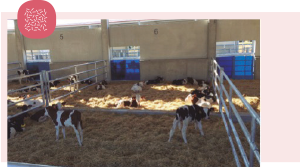
To achieve this, we follow the All-In-All-Out system, which involves removing all animals from the barn so that it is empty and can be properly disinfected and cleaned.
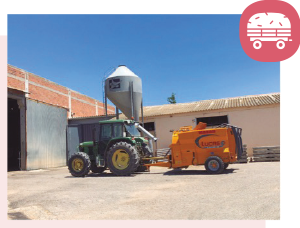
During the period when the animals are in the lactation phase, the pens are bedded weekly using a bedding machine.
COMPLETE DISINFECTION
Once the artificial lactation period is over, when the animals are moved to the fattening barns (at 2-3 months), the pens are cleaned using a very comprehensive disinfectant intended for livestock use.
FEEDLOTS
BAND CLEANING
The barns for fattening calves are cleaned and bedded once a week. For this, a band cleaning is performed, which involves closing the cattle to one side of the barn, so that the other side is completely free of cattle and fences, allowing entry with the machine and pushing the manure with the shovel to the barn’s manure pit, repeating the same procedure on the other side.
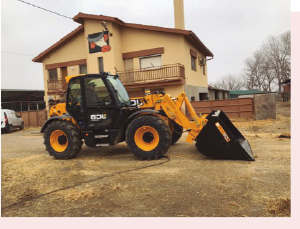
Once the fattening period is over, the pens are cleaned and disinfected using a specific product intended for livestock use.
 NUTRITION
SUCKLING AREAS
REHYDRATION
Upon arrival of the animals at the lactation barns, they are given a rehydrating agent to restore their hydroelectrolytic balance.
- If the calves arrive in the morning, the first feeding of reconstituted milk will be given in the afternoon.
- If the calves arrive in the afternoon, the first milk feeding will be given the next morning first thing.
MILK REPLACER
During this lactation period, the calves are fed a milk replacer as a substitute for maternal milk.
 Protocol for milk replacer intake:
- First 2 weeks or first month: one feeding in the morning and one feeding in the afternoon.
- Next 2 weeks: a single milk feeding in the morning, although it may vary depending on the animals’ condition and starter feed intake.
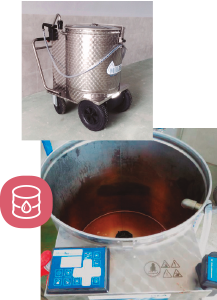
For the distribution of the milk replacer, a mixing machine with a 250-liter tank is used, which has motor traction to mix the powdered milk replacer with water and with the possibility of adding other additives. This machine allows giving the dose at the exact temperature to each calf.
TEAT SYSTEM
The animals ingest the milk through a teat system that is fixed by a guide. Each barn has its own set of teats to prevent bacterial and viral contamination between different batches of calves and they are cleaned every day after the corresponding milk feeding.
FEEDERS & DRINKERS
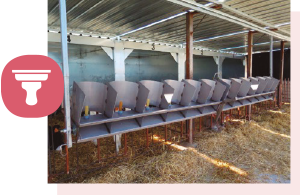
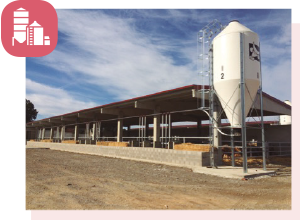
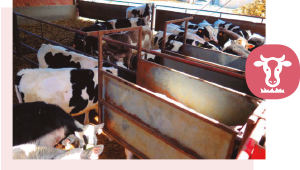
In each pen, there is a feeder and a drinker at the front. The feeder filling systems are automatic and are supplied from a side silo where the feed is stored and transported via screw tubes to the different feeders.
CLASSIFICATION BY SIZE
An important point to highlight is the classification of the animals in the pens by size, as the grouping of animals creates hierarchy and when the animals have different sizes, the smaller ones end up having problems going to eat and drink.
FEEDER FILLING
The feeder filling system is activated approximately every 20 minutes but only if the feeder where the screw motor is located is empty.
This motor is always located in the last pen of the barn, that is, on the opposite side of the storage silo. It is important to place the largest animals at this end, as they will eat the most and leave the feeder empty more frequently, and the automatic screw system will have more chances to activate.
PRE-STARTER FEED
If the entry weight of the animals is less than 50kg, they are given 4-5 kg of a pre-starter feed.
Characteristics of the pre-starter feed:
- Floury, very palatable for the animal and encourages the calf to start eating
- Rich in whey
- Heat-treated, providing high digestibility of the protein starches
- Contains microbiological additives that promote rapid implantation of ruminal and intestinal flora.
STARTER FEED
If the newly arrived calves are stronger and their weight is greater:
- They start directly with the starter feed that contains a 9% vitamin corrector.
- Subsequently, when the calf’s weight is about 110 kg, they switch to another starter that contains a 3% vitamin corrector.
ADAPTATION FEED
Once the calves are adapted and have eaten the corresponding kg of starter feed, they begin to eat an adaptation feed, which is very energetic but less rich in whey.
FEEDLOTS
GROWTH & FINISHING FEED
When the animals are moved to the fattening facilities, during the first few days they continue to be given the same adaptation feed as in the suckling area to minimize stress and adapt correctly to the new facilities. After this adaptation phase, they start eating the growth feed.
Depending on commercial lines and interest in finishing the carcass, finishing feed is used or not to fatten the carcass.
 EFFICIENT FEEDER
We would like to highlight the use of efficient feeders in our fattening farms. These feeders have the particularity that they do not allow feed loss due to the animals’ eating habits, nor do they allow the oxidation of nutritional components as they do not accumulate in excess, meaning they reduce feed waste while maintaining their optimal nutritional composition.
These are feeders where the tube coming from the upper screw that transports the food and ends in the feeder is approximately 2-3 cm from the base. This way, the granulated feed is stored in the tube and the animals extract the food through that margin without wasting it or allowing it to accumulate.
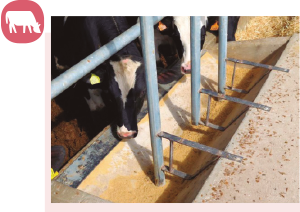
Efficient feeder, with a distance of 2-3 cm from the tube to the base.
 We maintain a collaboration agreement with IRTA, which conducts research in some barns of our farms. According to IRTA data, with this type of feeder, total feed expenditure is reduced by 6% compared to traditional feeders (Verdú et al. 2015), without affecting the amount ingested by the animals, resulting in a savings of approximately 65 kg of feed per calf.
 HEALTH
VACCINATION
The health program involves a fairly comprehensive vaccination protocol. Vaccination is done against:
- IBR, PI3, BSRV, and BVDV viruses
- Enterotoxemia
- Tetanus
- Blackleg
- Histophilus somni
- The leukotoxoid produced by Mannheimia haemolytica
ANTIPARASITIC & ANTIBIOTIC TREATMENT
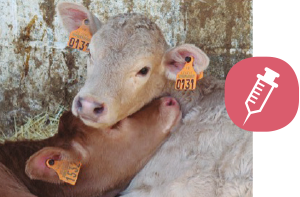
During the first week of arrival, a dewormer is used, oral antibiotics are not used, and the use of antibiotics as a general treatment is being minimized.
 ECONOMIC DATA
MORTALITY
The mortality rate in our farms is between 4.5 and 5% in Friesian animals while in colored animals it is 5 to 7% as they are more delicate animals.
PRICE
We must consider that the purchase price of these calves can vary between €200 and €230 for Friesian calves weighing 50-55 kg and between €400-500 for crossbred colored calves weighing between 65-75 kg.
TOTAL COST
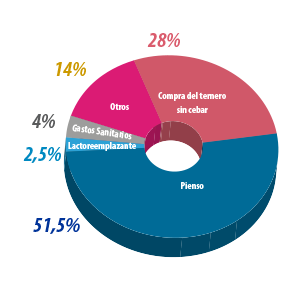
The total cost for fattening a calf is approximately €800, of which 28% corresponds to the purchase of the unfattened animal.
The cost of feeding is the highest, representing 54% of the total.
The cost of the milk replacer accounts for 2.5% while the feed represents 51.5%, as a fattened calf over 305 days consumes about 1,850 kg of feed.
Between 3.5 and 4% is due to health expenses, the rest of the expenses correspond to losses, labor, and others.
The selling price varies between €3.49 and €3.8 per kilogram of carcass.