


 Latinoamérica
 Europa
Managing a Dairy Farm – A Goal-Oriented Task







The dairy cattle sector evolves rapidly and dynamically. Adapting to this continuous process of change and specialization requires a wide range of technical knowledge, so the owner of a dairy farm must work with broad concepts of:
- Veterinary Science
- Nutrition
- Milking Facilities
- Machinery
- Agronomy
Managing a dairy farm is a very complicated task due to its vast amount of notions and specifications, almost impossible to carry out if it has to be combined with the farm’s own tasks, such as milking, feeding the animals, cleaning facilities…
It is essential for the farmer of a dairy farm to adopt a role of managing professional teams.
To manage their farm, they must surround themselves with a team of qualified managers to help oversee each of the specific areas or plots of the farm related to:
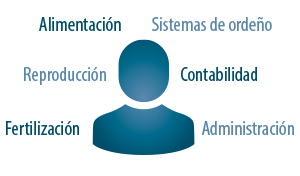
The farmer must choose, coordinate, and interrelate their team of professionals to define with them the strategies and objectives they wish to implement on their farm.
Objectives of a Dairy Farm
The objectives of a dairy farm must be defined, agreed upon, and approved by the farm owner along with their team of professionals, and as a fundamental premise, they must be quantifiable (through results) and time-bound (i.e., semi-annual, annual, by complete lactations, etc.).
In short, it is about defining a work protocol in which it is necessary to manage and determine what will be done, who will do it, and how it will be done.
Definition & Projection of Objectives
In defining and projecting objectives, it is important to consider that nutritional and health-related factors of the animals are the drivers of short-term farm productivity, with reproduction being the basic indicator to sustain production levels in the long term.
Each objective must have one or more responsible parties assigned, and once the execution timelines and action methods are defined, there will be intermediate review periods to observe its evolution, possible deviations, and implement corrective measures to achieve the previously agreed results.
The purposes of each objective must be specific to each farm and generated from the farm’s internal data, to analyze and evaluate an individual improvement process.
Progress in a dairy farm is difficult to achieve if we do not know where we are and where we are going. Management criteria must be adopted where numbers, not emotions, are responsible for farm decision-making.
Example 1. Reproduction Plot
Annual Objective
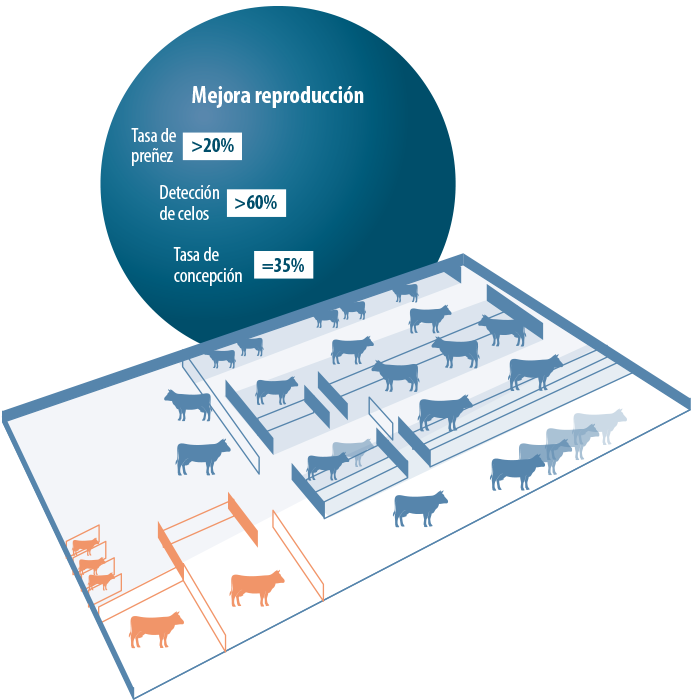
The person responsible for the reproduction plot may have an annual objective of improving the farm’s pregnancy rate, a value that should be above 20%.
A very good figure would be values close to 30%.
It is logical to link this objective to the size of the farm, as it is considered that this percentage in farms with fewer than 100 cows is higher than in larger farms; however, no significant percentage differences are observed in farms with 100 cows or more.
Corrective Measures
If negative deviations are observed during the objective’s development reviews, corrective measures will be adopted to try to steer the situation.
These measures could start from a review of the oestrus detection results, which should be above 60%, the voluntary waiting period for the first artificial insemination, which can be applied between 50 and 70 days after calving, and a verification of the conception rate value, which should be around 35%.
Example 2. Feeding Plot
Semi-annual Objective
The person responsible for feed management, considering the farm’s forage characteristics and availability, may have a semi-annual objective of reducing feeding costs.
Due to its impact and potential for improvement, the evolution of cost should be considered a constant objective in the trajectory of a dairy cattle farm and examined independently of factors such as milk price or raw material prices.
Feeding Cost
The feeding cost takes on a very significant specific weight in the management of a dairy farm, becoming one of the key factors in achieving one of the global and basic objectives in farming, which is to achieve a production cost ranging between 30–32 cents/L.
Considered as the most important variable cost (dependent on production), its value will range between 50–60% of the total production cost per liter of milk on a farm.
Correction of Objective Deviations
In correcting possible deviations from this objective, the number one rule of dairy profitability must be applied:
Never sacrifice milk production, because income always decreases faster than expenses. One kilogram of dry matter intake above maintenance requirements can mean two additional kilograms of milk produced.
Measures to Consider
Maximize milk price, focusing on reducing somatic cells, improving hygienic quality, and increasing solids.
Try to link the ingredient price with its nutrient value (for example: that the fiber quality influences the alfalfa price or that the starch percentage determines the corn silage price).
Achieving forages with a good level of dry matter and digestibility directly influences the increase in production and decreases the feeding cost per liter.
Review management guidelines for growth, feeding, and management of heifers.
The constant evolution of the dairy sector implies the definition of new objectives
Economic Profitability of a Dairy Farm
Starting from a fundamental premise such as the economic profitability of a dairy farm, the current social situation forces us to consider two new concepts linked to the dairy sector:
Animal Welfare on the Farm
Animal welfare is an aspect that will increasingly gain prominence in the actions to be developed on a farm, marked by three priorities:
- The proper functioning of the organism will result from having healthy and well-fed animals
- Absence of negative emotions in animals such as chronic pain and/or fear
- Possibility of expressing species-specific behaviors
There is a relationship between animal welfare and food safety. If the cow is stressed, the likelihood of diseases that affect milk quality and stability increases significantly.
Impact of Livestock Activity on the Environment
The intensification of livestock activity impacts the environment, as it can alter the balance between agricultural and livestock systems and generate significant impacts on the environment.
 The application of both concepts will involve the definition and implementation of actions and strategies on dairy cattle farms based on environmental sustainability and animal welfare.
Animal Welfare & Environment – Modes of Action
Comfort
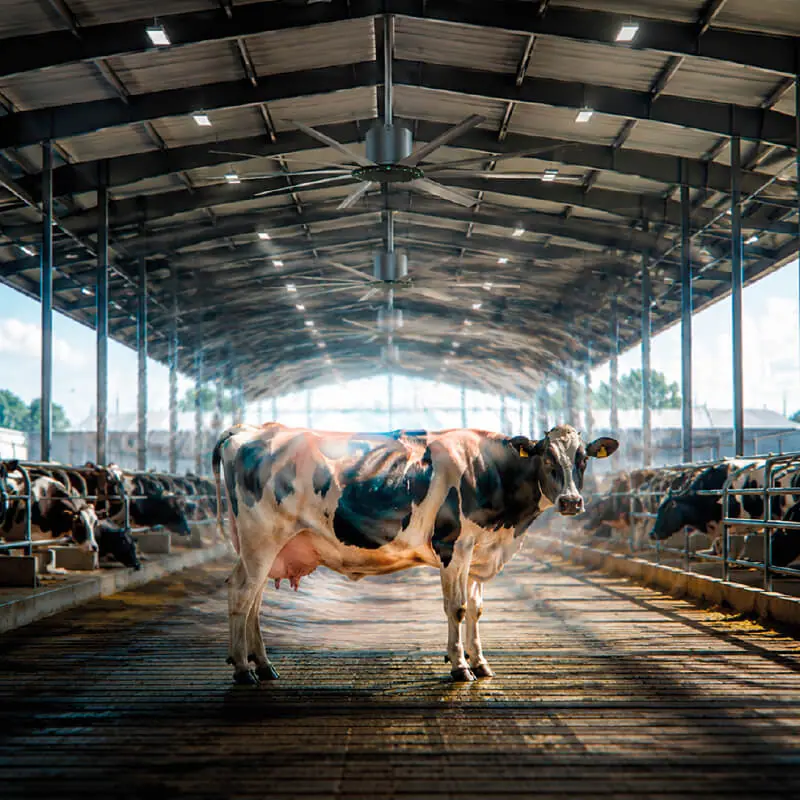
Improvements in farm facilities aimed at providing cows with better thermal and physical comfort to reduce the risk of diseases. It is proven that cows require 11 to 12 hours of rest daily, and for them, rest is a priority over food, so they will sacrifice time spent eating to compensate for lost rest time.
Sizing
Establish a relationship between the number of animals present on a farm and the sizing of the facilities it has for them.
Sustainability
Implement strategies in agricultural-livestock activity, directly involved in environmental sustainability and its influence on resources such as air, soil, and water (air quality, soil toxicity, proper and non-polluting water management).
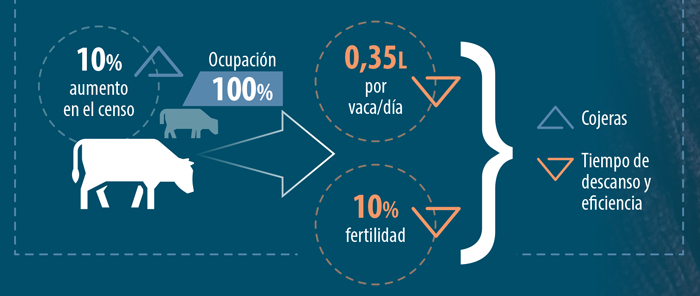
It has been proven that with a 10% increase in livestock census over 100% of its occupancy, milk production decreases by 0.35 liters per cow per day, fertility drops by 10%, lameness increases, and rest time and efficiency decrease, negatively affecting farm profit (Jose Luis Juaristi, 2017).
It is essential to carry out actions that result from consumer opinion, a figure that increasingly plays a greater role in the development, design, and characteristics of the final product they will consume.
The Consumer
Today, we find different consumer profiles that are increasingly informed and more demanding with the products they consume.
The quality of the food purchased is one of the main concerns for both the end customer and the company responsible for its commercialization.
Consumers, traditionally passive subjects or simple value exchangers, have now adopted a new role: that of value creators and competitive advantage. Their opinion is considered a strategy to strengthen brand value and positively influence product perceptions.

Animal Welfare
The integration and management of animal welfare in the food chain has led to greater consumer interest in this first link of production.
According to the latest surveys (Attitudes of Consumers, Retailers and Producers to Animal Welfare, 2016) conducted on the subject, 69% of European consumers rate the treatment animals receive on the farm, during transport, and at the slaughterhouse as “important.”
Sustainable Consumption & Production
Sustainable consumption and production are concepts increasingly valued and used by consumers, based on:
- Efficient use of resources and energy
- Construction of infrastructures that do not harm the environment Improvement of access to basic services
- Creation of green jobs, fairly remunerated and with good working conditions
These concepts translate into a better quality of life for everyone, helping to achieve general development plans that reduce economic, environmental, and social costs, increase competitiveness, and reduce poverty.
Greater producer-consumer interaction should not go unnoticed by the farmer and should be seriously considered in defining future strategies and objectives for their farm.