


 Latinoamérica
 Europa
Challenges and Physiological Adaptations of Weaning in Ruminants: Rumen Development and Metabolism










| The objective of calf rearing is to obtain a healthy and highly productive dairy cow. To achieve this, it is very important to consider the pre-weaning health of the calf, as mortality and morbidity rates remain high in these animals. |
A recent study conducted in Germany revealed mortality rates of up to 17% in calves (from birth to 6 months of age) in dairy farms.
 These high mortality and morbidity rates not only negatively affect the economy of the farms, but also severely compromise the health and welfare of the animals.
THE RUMEN, THE KEY POINT
 The development of the rumen is one of the most demanding physiological challenges for young ruminants, as it is a process that not only involves cell growth and differentiation, but also entails a significant change in the pattern of nutrient delivery to the small intestine and liver and, therefore, to the animal’s peripheral tissues.
The ruminal epithelium plays key physiological roles, such as the absorption, transport, and metabolism of short-chain fatty acids.
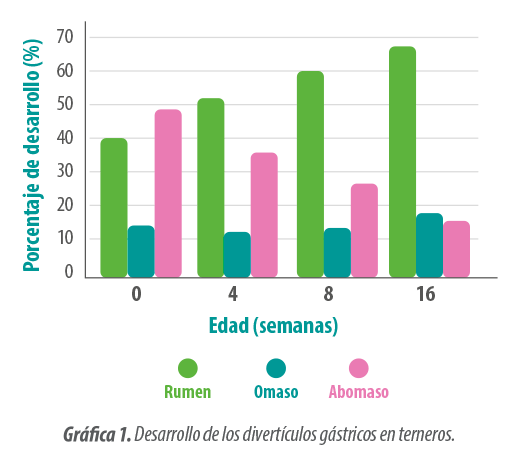
Unlike other organs, whose function decreases in relation to “empty body weight” as the ruminant matures, the rumen undergoes remarkable growth, increasing from 30% to 70% of the total capacity of the gastrointestinal system during the weaning process (Figure 1).
| In mammals, the intestinal tissue undergoes an intense cellular proliferation, both during fetal development and in the early postnatal stages, in response to the need to digest and absorb the nutrients present in milk.
|
 The variations in the composition of the nutrients supplied to the gastrointestinal tract can significantly influence this cellular proliferation, affecting the overall utilization of the feed and, ultimately, the availability of essential nutrients for growth.
| The liver is the central organ that regulates the distribution of nutrients to the periphery to support growth, needing to adapt to the nutrient absorption patterns derived from rumen development.
|
 In the preruminant, hepatic metabolism is dominated by a high glycolytic activity, while gluconeogenesis is less significant in comparison.
 In adult ruminants, the ketogenic function (glucose metabolism) is significantly reduced, while gluconeogenesis becomes more predominant and constant. Additionally, this process shows less sensitivity to glycolytic and glycogenic hormonal regulation mechanisms.
STAGES OF RUMEN DEVELOPMENT
In neonatal calves, the rumen is underdeveloped, both in its physical structure and metabolic functionality:
 It lacks the high degree of keratinization that characterizes the organ in its mature stage.
Metabolically, the rumen is practically inactive in terms of ketogenic capacity, meaning it does not efficiently perform carbohydrate breakdown or the fermentative processes typical of the adult animal.
| After the initiation of solid feed intake and subsequent establishment of ruminal fermentation, its physical and metabolic development begins. The physical development of the rumen involves two processes:1. Increase in ruminal mass (thickness of the wall). 2. Growth of ruminal papillae. |
Initial research suggested that the physical stimulation of the rumen by the presence of feed could be related to observable increases in the weight of the organ and its musculature.
 However, it has been proven that the mere presence of physical mass is not sufficient to promote the development of ruminal papillae.
For the ruminal epithelium to progress, a viable and constant fermentation process must be established, which suggests that the presence of short-chain fatty acids or volatile fatty acids (VFA) in the rumen lumen is needed to promote normal papillary development.
 Animals fed with grain and hay show a harmonious development of the rumen, both in weight and absorption capacity. Animals fed with grain and hay show a harmonious development of the rumen, both in weight and absorption capacity.
In contrast, neonates fed exclusively with milk during the first months of life present a limited ruminal development in aspects such as:
|
 The weight and capacity of the rumen.
It is likely that this lack of ruminal development is related to the effective diversion of milk directly to the abomasum through the reflex closure of the esophageal groove. This mechanism prevents milk or milk replacer from entering the rumen, thus preventing its fermentation.
 In classical trials, when milk was infused directly into the rumen, it resulted in VFA production and stimulated papillary growth.
 Lane and Jesse (1997) performed an infusion of 50% of the net energy requirements in lambs in the form of VFA at physiological concentrations, resulting in an increase in papillae length. Lane and Jesse (1997) performed an infusion of 50% of the net energy requirements in lambs in the form of VFA at physiological concentrations, resulting in an increase in papillae length.
Sodium propionate and sodium butyrate infusions led to a marked development of ruminal papillae in calves. A mixture of VFA salts (including propionate and butyrate) supplemented within 10% of a starter concentrate ration resulted in an increased incidence of ruminal parakeratosis and, in all treated animals, a thickening of the stratum corneum was observed, both in calves and lambs. |
 Increasing the amounts of concentrate in the diet did not produce any change in the rumen musculature, but it did lead to an increase in the density and height of the papillae in calves and lambs. Increasing the amounts of concentrate in the diet did not produce any change in the rumen musculature, but it did lead to an increase in the density and height of the papillae in calves and lambs. |
 A single mechanism responsible for papillary development has not been identified.
However, there are several processes that could be involved:
 The metabolism of butyrate and propionate in the rumen epithelium that causes an increase in blood flow through the rumen.
The direct effect of butyrate or propionate on gene expression within the rumen.
| In this regard, Wang et al. (1996) reported the identification of genes encoding two small proline-rich proteins associated with the development of the keratinized envelope of stratified squamous epithelial tissues (skin, rumen epithelium) and, therefore, may represent excellent molecular markers of the physical development of the rumen. |
These genes have a pattern of differential expression throughout the development of normally raised animals,
increasing their expression gradually, indicating a rather ontogenic control* than a change induced by an external trigger in the expression of these gene products.
 The proliferation of rumen epithelial cells has been studied, both in vivo and in vitro, by measuring the incorporation of 3H-thymidine and mitotic indices.
Butyric acid infused directly into the rumen stimulated mitotic indices (number of basal cell nuclei showing mitotic figures/total basal cell nuclei counted).
*Ontogeny is the history of the structural change of a unit without losing its organization. This continuous structural change occurs in the unit, at each moment, either as a change triggered by interactions from the environment where it is located or as a result of its internal dynamics.
A rapid increase, but not sustained, of butyrate in the rumen, which does not occur physiologically, stimulates cell proliferation, as evidenced by higher mitotic indices.
 To a lesser extent than with butyrate, it has been shown that both propionate and acetate stimulate mitotic indices when administered in a single dose, indicating that it is the presence of VFAs that causes the proliferation of ruminal tissue.
In vitro assays yield results completely opposite to those obtained in vivo, highlighting the differences between these responses and the apparently contradictory nature of the findings in in vivo models. All this points to the existence of an indirect pathway of cellular stimulation. Additionally, it has been found that intravenous infusions of insulin stimulate mitotic indices in the ruminal epithelium.
 On the other hand, since propionate has been shown to be a stimulator of insulin release in vivo, it is possible that insulin may be a mediator in the stimulation of mitosis in the ruminal epithelium.
 Therefore, other factors, besides the direct action of nutrients, cannot be ruled out as possible agents regulating ruminal epithelial proliferation, although their conclusive identification is still pending.

 In ruminants fed only with milk, due to the closure of the “esophageal groove” and the lack of VFA in the ruminal lumen, the main source of energy substrates is the nutrients absorbed intestinally. In ruminants fed only with milk, due to the closure of the “esophageal groove” and the lack of VFA in the ruminal lumen, the main source of energy substrates is the nutrients absorbed intestinally. |
The fatty acids and glucose absorbed in the small intestine must first pass through the liver. For this reason, glucose is the main energy substrate for immature tissues, as is the case with other neonatal tissues.
 Oxygen absorption in the neonatal rumen increases significantly when glucose is present as an oxidizable substrate in the ruminal lumen. Likewise, in mature ruminal papillae, oxygen consumption also increases above basal levels when glucose is added.
 In contrast, the addition of butyrate increases oxygen absorption more notably in mature ruminal papillae than in the neonatal rumen. Furthermore, butyrate ketogenesis is significantly lower in the neonatal rumen compared to mature tissue, suggesting that, at this stage of development, butyrate is used directly in the rumen epithelial tissue.
| In this regard, Lane et al. (2000) studied the metabolic development of the ruminal epithelium in lambs fed exclusively with milk replacer, without solid feed intake, observing a characteristic and significant increase in ketogenic capacity at 42 days, independent of the dietary regimen. |
 While other metabolic parameters did not follow this characteristic development, this is again indicative of an ontogenic response rather than a nutrient-triggered event.
 Additionally, when analyzing the rumen epithelial RNA isolated from these same experimental animals, an increase in gene transcripts was observed, even in the absence of significant VFA production in the rumen.
 The ontogenic control of some of the critical changes in ruminant development cannot be ruled out as a causal factor, despite the large amount of evidence implicating butyrate as the supposed trigger for development. What is clear is that these processes do not have to be mutually exclusive. The ontogenic control of some of the critical changes in ruminant development cannot be ruled out as a causal factor, despite the large amount of evidence implicating butyrate as the supposed trigger for development. What is clear is that these processes do not have to be mutually exclusive. |
You may be interested in: Precision nutrition in cattle