


 Latinoamérica
 Europa
Control of Nematodes in Small Ruminants with Natural Bioactive Compounds








Any sheep and/or goat production system whose feeding is based on pasture utilization invariably faces the presence of gastrointestinal nematodes (GIN).
Currently, the infection caused by GIN is still considered a major health threat to sheep and goat herds, negatively impacting the viability and profitability of these production systems.
 This situation is exacerbated by the emergence of strains of GIN resistant to conventional anthelmintics (AH) and even to the most recently introduced active ingredients on the market.
 It is estimated that the losses caused by GIN infection and its associated costs are, on average:
- 151 million euros in dairy sheep.
- 206 million euros in meat sheep.
- 86 million euros in dairy goats.
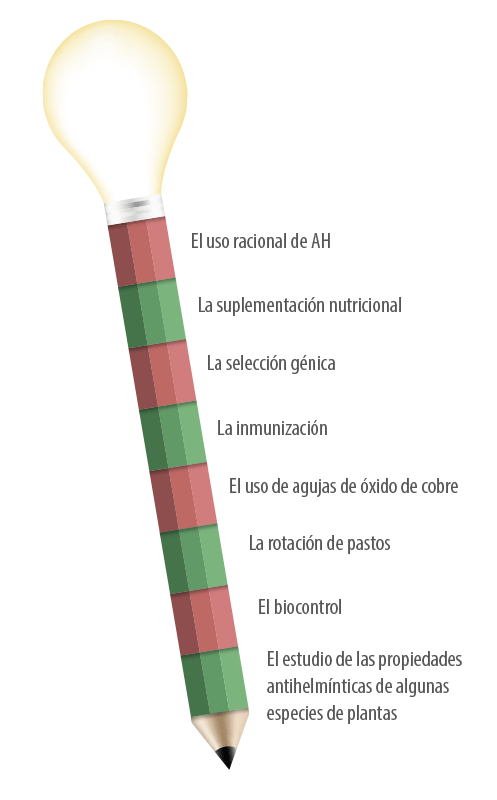
 In order to find non-pharmacological alternatives to address the high resistance rates of GIN to AH, various strategies have been proposed, encompassed under the term “Integrated Gastrointestinal Nematode Control.” In order to find non-pharmacological alternatives to address the high resistance rates of GIN to AH, various strategies have been proposed, encompassed under the term “Integrated Gastrointestinal Nematode Control.” |
SECONDARY METABOLITES OF PLANTS AND THEIR ANTHELMINTIC PROPERTIES
Invariably, all plant species produce different amounts and concentrations of certain compounds with multiple biological functions, known as secondary metabolites of plants (SMP).
The production of SMP depends on:
 Plant exposure to light
Temperature
Stress
Specific soil characteristics, such as salinity and pH
Due to the heterogeneity of their chemical composition, there are many methods of classifying MSPs, but three major functional groups have been established:
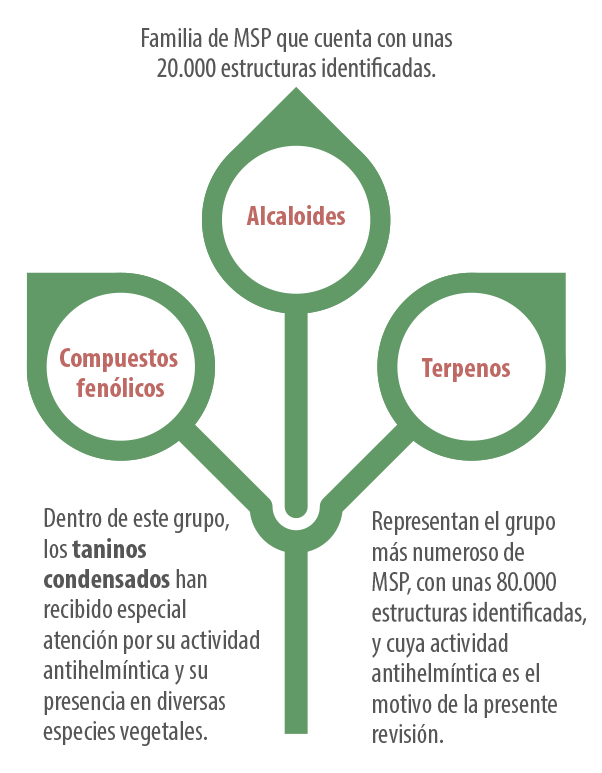
Terpenes, terpenoids, and isoprenoids
These MSPs are part of the most diverse and complex group from a chemical and structural point of view.
 In general, terpenes are volatile substances, mainly responsible for the scent of many plants and fruits.
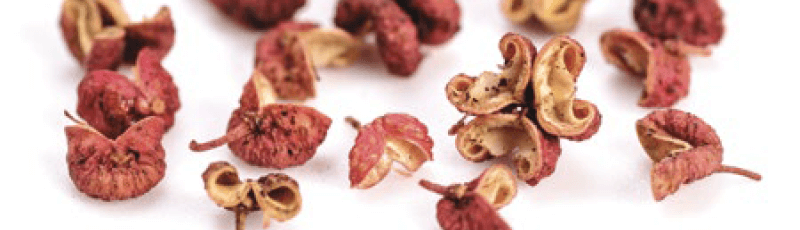
Essential oils
Essential oils (EOs) are very heterogeneous in their chemical composition and in the wide variety of properties attributed to them in different fields, such as the pharmaceutical, cosmetic, veterinary, and livestock industries.
 Despite their name, they are not true oils. Similarly, the term essential does not refer to a determining property, but rather to the fact that they derive from the components responsible for the fragrance or quinta essentia of the plants.
| As a result of the search for non-pharmacological strategies to address resistance to AH and NGI, the anthelmintic properties of terpenes and EOs have been documented. |
 IN VIVO APPROACH TO THE EVALUATION OF COMPOUNDS WITH BIOACTIVE POTENTIAL IN SMALL RUMINANTS
It should be noted that there are still no official guidelines to determine the efficacy of natural products in ruminants, so the work carried out to date has used the official guidelines designed to evaluate synthetic products or publications prepared by experts in the field.
 This type of strategies involves the in vitro study of the anthelmintic properties of plants or their extracts and their impact on the different stages of the NGI biological cycle.
The in vitro tests have a low cost, a faster result time, and offer the possibility to examine a relatively wide number of materials in a short period of time.
However, they do not reflect the multifactorial nature of animal physiology, in which:
1. There is a dynamic in the quantities and concentrations of the compounds entering the digestive system.
2. The rate and sequence with which the MSP enter and are processed is variable and changing.
3. A high intake of fresh plant material by the animals is required to reach the concentrations that show positive results under in vitro conditions.
4. The microbial populations in the rumen have the ability to develop adaptations to the MSP.
| Therefore, due to the difficulty of reproducing these factors, the evaluation in vivo (in the host) constitutes the best alternative to determine the anthelmintic value of plants and their derivatives. |
For the development of the in vivo approach in the evaluation of the anthelmintic activity of natural products, two methodologies can be implemented.
NGI Fecal Egg Count Reduction Test (FECRT)
 The bioactive material is administered to a group of animals and a quantitative monitoring of the excretion of eggs per gram (EPG) of NGI is carried out over a period of time (before and after treatment).
Controlled Test (CT)
It has the same fundamentals as the FECRT, but requires establishing a control group and performing humane sacrifices of the animals in order to recover the organs of the gastrointestinal tract where the adult NGI are located.
Subsequently, counts of the NGI populations are carried out, as well as measurements on the recovered specimens, allowing for a comparison between experimental groups.
| This methodology, although more costly and labor-intensive, is the most reliable for evaluating the anthelmintic activity of a natural product. |
EXPERIENCES IN THE USE OF TERPENES AND ESSENTIAL OILS AGAINST GASTROINTESTINAL NEMATODES IN SHEEP AND GOATS
The TRCFH was used in all the studies included in this review. The results of the dynamics in the EPG counts after the administration of PRT or EOs were variable, showing activities that can be classified as:
 Null
Null
Moderate
Positive
Outstanding
Although these responses in the dynamics of NGI infection come from a limited number of studies and are somewhat ambiguous, they allow us to glimpse the therapeutic potential of these compounds in small ruminants.
In the works of Ketzis et al. and Katiki et al., the administration of EOs from Chenopodium ambrosioides and Cymbopogon schoenanthus, respectively, had no effect on the number of adult NGI recovered at necropsy.
| In contrast, Camurça et al. reported significant results of a certain level of selectivity of EOs of Lippia sidoides on the populations of Haemonchus contortus. |
Likewise, the EOs of the fruits of Zanthoxylum zanthoxyloides and an encapsulated solution of the terpenes anethole and carvone reduced:
The number of adult NGI
The size of the males
The number of eggs produced per female
The mechanisms of action by which the terpenes or EOs affect the NGI are still uncertain, but it has been proposed that, due to their hydrophobic nature, the cell membrane constitutes their main target.
These compounds penetrate the structures of the GIN through transcuticular diffusion, interfering with their metabolism and impeding vital functions, and even affecting some locomotion mechanisms.
According to López and Pascual-Villalobos, the EOs exhibit activity on acetylcholinesterase receptors present in vertebrates and invertebrates, producing a neurotoxic damage similar to that of organophosphates.
However, it is worth noting that the bioactivity of terpenes and EOs against other organisms can be as broad and diverse as the large number of identified molecules.
| The research and development of natural products with anthelmintic properties have emerged as a response to the growing populations of GIN resistant to commercial AHs. |
During this review, the existence of GIN populations resistant to ivermectin became evident, with reductions in FEC elimination of the order of 67–85%, 35–54%, and 25% being reported.
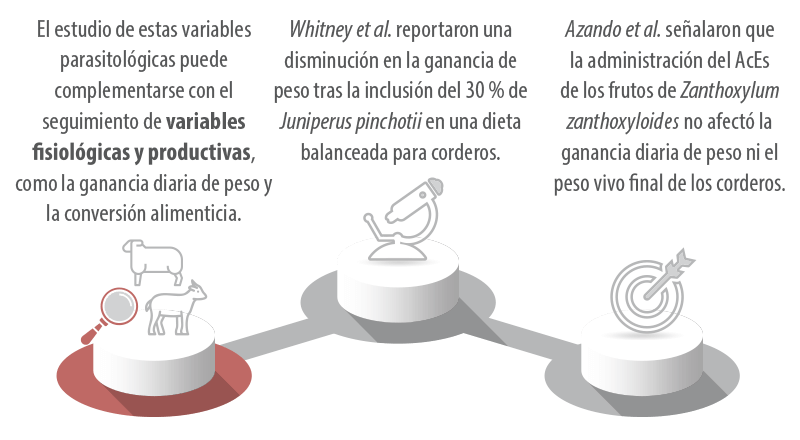
| In this regard, although the results tend to indicate some impact on productive variables, future work should establish the cost-benefit relationship between nutrition and health. |
CONCLUSIONS
Currently, around 80,000 plant species have been identified that exert some influence on animal health and productivity.
It is necessary to understand the nature of their interactions with herbivores to recommend their use as resources with nutritional and pharmaceutical benefits in sheep and goat production systems.
These benefits could materialize in the so-called functional foods or nutraceutical resources.
 Future research should consider the factors that may influence the bioactive properties of natural compounds, such as dosage, bioavailability, plant harvesting season, MSP or EOs extraction method, presence of other MSPs, and possible interactions between them.
Similarly, factors related to the animals must be considered, such as the route of administration, productive behavior, nutritional level, physiological state, and level of adaptation to MSPs.