


 Latinoamérica
 Europa
Genetic Improvement for the Sustainability of Dairy Sheep through Mitigation and Adaptation Strategies to Climate Change: SUMAsheep Project


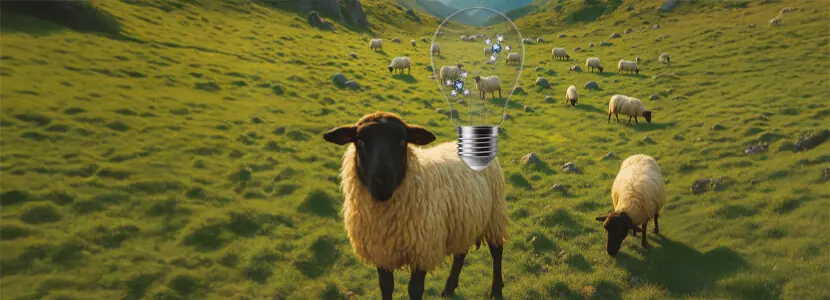












Historically, dairy sheep genetic improvement programs have primarily focused on increasing milk production and fat and protein content.
 In the case of the Latxa and Manchega breeds, these programs have been in place since the 1990s, leading to a consolidated genetic and phenotypic increase in the mentioned traits.
| In response to current demands, both social and from the livestock sector in general, genetic improvement schemes have continued to evolve towards the study of new traits that are complementary to purely productive ones, traits that are grouped under the concept of SUSTAINABILITY. |
 This is why the SUMAsheep project was born, a proposal funded in the 2022 call for KNOWLEDGE GENERATION PROJECTS, within the framework of the State Program to promote Scientific-Technical Research and its Transfer, in the State Plan for Scientific, Technical and Innovation Research 2021-2023.
The project will last for 3 years and aims to generate knowledge that helps comprehensively boost the viability of the dairy sheep sector of the Latxa and Manchega breeds in the face of a future marked by climate change.
| The project proposes to integrate, within the improvement objectives, environmental sustainability through the combination of mitigation and adaptation strategies to climate change, as a tool to improve resilience. |
CLIMATE CHANGE MITIGATION STRATEGIES
In terms of climate change mitigation, a useful and promising tool is the reduction of greenhouse gas emissions to the atmosphere, mainly:
 Carbon dioxide (CO₂)
Methane (CH₄)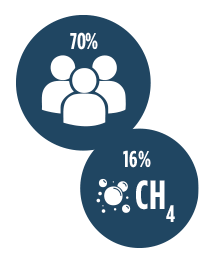
Nitrous oxide (N2O)
Of these gases, 70% have an anthropogenic origin (they are produced by human activity), and of this percentage, 16% corresponds to methane.
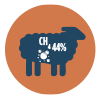 Enteric fermentation of ruminants is the main source of methane production, accounting for 44% of global emissions attributed to livestock activity (FAO, 2020). Enteric fermentation of ruminants is the main source of methane production, accounting for 44% of global emissions attributed to livestock activity (FAO, 2020). |
Methane Emission Mitigation
Strategies for mitigating methane emissions generally include the inclusion of feed additives in the diet that modulate the rumen microbiota and, consequently, the fermentation patterns and gas emissions.
 There are also other strategies, such as genetic improvement aimed at selecting animals that emit less, which are cumulative from generation to generation and long-lasting over time.
 However, this approach requires time to achieve noticeable effects of genetic progress in the population.
Due to the scarcity of information on in vivo methane emissions in sheep—essential to understand their nature and study their genetic basis—, the SUMAsheep project has focused on collecting individual data from Latxa and Manchega breed sheep over the past three years.
So far, the methane exhaled by lactating sheep has been measured individually 3 times a month using non-invasive techniques (sniffer) in the experimental herds of Neiker (Basque Country) and IRIAF (Castilla-La Mancha).
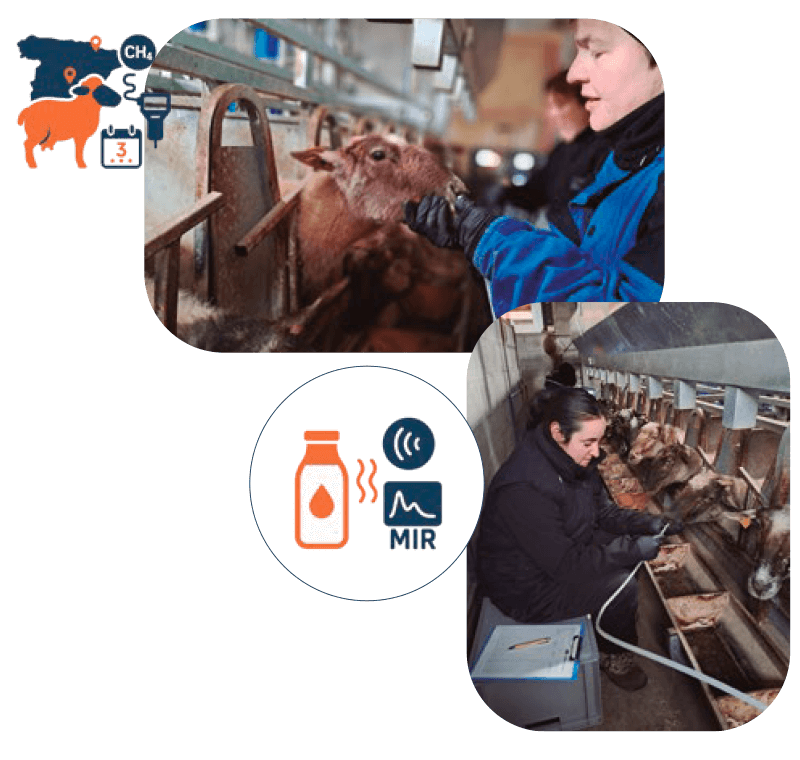
 In parallel, milk samples have been taken to obtain mid-infrared (MIR) spectroscopy readings, to evaluate the possibility of using them as indirect indicators of methane emissions. In parallel, milk samples have been taken to obtain mid-infrared (MIR) spectroscopy readings, to evaluate the possibility of using them as indirect indicators of methane emissions. |
 Currently, the data collected in the 2024 and 2025 campaigns are being analyzed, but it will not be until the end of 2026 that the most complete database will be available to obtain the most representative results of these populations. Currently, the data collected in the 2024 and 2025 campaigns are being analyzed, but it will not be until the end of 2026 that the most complete database will be available to obtain the most representative results of these populations. |
CLIMATE CHANGE ADAPTATION STRATEGIES
Climatology is being affected by global warming, and the Mediterranean region is classified as a vulnerable area.
 During the last third of this century, increases in summer temperatures of between 5 ºC and 7 ºC have been predicted in the central-southern areas of the Iberian Peninsula (De Castro et al., 2005).
 It is forecasted that by the year 2050 there will be areas in the center, south, east, and northeast of the Peninsula where alert conditions for animal production systems in the summer months will occur (Signalini et al. 2013).
 The heat stress has a marked negative effect on the productivity and reproductive ability of farm animals, which in turn leads to significant economic losses.
 In this context, genetic improvement emerges as a long-term tool to enhance the adaptive capacity of animals to stressful environmental conditions, through the identification and selection of the most resilient animals. In this context, genetic improvement emerges as a long-term tool to enhance the adaptive capacity of animals to stressful environmental conditions, through the identification and selection of the most resilient animals. |
To evaluate the implementation of thermotolerance as a new improvement objective, it is necessary to have climatological and productive information (dairy control data) that allows:
1. Identify the comfort thresholds at the population level and the associated productive losses.
2. Estimate the individual response capacity, and identify the animals that respond best to thermal stress conditions.
 Within the framework of the SUMAsheep project, thermotolerance studies of the Latxa and Manchega breeds have been carried out, using information from the average temperature recorded on the day of the official milk control over the last 10 years.
 The climatic data have been downloaded from the NASA open repository, individually for 48 herds of Latxa and 83 of Manchega, using the geographical coordinates of each herd.
| With all the information collected, it is intended to evaluate different phenotypes or indicators of heat tolerance and estimate their genetic parameters. |
WHAT SPECIFIC RESULTS ARE EXPECTED TO BE ACHIEVED WITH THE SUMAsheep PROJECT?
At the end of the project, several objectives are expected to be achieved, which can be summarized as:
 Implementation of methane emissions as a new selection objective, through the incorporation of information obtained at the farm level and the use of MIR spectra as an indirect indicator of these emissions.
Implementation of heat tolerance as a new selection objective, through the definition of a set of indicators and selection criteria.
Definition of a selection index that integrates the selection objectives of each of the breeds (milk production, composition and udder morphology), along with the mitigation and adaptation objectives defined in the project.
Acknowledgements
To the R&D&I project SUMASHEEP (PID2022-137504OR), funded by MCIU/AEI/10.13039/501100011033/ and by “FEDER A way of making Europe“; to the Confederation of Breeders’ Associations of Latxa and Carranzana Sheep Breeds (CONFELAC) and the National Association of Breeders of Select Manchega Sheep (AGRAMA), for providing phenotypic and genealogical data.