


 Latinoamérica
 Europa
New Strategies to Increase Conception Rate in Dairy Cows



 Carrer Barcelonès, 26 Les Franqueses del Vallès 08520
  +34 93 849 51 33
WHEN AND HOW TO INCREASE PROGESTERONE TO IMPROVE FERTILITY IN CATTLE.
STRATEGIC USE OF HUMAN CHORIONIC GONADOTROPIN (hCG) IN MULTIPAROUS COWS: EXPERIENCE IN SPAIN
Authors:
Dr. José María Sánchez. Ramón y Cajal Researcher at the Andalusian Institute of Agricultural and
Fisheries Research and Training, Food and Organic Production (IFAPA).
Inmaculada Cuevas Gómez. Postdoctoral Researcher of the Junta de Andalucía. Andalusian
Institute of Agricultural, Fisheries and Organic Production Research.
Javier Jiménez Bejarano. Product Manager Livestock. LABORATORIOS CALIER S.A
In dairy production systems, fertility is a fundamental pillar to improve the efficiency and profitability of the herd, as reducing the calving interval contributes to increased milk production (De Vries, 2006). Considering that gestation in cows lasts approximately 283 days, it is necessary for the animal to conceive again within 80 to 90 days postpartum to achieve a calving interval of 365 days.
The establishment of a viable pregnancy depends on a sequence of key reproductive events: the ovulation of a competent oocyte, its fertilization by a capacitated sperm, and the development of the embryo in a favorable uterine environment.
 Although the fertilization rate after artificial insemination (AI) is between 80 and 90%, many of the resulting embryos do not reach term. Although the fertilization rate after artificial insemination (AI) is between 80 and 90%, many of the resulting embryos do not reach term. |
In fact, most pregnancy losses occur between fertilization and maternal recognition of pregnancy (Figure 1), which in cattle occurs around day 16 after oestrus (Ribeiro et al., 2018).
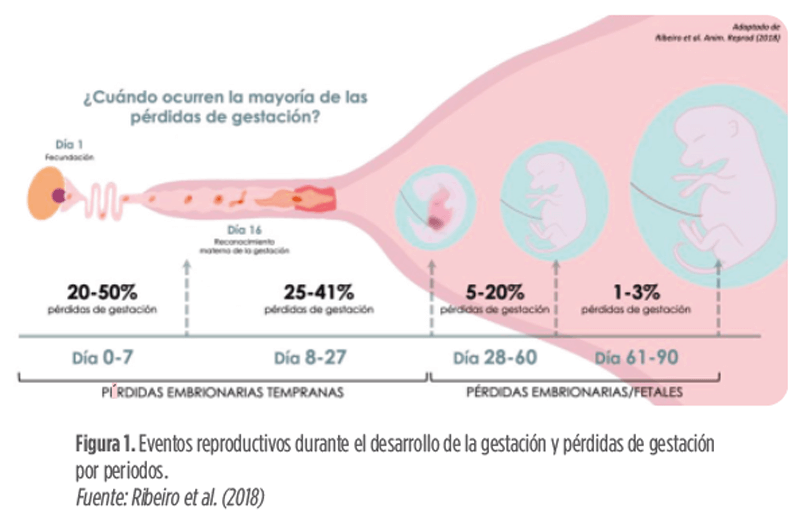
The causes associated with subfertility in high milk yield cows are complex and multifactorial. Progesterone (P4) —a steroid hormone synthesized and secreted by the corpus luteum (CL)— plays a key role in the establishment and maintenance of pregnancy, influencing both oocyte quality and uterine receptivity (Lonergan and Sánchez, 2020).
 A high concentration of P4 during the first week after ovulation, a critical phase of early embryonic development, has been associated with favorable changes in the embryo, in the receptivity of the uterine environment and, ultimately, with better pregnancy rates (O’Hara et al., 2014; Sánchez et al., 2019; Crowe et al., 2024).
 Conversely, low concentrations of circulating P4 during the same period, common in high-producing cows due to elevated hepatic metabolism of steroid hormones (Wiltbank et al., 2006), compromise endometrial physiology and embryonic development with the consequent reduction in fertility (Lonergan and Sánchez, 2020).
Taking all of the above into account, it seems reasonable to think that the implementation of strategies aimed at increasing P4 concentrations as soon as possible after AI would contribute to improving fertility in high-producing dairy cows.
| The elevated concentration of progesterone during the first week after ovulation has been associated with better pregnancy rates. |
How can we increase P4 in that critical window— the first week post-AI?
An effective strategy is the administration of human chorionic gonadotropin (hCG) in early metoestrus, whose luteotropic effect favors the development of the forming CL.
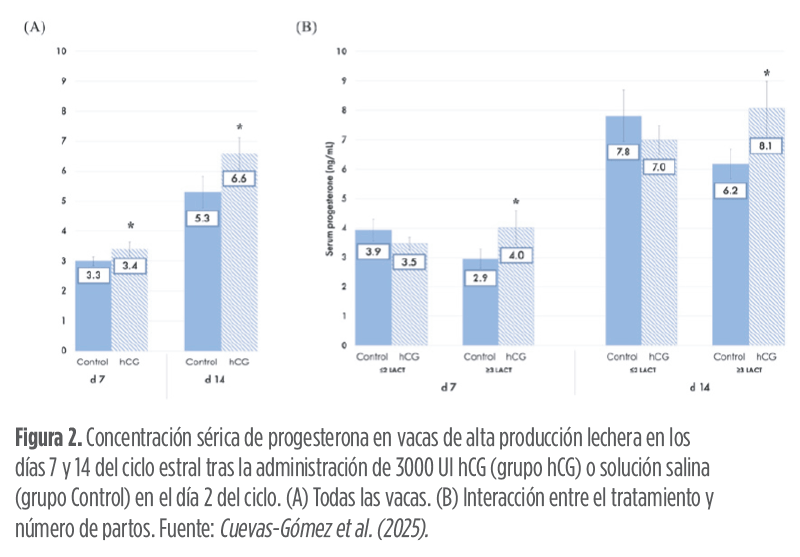
 In a recent study conducted in Spain (Cuevas-Gómez et al., 2025), the administration of hCG on day 2 of the estrous cycle (Day 0 = expected day of oestrus) led to a increase in P4 concentration during the first and second week post-ovulation in high milk yield cows (Figure 2A).
Specifically, when analyzing the effect of the treatment based on parity, this increase was only observed in cows with ≥3 lactations, whose basal P4 levels were lower than in cows with 1st or 2nd lactation (Figure 2B).
In the study by Cuevas-Gómez et al., 2025, the increase in P4 stimulated by the administration of hCG favored the improvement of conception rates at the first postpartum AI in cows with ≥3 lactations (42.1%) compared to the control group (27.3%), thus equating their fertility to that of cows with lower parity (Figure 3).
In contrast, in cows with 1st or 2nd lactation, no differences were observed in P4 concentration or in conception rates at first AI between the treatment and control groups (Figure 3).
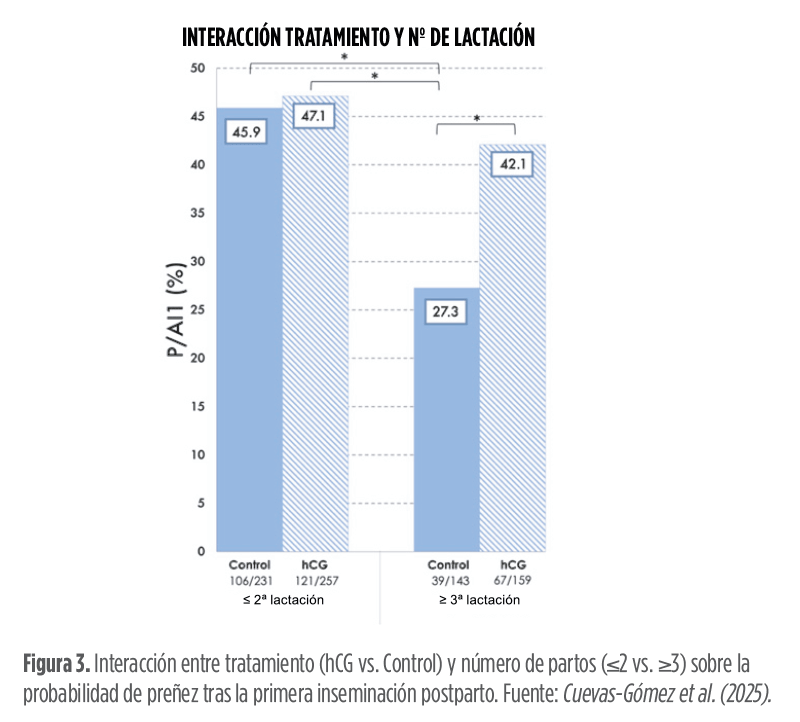
 The application of human chorionic gonadotropin on day 2 of the oestrous cycle increased progesterone concentration in cows with ≥3 lactations, consequently improving the conception rate The application of human chorionic gonadotropin on day 2 of the oestrous cycle increased progesterone concentration in cows with ≥3 lactations, consequently improving the conception rate |
In conclusion, these results suggest that the targeted use of hCG on day 2 of the oestrous cycle could be used to improve reproductive efficiency in high-producing cows with ≥3 lactations, a group especially susceptible to reproductive failures associated with suboptimal P4 concentrations.
Consequently, this strategy could help reduce the risk of culling due to infertility and, therefore, extend the useful life of cows in the herd, a key aspect for the sustainability of dairy farms from both an economic and environmental perspective.
KEY ASPECTS FOR THE USE OF HUMAN CHORIONIC GONADOTROPIN (hCG) IN PRIMIPAROUS COWS: EXPERIENCE IN ITALY
Author: Dr. Stefano Allodi. Mantova Veterinary Group. Italy.
In recent years, advances in reproductive physiology have driven the development of fertility programs such as Ovsynch and Double-Ovsynch, especially for high-producing dairy cows.
 A crucial aspect of these programs is the role of progesterone (P4) during the estrous cycle, essential for the maintenance of gestation and embryonic development. A crucial aspect of these programs is the role of progesterone (P4) during the estrous cycle, essential for the maintenance of gestation and embryonic development. |
Several studies have been conducted to increase P4 levels after artificial insemination (AI) in order to improve conception rates or reduce embryonic loss.
Common strategies include the use of gonadotropin-releasing hormone (GnRH), human chorionic gonadotropin (hCG), or exogenous P4 implants. hCG, a potent luteotropic agent with activity similar to LH, has been tested in several studies and has proven effective in improving ovulatory efficiency and increasing P4 levels by promoting the formation of an accessory corpus luteum (CL) (Cabrera et al., 2021a; Nascimento et al., 2013; Cunha et al., 2021b; 2022).
Furthermore, studies have shown that total luteal volume and plasma P4 levels vary after hCG treatment, and treated cows show greater luteal volume with higher P4 levels compared to controls. This supports the hypothesis that elevated P4 levels during the early stages of gestation are beneficial for embryo survival.
| Human chorionic gonadotropin has been shown to improve ovulatory efficiency and increase progesterone levels during the early stages of gestation, enhancing embryo survival. |
However, the effects of hCG treatment on fertility remain inconsistent across different studies. Its efficacy seems to be influenced by various factors, such as the number of calvings (primiparous versus multiparous cows), environmental conditions (e.g., heat stress), and dosage.
Ongoing studies explore the genetic factors that could affect the response to these treatments (Zolini et al., 2019) .
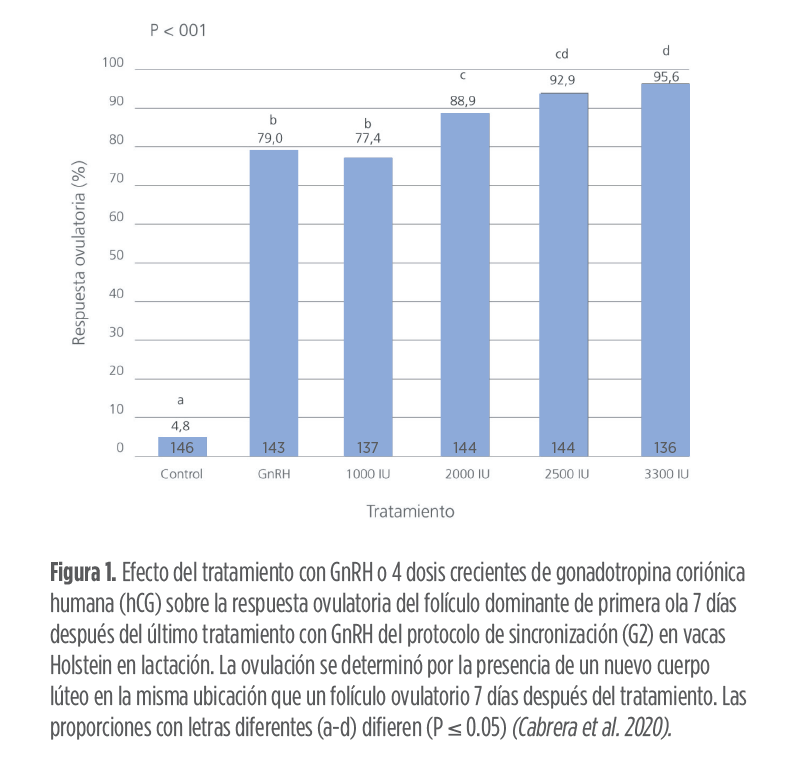
To evaluate the impact of GnRH and increased doses of hCG on ovulatory response and plasma P4 concentrations, a study (Cabrera et al., 2020) was conducted on lactating Holstein cows. Treatments were administered 7 days after the last GnRH injection, following a Double Ovsynch (DO) or Resynch protocol. The cows were assigned to one of the following groups:
Control (no treatment).
GnRH (100 μg).
hCG at doses of 1000, 2000, 2500, or 3300 IU.
The ovulatory response and P4 concentrations were measured 7 days after treatment.
In conclusion, cows treated with 2000, 2500, or 3300 IU of hCG showed greater ovulatory responses and higher P4 concentrations compared to control animals, with the best response observed with 3300 IU.
 The application of 2500 IU was considered the optimal dose as it showed no differences in ovulatory response compared to 3300 IU, and produced the greatest numerical increase in plasma P4 concentration between days 7 and 14. The application of 2500 IU was considered the optimal dose as it showed no differences in ovulatory response compared to 3300 IU, and produced the greatest numerical increase in plasma P4 concentration between days 7 and 14. |
If we analyze more specifically, some studies have highlighted certain efficacy in improving conception rate (CR), especially in primiparous cows.
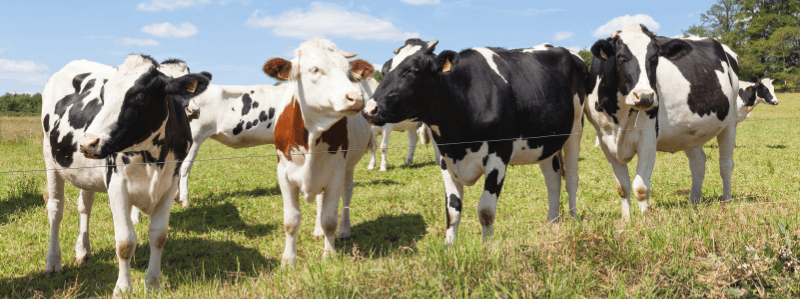
In a study published in 2013 (Nascimento et al.), two independent analyses were conducted:
1| META-ANALYSIS:
Combining data from 10 published studies, it was observed that treatment with hCG (administered between days 4 and 9 post-AI) increased pregnancy per AI (P/AI) by 3.0%. The P/AI was 34% in the control group and 37% in the group treated with hCG.
2| FIELD TRIAL:
A study with 2979 Holstein cows from six commercial herds demonstrated that treatment with hCG 5 days post-AI (with synchronized ovulation protocols like Ovsynch) resulted in an increase in P4 levels (5.3 ng/mL versus 4.3 ng/mL) and an improvement in P/AI (40.8% versus 37.3% in the control group). In particular, primiparous cows showed a greater improvement (49.7% versus 39.5%) compared to multiparous cows, where no significant change was observed.
| Human chorionic gonadotropin applied 5 days after AI increased the pregnancy rate per AI by 10% in primiparous cows. |
In a second field trial (Zolini et al., 2019), cows treated with 3300 IU of hCG 5 days after AI were examined, resulting in a increase in P4 levels and a higher P/AI ratio in primiparous cows. Genetic response was also considered, as certain single nucleotide polymorphisms (SNPs), such as those of the COQ9 gene, influenced fertility outcomes, showing different responses between hCG-treated cows and control cows.
In a field study in Italy (Allodi et al.; unpublished), the effect of administering 2500 IU of hCG (Calier) was evaluated on the formation of one or more accessory corpora lutea (CL) and the possible improvement of the conception rate (CR) in the treated group.
Treatment groups:
Fifty primiparous cows (treated group) with 2500 IU of hCG (Calier) by intramuscular injection on day 7 after AI.
Fifty primiparous cows (control group) received placebo (the same ml as the treated group in this case of 0.9% NaCl).
On day 7 after AI, a subgroup of 20 animals per group underwent ultrasound to assess the presence and volume of the CL.
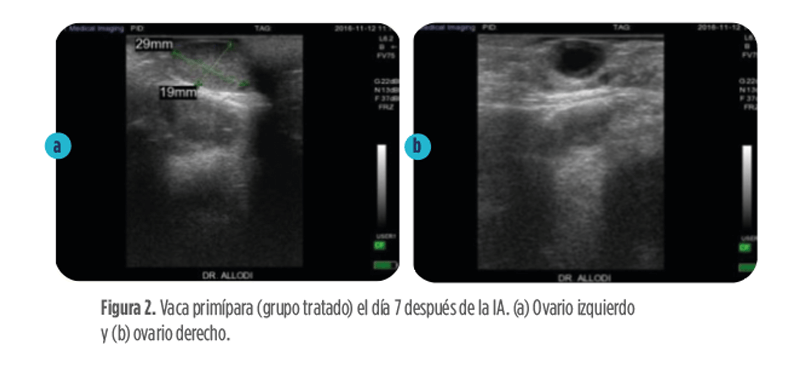
On day 14 post-AI, the same animals were reevaluated by ultrasound to check for the formation of one or more accessory CL and to calculate the new luteal volume.
All animals were previously synchronized using the Ovsynch 56 protocol, starting between days 70 and 82 postpartum. Between days 32 and 39 after AI, all cows in the study, regardless of the return of oestrus, underwent pregnancy diagnosis by ultrasound.
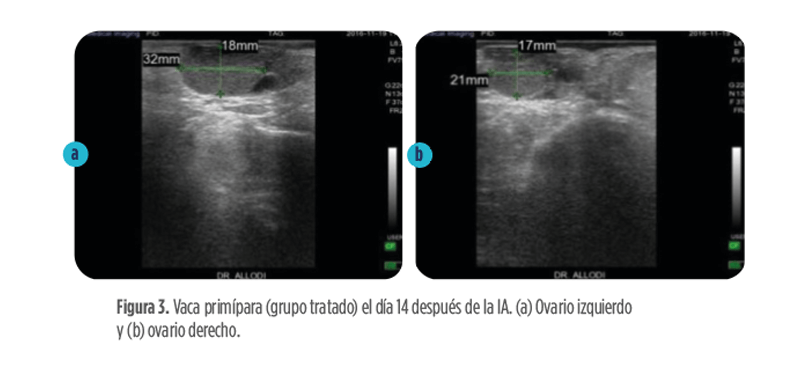
At the end of this preliminary study, the results were summarized as follows: a 95% ovulation rate of the dominant follicle of the first wave with the formation of one or more accessory CL in the treated group; a 55% increase in total luteal volume 7 days after treatment with hCG and a higher conception rate in the treated group compared to the control group (44.68% versus 37.5%, respectively).
| An Italian field study showed a 7% increase in the conception rate of primiparous cows in the group treated with human chorionic gonadotropin 7 days after AI. |
This field experience showed a positive trend in the group treated with hCG regarding the conception rate (CR), the formation of one or more accessory CL, and the increase in total luteal volume, which is consistent with the findings of previous and more recent studies.
In conclusion, treatment with hCG 5-7 days after AI tends to improve fertility and P4 levels, especially in first-lactation cows. However, its efficacy varies according to the cow’s parity, the dose of hCG, and genetic factors. Future research is needed to explore the role of genetic markers in the fertility response.
REFERENCES
Allodi S. 2017. Unpublished data owned by the author.
Cabrera, E. M., M. R. Lauber, E. M. Peralta, T. R. Bilby, and P. M. Fricke. 2020. Human chorionic gonadotropin dose response for induction of ovulation 7 days after a synchronized ovulation
in lactating Holstein cows. JDS Commun. 2:35 40. https: / / doi .org/ 10 .3168/ jdsc .2020-0024.
Crowe, A.D., J.M. Sánchez, S.G. Moore, M. McDonald, R. Rodrigues, M.F. Morales, L. Orsi de Freitas, F. Randi, J. Furlong, J.A. Browne, M.B. Rabaglino, P. Lonergan, and S.T. Butler. 2024. Fertility in seasonal-calving pasture-based lactating dairy cows following timed artificial insemination or timed embryo transfer with fresh or frozen in vitro-produced embryos. J Dairy Sci 107:1788–1804. doi:10.3168/jds.2023-23520.
Cuevas-Gómez, I., L. Molina, J.F. Sánchez-Madueño, I. Sánchez-Madueño, P. Lonergan, D. Rizos, C.C. Pérez-Marín, and J.M. Sánchez. 2025. Circulating progesterone concentrations and pregnancy outcomes in high-producing lactating dairy cows treated with human chorionic gonadotropin on day 2 of the estrus cycle. J Dairy Sci S0022-0302(25)00155–9. doi:10.3168/jds.2024-26000.
Cunha, T. O., L. R. Statz, R. R. Domingues, J. P. N. Andrade, M. C. Wiltbank, and J. P. N. Martins. 2021b. Accessory corpus luteum induced by human chorionic gonadotropin on day 7 or days 7 and 13 of the estrous cycle affected follicular and luteal dynamics and luteolysis in lactating Holstein cows. J. Dairy Sci. 105:2631 2650. https: / / doi .org/ 10 .3168/ jds .2021 -20619.
Cunha, T.O., Martins, J.P.N., 2022. Graduate student literature review: effects of human chorionic gonadotropin on follicular and luteal dynamics and fertility in cattle. J. Dairy Sci. https://doi. org/10.3168/jds.2022-21991.
De Vries, A. 2006. Economic value of pregnancy in dairy cattle. J. Dairy Sci. 89:3876–3885. Doi: 10 .3168/ jds .S0022-0302(06)72430 -4.
Lonergan, P., and J.M. Sánchez. 2020. Symposium review: Progesterone effects on early embryo development in cattle. J Dairy Sci 103:8698–8707. doi:10.3168/jds.2020-18583.
Nascimento, A. B., R. W. Bender, A. H. Souza, H. Ayres, R. R. Araujo, J. N. Guenther, R. Sartori, and M. C. Wiltbank. 2013. Effect of treatment with human chorionic gonadotropin on day 5 after timed artificial insemination o fertility of lactating dairy cows. J. Dairy Sci. 96:2873 2882. https: / / doi .org/ 10 .3168/ jds .2012 -5895.
O’Hara, L., N. Forde, F. Carter, D. Rizos, V. Maillo, A.D. Ealy, A.K. Kelly, P. Rodriguez, N. Isaka, A.C.O. Evans, and P. Lonergan. 2014. Paradoxical effect of supplementary progesterone between Day 3 and Day 7 on corpus luteum function and conceptus development in cattle. Reprod Fertil Dev 26:328– 336. doi:10.1071/RD12370.
Ribeiro, E. de S., J.F.W. Spricigo, M.R. Carvalho, and E. Ticiani. 2018. Physiological and cellular requirements for successful elongation of the preimplantation conceptus and the
implications for fertility in lactating dairy cows. Anim Reprod 15:765–790. doi:10.21451/1984-3143-AR2018-0028.
Sánchez, J.M., D.J. Mathew, S.K. Behura, C. Passaro, G. Charpigny, S.T. Butler, T.E. Spencer, and P. Lonergan. 2019. Bovine endometrium responds differentially to age-matched short and long conceptuses†. Biol Reprod 101:26–39. doi:10.1093/biolre/ioz060.
Wiltbank M., López H., Sartori R., Sangsritavong S., and Gumen A. 2006. Changes in reproductive physilogy of lactating dairy cows due to elevated steroid metabolism. Theriogenology 65:17-29. doi:10.1016/j. theriogenology.2005.10.003
Zolini, A. M., W. G. Ortiz, E. Estrada-Cortes, M. S. Ortega, S. Dikmen, F. Sosa, J. O. Giordano, and P. J. Hansen. 2019. Interactions of human chorionic gonadotropin with genotype and parity
on fertility responses of lactating dairy cows. J. Dairy Sci. 102:846 856. https: / / doi .org/ 10.3168/ jds .2018 -15358.