


 Latinoamérica
 Europa
RESOL: nutrient return to the soil during grazing












| The definition of precision agriculture is a management strategy that collects, processes, and analyzes temporal, spatial, and individual data and combines them with other information to support management decisions according to the estimated variability, thus improving resource use efficiency, productivity, quality, profitability, and sustainability of agricultural production. |

IMPACT OF GRAZING ON THE SOIL
During grazing, animals have an impact on the environment, and improving their management will help reduce it. Since 2007, in the Parc Natural de la Zona Volcànica de la Garrotxa, work has been done to promote good practices in pasture fertilization.
 Its main objective is to optimize the use of nitrogen used in agriculture, minimizing the negative effects of incorrect fertilization on the environment, ensuring the quality and productive yields of crops and pastures.
The technicians of the Parc Natural wanted to take a step further and not only understand the use of nitrogen, but also begin to study the impact of other minerals such as:
 Calcium
Phosphorus
Magnesium
Potassium

RESOL PROJECT: NUTRIENTS TO THE SOIL
| The RESOL project funded by the operation 01.02.01 of technological transfer of the rural development program of Catalonia 2014-2022 has allowed us to know that at least 60% of the minerals ingested by the cows in the pasture return to the soil through feces and urine.
|
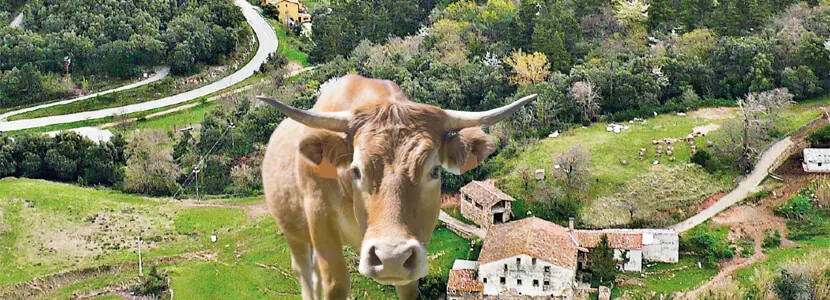
The RESOL project, in addition to the technicians of the Parc Natural de la Zona Volcànica de la Garrotxa and the IRTA, has had the collaboration of the Rius CB Limousine breed farm which has allowed the collection of information from 12 of its animals.
 The main objective of this project was to estimate the nutrient contribution (N, P, Ca, Mg, K) of the animals to the soil when they are grazing, with the aim of adjusting the external fertilization contributions.
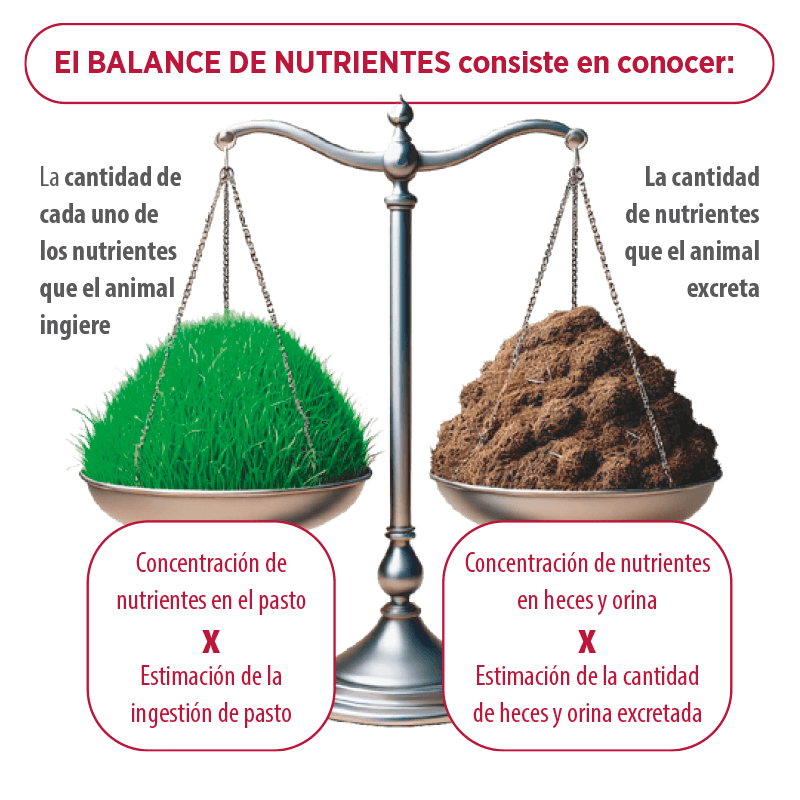
 The work consisted of making a nutrient balance using the alkane technique as a method to estimate intake and solid excretions, as well as the creatinine concentration in urine to estimate daily urine excretion. The work consisted of making a nutrient balance using the alkane technique as a method to estimate intake and solid excretions, as well as the creatinine concentration in urine to estimate daily urine excretion. |
 The ALKANES are waxes that are naturally found in leaves and their proportion will depend on the type of plant. These compounds are characterized by the fact that most are excreted in feces and can be used to:
 Determine the type of plants that the animals ingest.
Make estimates of the intake, fecal excretion, or diet digestibility.
(Dove et al., 2006)
 The addition of a known external source of one of the alkanes that is found in low proportion in plants such as C32 along with the relationship with others mostly present in plants such as C29, C31 or C33 allows for the necessary calculations to estimate intake, fecal excretion, and digestibility of the diet.
PRELIMINARY RESULTS AND NEXT STEPS
The sampling of the animals was carried out during the spring of 2023 and 2024 using 12 animals in each period.
 For the moment, only the results of the first group of animals are available, and the results expressed in this article will only refer to the first period.
The pasture of the animals was mainly composed of the species:
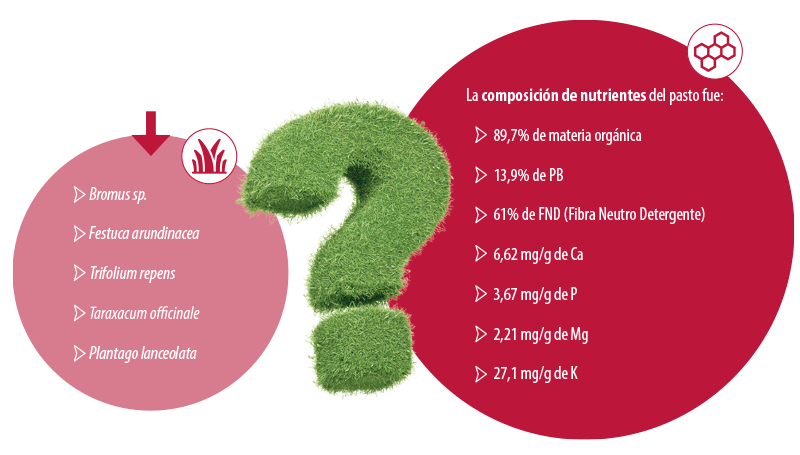
 The first group of Limousin cows consisted of 7 pregnant animals and 5 lactating ones with an average live weight of 650 kg.
During the 12-day study, each day the animals had access to a different plot of the grazing area.
Twice a day they entered the barn to dose a bolus of known dose of the alkane C32.
From the seventh day (when it is considered that the external dosing of alkane has been homogeneously distributed through the animal’s digestive tract) feces and urine samples were taken to estimate the previously described parameters.

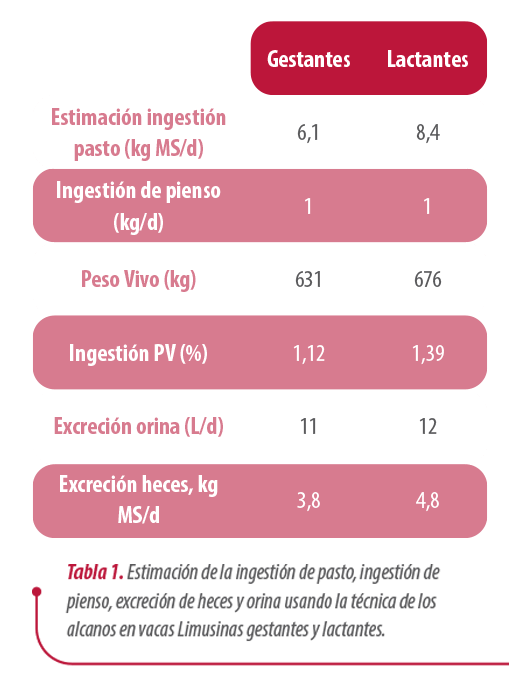
The main results are detailed in Tables 1 and 2.
In Table 1 the intake of the animals according to their physiological state is detailed and, as expected, the animals that were raising a calf had a higher intake of pasture and excretion of urine and feces than the pregnant animals.
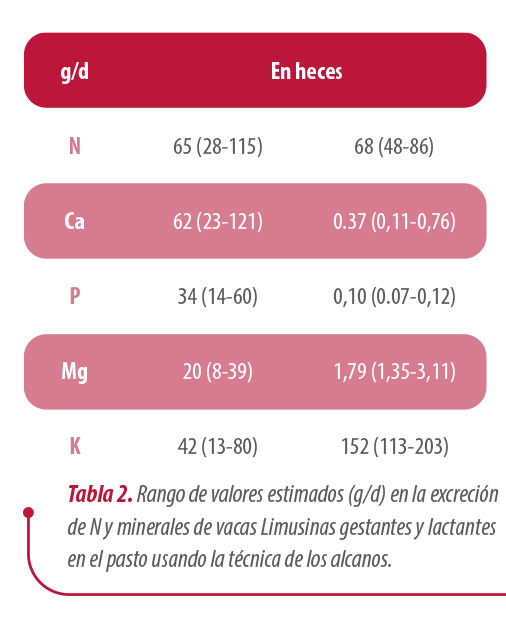
The results of the first period allowed for the description of a very wide range of excretion of different minerals (Table 2), being:
 K is excreted mainly in urine.
 Ca, P, and Mg are excreted mainly in feces.
 N is excreted in a 40:60 ratio in feces and urine.
As a practical example, if we consider the scenario of a mesophilic pasture with rotational grazing with three utilizations with the livestock per year, taking into account the averages obtained in Table 2, we observe that between 52% and 94% of the mineral supply needs are already provided by the animal excretions during grazing (Figure 1).
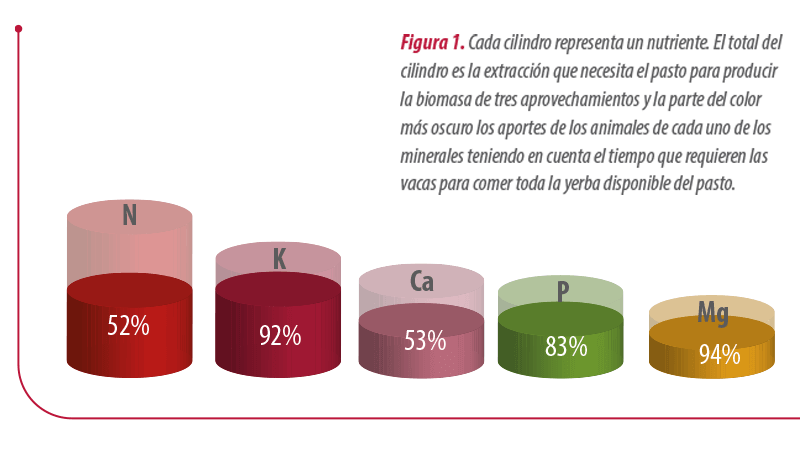
| These data allowed us to conclude that more than 60% of the minerals ingested by the livestock returned to the soil for fertilization and, in some cases, almost reach 100% of the soil’s needs.
|
 However, it is necessary to compile the data from the second period to determine a smaller range of values to optimize the averages and to be even more precise in fertilization planning.
You may be interested in: Organic production and sustainability