


 Latinoamérica
 Europa
What is Fiber? – A Guide to Understanding and Quantifying Its Value






The concept of fiber and its quantification are highly relevant in the nutrition of herbivorous animals, but also in that of omnivores and granivores, as it is an essential component for all of them.
 Therefore, it would be very useful to have a unit that reflects the physiological effects of the fiber present in the ingredients, that is, that evaluates its “fibrosity” and allows for the simple establishment of the fiber needs of the animals.
FROM CRUDE FIBER TO DIETARY FIBER: A LONG JOURNEY TOWARDS A FUNCTIONAL DEFINITION
Crude fiber
For a long time, fiber has been a subject of debate, both due to the lack of a definition that identifies it unequivocally and the methods used for its determination.
 The concept of fiber has historically been conditioned by the technique used for its quantification.
In the early 19th century, the crude fiber method was developed and standardized, which was widely used until the end of the last century.
 This method attempted to isolate the indigestible fraction of the feed, considered mostly as cellulose and, from its inception, was used to estimate the nutritional value of the ingredients.
Its main drawback is that it does not retain a significant portion of the hemicelluloses and the lignin, and it can even lose part of the cellulose. This causes:
 The solubilized fraction to be less digestible than the retained fraction.
The compounds that are retained vary according to the ingredient, resulting in a chemically very heterogeneous residue.
However, despite these limitations, the determination of crude fiber has been very useful for assessing the nutritional value of low-fiber content feeds, especially in non-ruminant animals.
 Currently, in the European Union, crude fiber continues to be the official method for declaring fiber content on the labeling of feeds and raw materials (Regulation (EC) No 767/2009). It is also the reference measure included in the catalog of raw materials for feeds (Regulation (EU) 2022/1104), with the sole exception of purified powdered cellulose. Currently, in the European Union, crude fiber continues to be the official method for declaring fiber content on the labeling of feeds and raw materials (Regulation (EC) No 767/2009). It is also the reference measure included in the catalog of raw materials for feeds (Regulation (EU) 2022/1104), with the sole exception of purified powdered cellulose. |
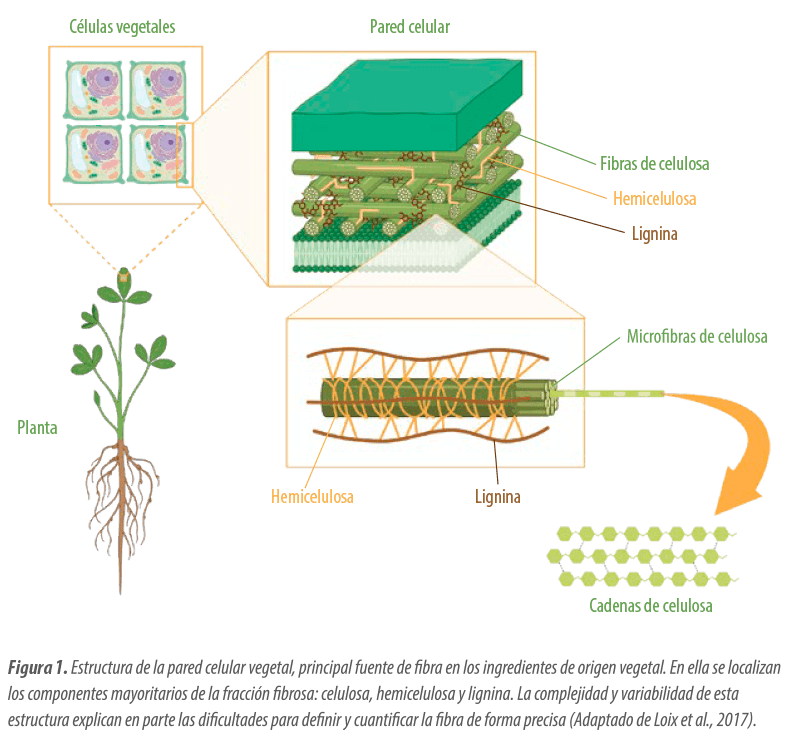
 The difficulty in finding an appropriate definition and methodology to serve as an alternative to crude fiber lies in the heterogeneity of the chemical compounds to be quantified. There are no “standard substances” with which to make comparisons, and moreover, these compounds are mostly located in the plant cell wall.
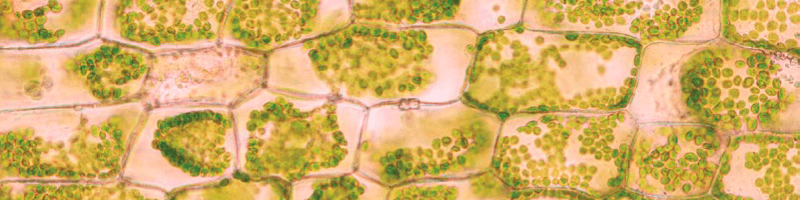
In a plant —whether the entire plant, the leaves, the fruit, or the fruit peel— there are numerous tissues, formed by very different types of cells which, in turn, are protected by cell walls with very variable chemical compositions, structures, and physical characteristics.
 These differences respond to the physiological function that each cell type performs within the tissue and, collectively, in the plant.
 The interaction between the chemical composition and the physical structure of plant cell walls determines the physical properties of each ingredient, which can be as or even more relevant than their chemical composition, although they are also difficult to evaluate and quantify. The interaction between the chemical composition and the physical structure of plant cell walls determines the physical properties of each ingredient, which can be as or even more relevant than their chemical composition, although they are also difficult to evaluate and quantify. |
Dietary fiber
It was not until about 50 years ago that a consensus was reached on the definition of the concept of fiber, which was consolidated with the introduction of the term dietary or food fiber, formulated by British researchers. This concept integrates:
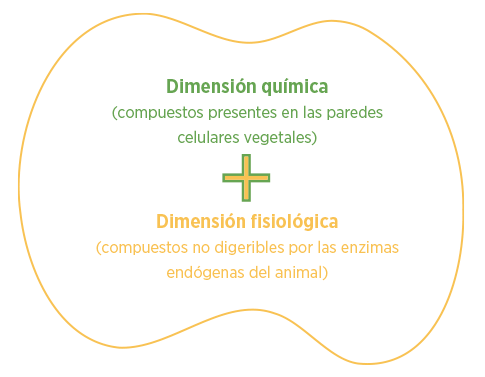
 The evolution of this concept culminated in the first official definition of fiber in the European Union, when in 2010 the EFSA published a report (Scientific opinion on dietary reference values for carbohydrates and dietary fibre) that adopted the definition of dietary fiber proposed by the Codex Alimentarius in 2009. This definition was later incorporated into Regulation (EU) No 1169/2011. The evolution of this concept culminated in the first official definition of fiber in the European Union, when in 2010 the EFSA published a report (Scientific opinion on dietary reference values for carbohydrates and dietary fibre) that adopted the definition of dietary fiber proposed by the Codex Alimentarius in 2009. This definition was later incorporated into Regulation (EU) No 1169/2011.
|
 In addition to identifying the chemical compounds it includes, this definition expanded the physiological effects that fiber must exert, going beyond its indigestibility, also incorporating its possible benefits for human health, an aspect that remains a subject of debate.
Although dietary fiber is already defined, the European Union has not officially recognized which method should be used for its quantification, although the methodology described by the AOAC (2017.16/2022.01) seems to be the most appropriate.
 This definition is useful in the case of non-ruminant animals, but lacks special interest in the context of ruminants.
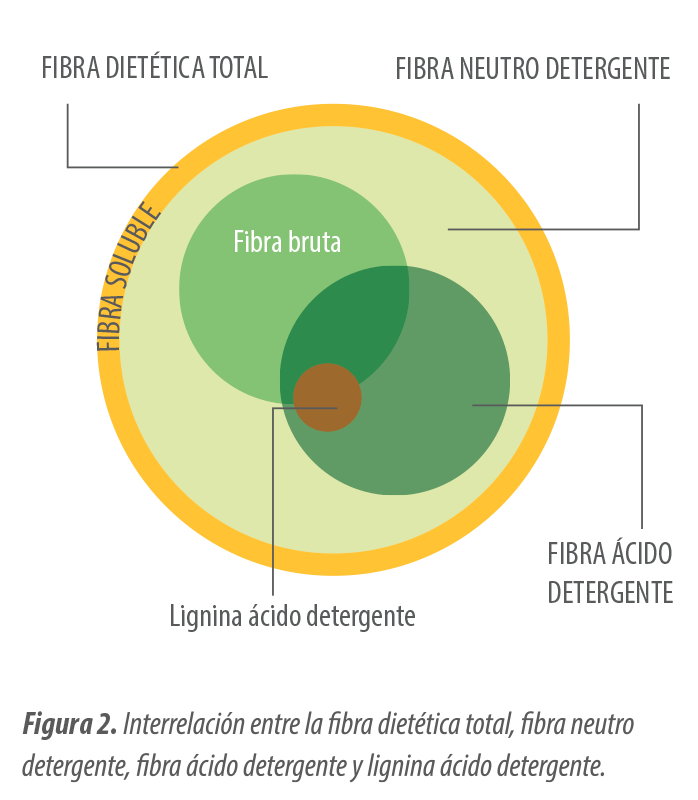
Fractions of insoluble dietary fiber: NDF, ADF, and ADL
In the case of herbivorous animals, especially ruminants, Prof. Van Soest considered that dietary fiber should be understood more as a biological entity than as a chemical entity, since properties such as particle size or density also significantly influence the physiological effects that fiber exerts on the animal.
 More recently, Prof. Mertens defined dietary fiber in herbivores as that indigestible or slowly digestible organic matter that occupies space in the gastrointestinal tract.
 The methodology developed by Prof. Van Soest was based on separating the fractions of the feed according to their availability to the animal, without neglecting the chemical quantification of the main compounds. The methodology developed by Prof. Van Soest was based on separating the fractions of the feed according to their availability to the animal, without neglecting the chemical quantification of the main compounds. |
His sequential methodology (Figure 2 and Graph 1) —modified over time— allows:
1. Separate the most digestible fraction of the feed, located in the cytoplasm of plant cells (mainly proteins and starch), to subsequently isolate most of the plant cell wall (hemicellulose, cellulose, and lignin) in a residue called neutral detergent fiber (NDF).
In this residue, most of the pectins are not retained, as they are solubilized. However, this does not pose a significant issue, given that their digestive behavior — highly fermentable— is much more similar to that of starch than that of cellulose.
Within the NDF, separate the partially degradable cell wall fractions (hemicellulose and cellulose) from the completely inaccessible fraction (lignin). This process results in two residues:
 Acid Detergent Fiber (ADF): composed mainly of cellulose and lignin.
 Acid Detergent Lignin (ADL): primarily quantifies lignin and, in some ingredients, may also include significant amounts of cutin, which is also not usable by the animal.
 This methodology has been established as a reference for the nutritional evaluation of ingredients and to establish the nutritional needs of herbivorous animals. This methodology has been established as a reference for the nutritional evaluation of ingredients and to establish the nutritional needs of herbivorous animals. |
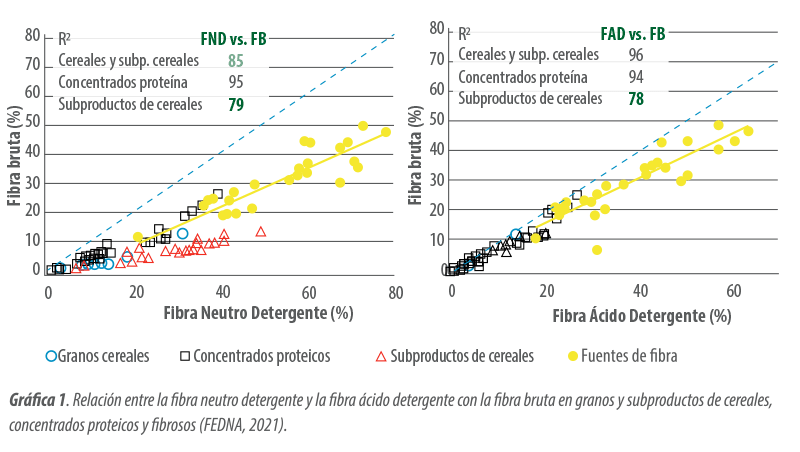
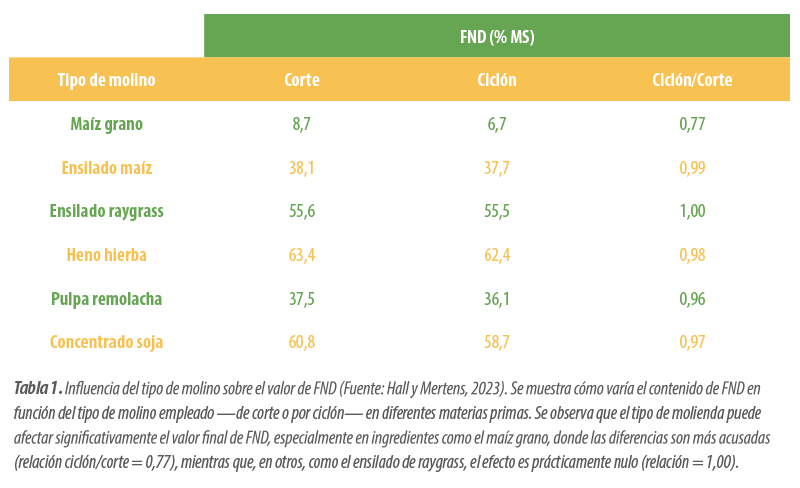
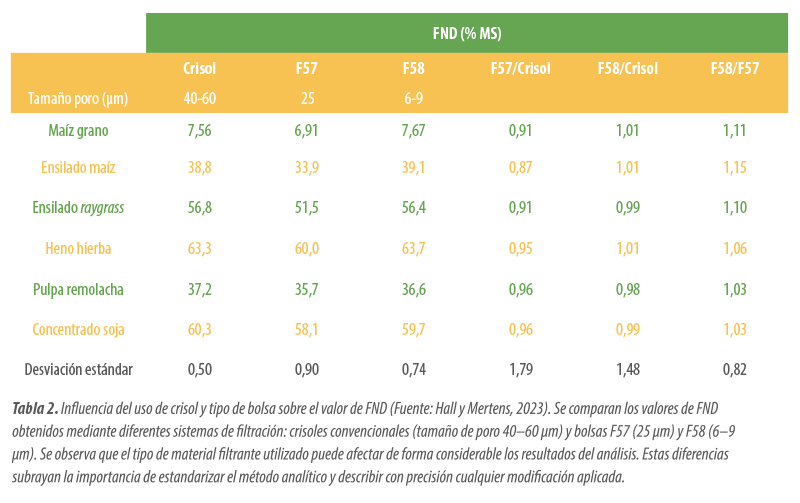
There is a perception that the quantification of NDF presents much greater variability than that of crude fiber or ADF, which seems to be due to differences in the methods employed, for example, the type of sample grinding (Table 1), the use of crucibles or filter bags (Table 2), the modification of the reagents used, the correction —or not— for ash content, etc.
| For this reason, it is being demanded that the analysis of NDF be carried out according to the official method described by the AOAC (2002.04) and that, if any modification is introduced, it should be thoroughly documented. |
 In short, both the chemical composition and structure and the physical properties of plant cell walls vary considerably even among cells of the same plant.
Despite this, there is already a consensus on what fiber is, recognizing that the insoluble fraction is the most relevant for ruminants and that its quantification can be carried out by determining the neutral detergent fiber (NDF).
However, this measure still presents a high variability due to the lack of standardization of the method and does not allow for a complete explanation of all the physiological effects that the fibrous fraction exerts on the animal.
 The development of a methodology that integrates both the chemical and physical characteristics of plant cell walls remains a pending challenge to optimize the feeding of ruminants. The development of a methodology that integrates both the chemical and physical characteristics of plant cell walls remains a pending challenge to optimize the feeding of ruminants. |
You may be interested in: Importance of fiber in calf fattening