


 Latinoamérica
 Europa
Challenges and Physiological Adaptations of Weaning in Ruminants: Intestinal and Liver Function










A large portion of the nutrients absorbed by the intestine of ruminants are modified or utilized during microbial fermentation in the small intestine and also by the absorptive tissues of the calf before being released into circulation.
 This results in a decrease in the supply of energy and amino acid precursors from a given food source that are available to productive tissues.
This use of energy and amino acids cannot be considered a total loss, as the absorptive intestinal tissues perform a vital service for the rest of the organism. Therefore, it represents a decrease in productive efficiency per unit of dietary energy supplied.
INTESTINAL RESPONSE TO WEANING
By functional necessity, the intestine and liver are anatomically positioned to have access to absorbed nutrients before peripheral tissues. Intestinal and hepatic metabolism determine the availability of most nutrients for the development of productive functions, being crucial for health and growth.
In fact, the portal system (digestive tract, pancreas, spleen, omental fat, and mesenteric fat) only represents 8-10% of body tissues, but consumes 18-25% of the animal’s O₂, with an additional 25% represented by the liver.
While a portion of the energy expended by the intestinal epithelium is directly associated with the cost of actively absorbing and transporting nutrients for later use, most is used for maintaining the integrity and mass of the tissues. These functions mainly include:

 The activity of Na+-K+-ATPase.
The synthesis and degradation of proteins.
The synthesis of urea.
 However, defining the real cost of intestinal tissues is complex due to the fact that their mass changes in response to the nutritional plane, the chemical composition of the diet, and the physiological state of the animal.
Most research has focused on the role of milk and colostrum growth factors in the neonatal intestinal development of ruminants, but there is a lack of data describing the intestinal and ruminal response during weaning.
INTESTINAL AND RUMINAL RESPONSE: WHAT DO WE KNOW SO FAR?
The rumen mass responds exceptionally to changes in the form of the diet, which likely reflects the success of bypassing the milk replacer beyond the rumen and the disruption of the establishment of ruminal fermentation.
 Although changes in intestinal mass are not evident, nutrient assimilation capacity may be affected.
 This suggests that rumen growth responds to the supply of energy substrate, but intestinal tissue growth does not.
Taken together, these data show that intestinal growth is not simply a function of the supply of energy substrate or the chemical composition of the diet, but rather a set of nutritional and physiological inputs.
 Despite the fact that the neonatal and pre-ruminant liver represents a greater percentage of empty body weight than that of the adult ruminant, the fraction of whole-body oxygen use attributed to the liver is considerably lower.
 This makes it clear to us that there is lower metabolic activity.
The increase in hepatic metabolic activity in the animal’s adult life likely reflects changes in the quantity and type of substrates metabolized by the liver, for example, glucose and fatty acids versus VFA, as a consequence of rumen development.
 In developing animals, digestive adaptation before the weaning of a pre-ruminant to a functional ruminant coincides with a change from glucose absorbed mainly by the intestine, long-chain fatty acids, and amino acids derived from milk to VFA, ketones, amino acids from microbial and feed sources, and other dietary compounds.
| Consequently, this change in the pattern and supply of dietary nutrients causes substantial alterations in liver function and energy distribution that require processes such as glucose and protein synthesis, maintenance of ionic gradients, the citric acid cycle, the urea cycle, and detoxification of compounds. |
|
|
 To clarify the hepatic mechanisms involved in this transition period, most research has attempted to determine whether the pre-ruminant liver is fully adapted to the arrival of any product from the small intestine or if it undergoes its own maturation process in response to rumen development.
  The major change in the main metabolic processes during rumen development is the shift from a glycolytic to a glycogenic liver (Table 1).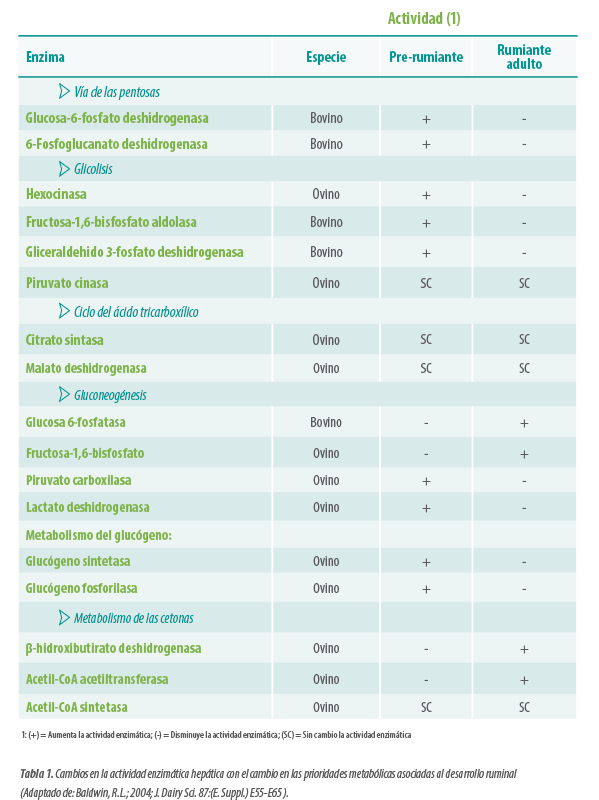
As we have already seen, as microbial fermentation increases, there are fewer carbohydrates available for postruminal digestion and the dietary supply of glucose decreases.
There is a basic reduction in enzymatic capacity for hepatic glucose oxidation. The liver tissue will need to support the increased glucose requirements of the animal while simultaneously experiencing a decrease in glycolysis.
This results in a rapid increase in hepatic gluconeogenic activity at the same time as rumen development.
| It has been shown that glucose 6-phosphatase activity doubles (or more) during the weaning period. |
Pre-ruminants can convert lactate or propionate into glucose. The inhibition of lactate gluconeogenesis in adult ruminants is probably the result of greater availability of propionate.
The change in hepatic metabolism to become gluconeogenic may be a response to the development of the functional rumen that generates a continuous supply of glucogenic substrate in the form of propionate.
The differences in portal nutrient supply from pre-ruminant and ruminants to the liver also modify the hormonal regulation of hepatic function.
 As rumen development progresses, there is a decrease in the sensitivity of hepatic gluconeogenesis in response to high concentrations of insulin and glucagon.
|
The hepatic glycogen reserves of the pre-ruminant usually match or exceed adult levels. However, a short fast of 16 hours results in the consumption of almost all hepatic glycogen, while similar fasts had little effect on hepatic glycogen in adults. |
 In isolated hepatocytes from pre-ruminants, glucagon effectively increases gluconeogenesis from propionate and lactate, but had no effect on hepatocytes from adult ruminants.
 Once again, because the pre-ruminant experiences very energetic changes in postprandial nutrient delivery patterns, broad hormonal control of hepatic gluconeogenesis is necessary. The functional ruminant receives a more continuous supply of glucogenic substrates in the liver and is a constant producer of glucose; therefore, it requires less hormonal control.
One of the main features of the functional small intestine in non-pregnant and non-lactating animals is the ruminal production of ketones. In a non-pregnant and non-lactating adult ruminant, the small intestine is the main producer of ketones, while the small intestine of the pre-ruminant produces insignificant amounts of ketones.
This is due to the absence of microbial fermentation, with the liver being the main site of ketogenesis.
| In the case of prolonged fasting, the pre-ruminant is capable of performing hepatic ketogenesis almost from the moment of birth, but it is not usually performed. The development of the rumen has a clear and important impact, and several studies have been conducted to elucidate the mechanisms that control ruminal differentiation, and despite the effort, they are still not satisfactorily understood. |
FINAL COMMENTS
 There is not enough evidence to decide which of them is the most important: whether it is the ontogenic control or whether the nutritional and endocrine factors are the regulators of this important moment. It seems to be the combination of all of them.
 Here is very likely the answer to why in practice there are some additives that work on some occasions and not on others.
It is clearer that intestinal development occurs during the fetal and perinatal period, being almost entirely an ontogenic control, although the nutrient transport capacity changes, as the pre-ruminant animal becomes a ruminant as a result of the specific nutrients supplied.
In the growing ruminant, dietary effects, that is, the intake on ruminal and intestinal mass, clearly alter the maintenance protein and energy requirements. These changes in intestinal mass affect the digestive and absorption capacities.
| Fundamental changes in metabolic pathways occur in the liver as a consequence of rumen development, and may be responsible for the increased energy requirements associated with the hepatic function of mature ruminants compared to the liver of pre-ruminants. |
You may be interested in: Challenges and physiological adaptations of weaning in ruminants: rumen development and metabolism